
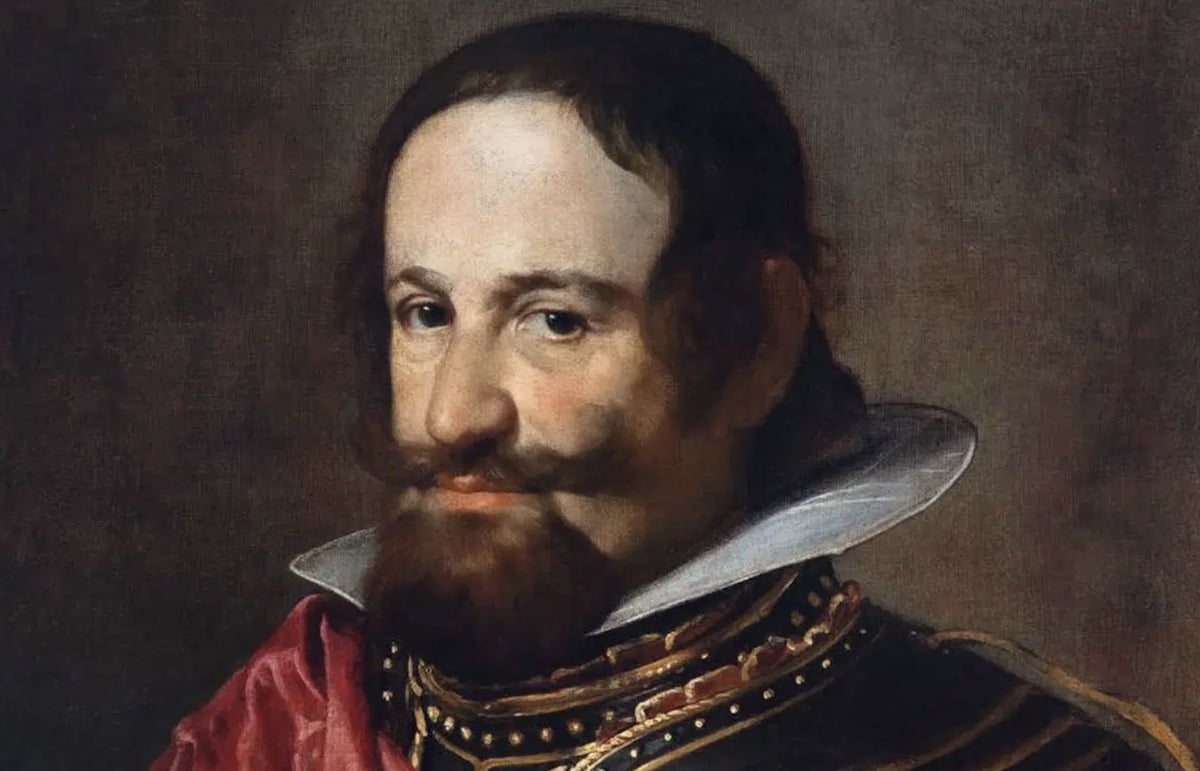
A previously unknown painting by Diego Velázquez has been identified in a private collection in Spain. The work is a half-length portrait of the Count-Duke of Olivares in armour, painted in 1626, and its discovery was announced by Salvador Salort-Pons, director of the Detroit Institute of Arts, in a lengthy article published in the latest issue of ARS Magazine. If the attribution holds, and the technical and documentary evidence presented is substantial, this is among the most significant additions to Velázquez’s catalogue in recent years.
The story of how the painting came to light is itself compelling. In 1970, the historian Enriqueta Harris published excerpts from the journal of Cassiano dal Pozzo, a collector, patron and secretary to Cardinal Francesco Barberini, whom Pope Urban VIII had sent on a diplomatic mission to the court of Philip IV in Madrid in 1626. The mission’s primary aim was to negotiate a truce between Spain and France over the disputed territory of Valtellina. Dal Pozzo’s diary recorded that during this visit, Velázquez painted two portraits: one of Cardinal Barberini and one of the Count-Duke of Olivares, Gaspar de Guzmán y Pimentel, the king’s powerful chief minister. Until now, neither painting had been located.
Dal Pozzo also expressed his considerable disappointment with Velázquez’s portrait of Barberini, which he described as executed with a melancholic, severe air. The Roman delegation subsequently commissioned a replacement portrait from Juan van der Hamen, a Madrid-based painter of Dutch origin, whose version proved more acceptable to the papal entourage. Scholars now read this episode as evidence of the tensions surrounding Velázquez’s rapid rise at the Alcázar, as well as the resistance his prominence generated among established court painters and their patrons.
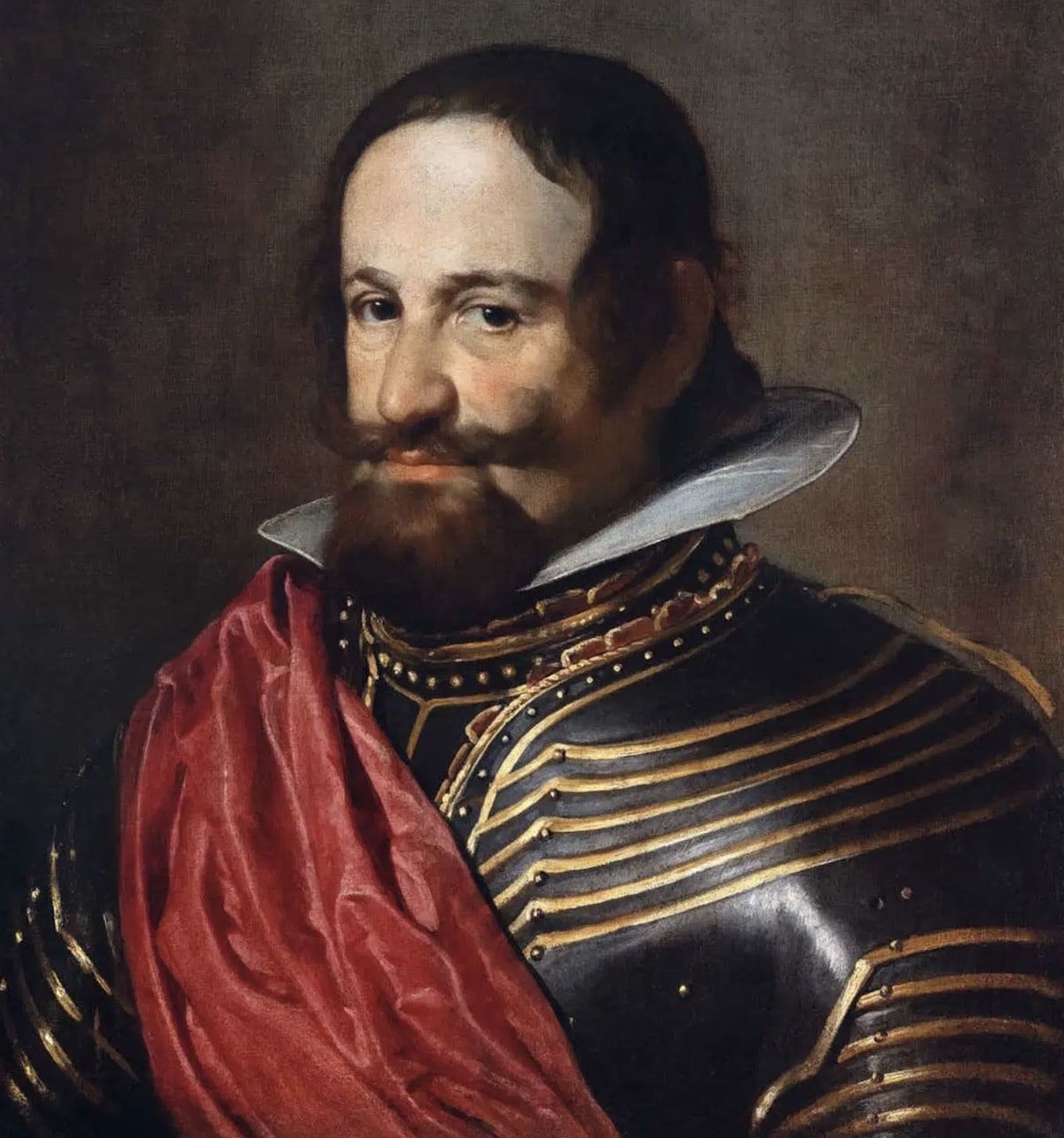
Unknown Velázquez Portrait of Count-Duke of Olivares Private Collection
The portrait of Olivares, measuring 60 by 48 centimetres, has been formally identified by Salort-Pons as the painting recorded in the 1631 inventory of Cardinal Barberini’s Roman collection. The inventory describes it precisely: a portrait of Count Olivares, head and bust, in armour, on a head-sized canvas, a technical term historically denoting works of approximately 62 by 47 centimetres. The dimensions match. The painting remained in the Barberini collection until the cardinal’s death and appears in the posthumous inventory of his estate drawn up in 1669 at the Palazzo della Cancelleria under inventory number 191.
Between 1623 and 1626, Velázquez developed three distinct ways of portraying Olivares, each serving a specific political function. The first, now at the Museu de Arte in São Paulo, shows the Count-Duke in a frontal pose, seated at a table, wearing the cross of the Order of Calatrava and the attributes of his court offices. The second, dated to 1625 and documented in two autograph versions at the Hispanic Society of America and in a Spanish private collection, adopts a more refined three-quarter pose, adding a general’s baton and a whip as symbols of military and governmental authority. The newly discovered painting belongs to the third type, the armoured portrait, created specifically for Barberini’s visit and intended to project an image of Olivares as a military leader capable of pursuing his international political strategy, the Unión de Armas, at the Roman court.
X-ray analysis has revealed that the painting was not originally conceived this way. Beneath the armour, Velázquez first painted Olivares in a dark civilian suit trimmed with fur, applying lead white in short dot-like brushstrokes to suggest the fur’s texture. At an intermediate stage, the hilt of a sword appeared in the lower portion of the composition before being removed. The ruff also changed: the final version was wide, stiff, and smooth, replacing a narrower, slightly ruffled initial collar. The painting evolved from a portrait of a statesman to a portrait of a commander, precisely what the political moment required.
The face in its finished state presents an intense, introspective gaze and tightly pursed lips. This expression, which Salort-Pons connects to the severity and melancholy that Italian observers found in Velázquez’s portrait of Barberini, suggests a consistent psychological register across both works. Subsequent correspondence between Barberini and the papal nuncio in Madrid indicates that the Olivares portrait also failed to satisfy Roman expectations fully. In November 1626, the nuncio arranged for a new drawing, probably by Velázquez and approved by Barberini, to be sent to Rome, where it received papal approval the following month. This drawing may correspond to a circular sheet now at the École des Beaux-Arts in Paris.
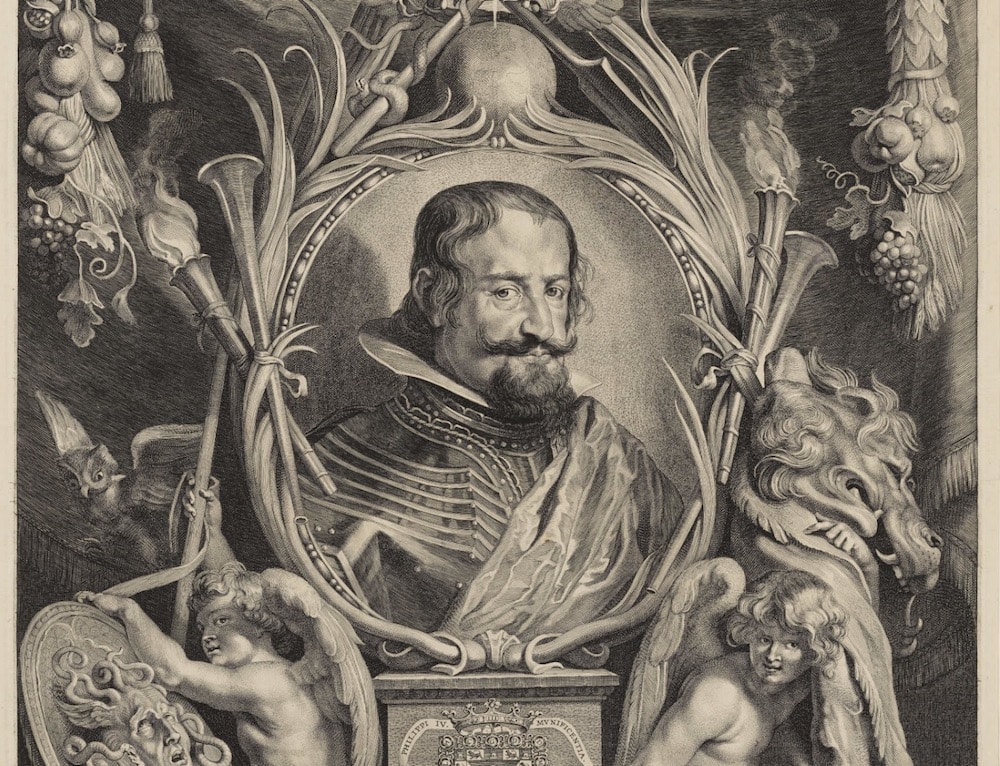
Paulus Pontius (after Diego Velázquez and Pieter Paul Rubens), Allegorical Portrait of the Count-Duke of Olivares, 1626; etching. Detail Courtesy Metropolitan Museum
The connection to a 1626 allegorical engraving by Paulus Pontius, produced in collaboration with Rubens and Velázquez, provides further confirmation. Rubens’s preparatory sketch, held at the Musées royaux des Beaux-Arts in Brussels, depicts Olivares wearing the fur-trimmed civilian robe now visible in the X-rays of the painting’s first state. In the final print, Pontius replaced the head and torso with Velázquez’s armoured model. A preparatory drawing by the engraver reproduces the painting with great fidelity, even studying the ear separately in the sheet’s margin.
Technical analysis of the canvas itself corroborates the attribution. The preparation consists of a black-and-white ground covered by a reddish primer, consistent with Velázquez’s court practice in the 1620s. The fabric, woven on a handloom, has ten warp threads per centimetre and eleven weft threads, values identical to those found in the portraits of Philip IV and the Infante Don Carlos at the Prado. Infrared reflectography has revealed the preparatory drawing of the facial features. Macro photography of the left eye found a minute brushstroke of azurite in the iris and a dot of lead white simulating a light reflection, a technique Velázquez also used in the Philip IV portrait at the Prado and one that is essentially invisible at normal viewing distance.
One further detail is worth noting. In both the engraving and the painting, Olivares wears armour believed to have been made in Brussels. Velázquez deliberately left one of the rivets on the upper left arm incomplete: the hole was present, but the rivet was absent. This is a trompe l’oeil device, the kind of demonstrative technical virtuosity that was particularly admired at the Madrid court and specifically praised by Velázquez’s teacher Francisco Pacheco. The painting is not a copy derived from the print. It is the original model from which the print was made.