
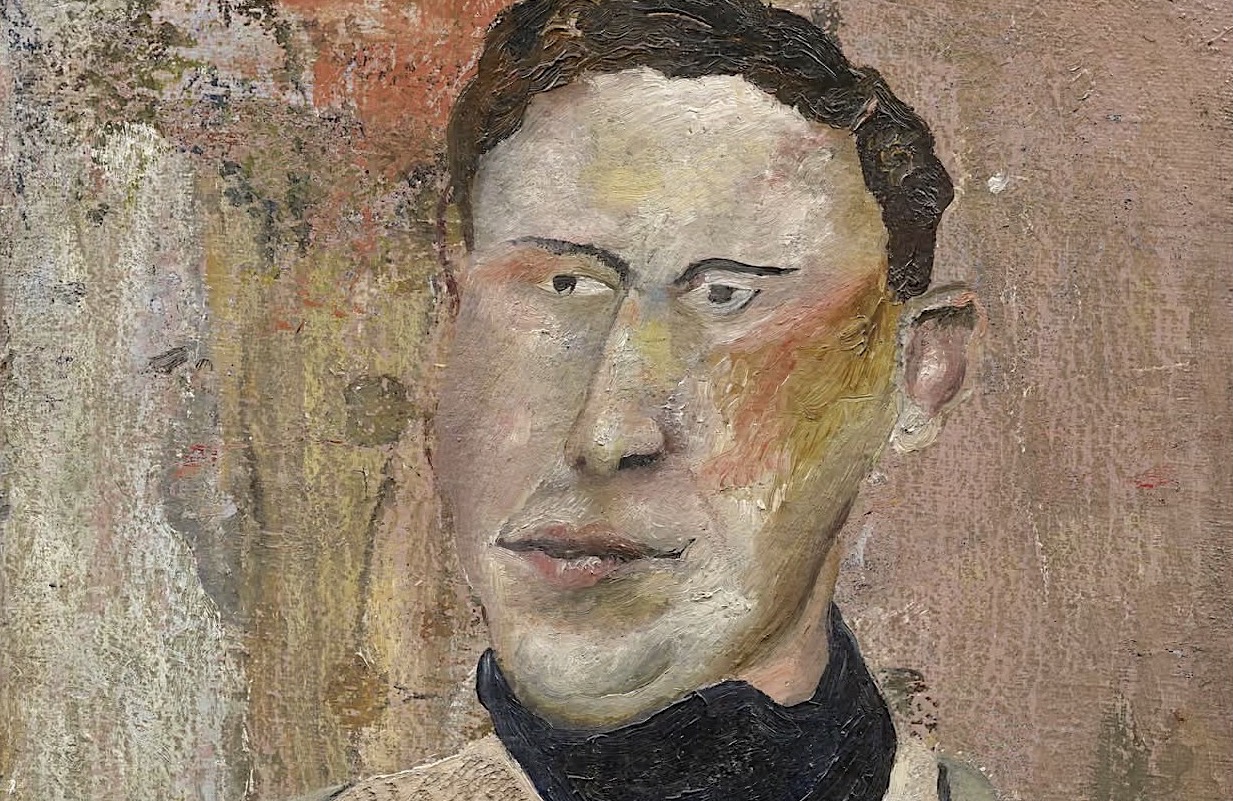
The story of Man in a Black Scarf, a portrait of sufficient quality that Christie’s attributed it to Lucian Freud in 1985, only to retract the attribution when the artist himself said it wasn’t his. Freud maintained that position until his death in 2011, and his solicitor later reported that, in a 2006 phone call, the artist had admitted starting the painting but claimed someone else had finished it, which was why he refused to acknowledge it.
The painting is believed to have been made in 1939, when Freud was a student at the East Anglian School of Painting and Drawing in Suffolk, and shows his friend John Jameson, of the Irish whiskey family. Students at the school kept daily records of what they were working on. Those records, held in the Tate Britain archive, show Freud painting John Jameson in 1939. That is about as close to a smoking gun as art history tends to offer. Now, scientific analysis and a panel of three Freud experts have concluded that the work was almost certainly the work of a single hand. His.
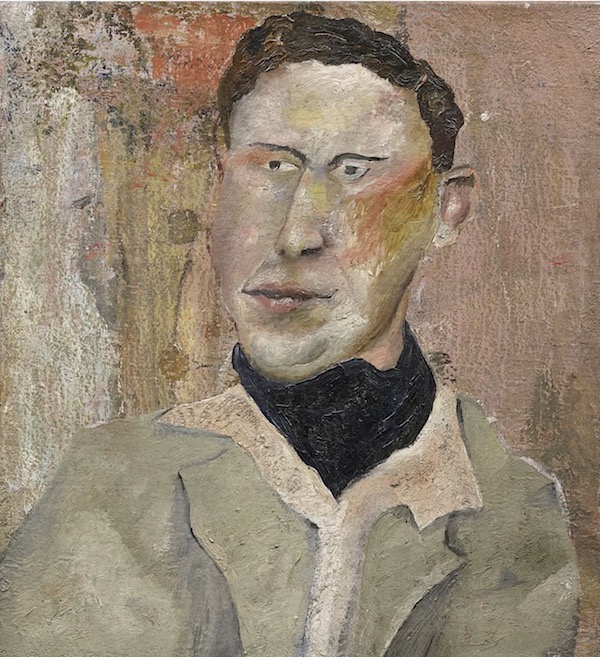
Lucian Freud Portrait of John Jameson, of the Irish whiskey family 1939 Courtesy The Garden Museum
So why the decades-long denial? The answer, characteristically for Freud, involves a grudge. The painting passed to Jon Lys Turner, who received it from Denis Wirth-Miller and Richard Chopping, former schoolmates of Freud’s who, it turns out, bore him considerable ill will. Chopping had apparently written a document titled “The Thirteen Reasons to Hate Lucian,” which gives you a sense of the temperature of those relationships. Lys Turner says he was gifted the painting on the explicit condition that he authenticate and sell it specifically to infuriate Freud. “He was the golden boy, he was a star even then, and there was jealousy,” he explained. Old school dynamics, in other words, are playing out across six decades.
Philip Mould, the art dealer and historian who led the authentication investigation, described the process as unlike anything his team had previously undertaken. Overturning the stated position of an artist, even a dead one, is not a simple matter. “We had never had to arm-wrestle with the words of an artist beyond the grave,” he said. Materials analysis supported the conclusion that the work was by one hand throughout, and the stylistic comparison with other paintings Freud acknowledged from the same period apparently proved persuasive to the expert panel.
The portrait will now be shown publicly for the first time following authentication, at the Garden Museum in Lambeth, as part of an exhibition called Benton End: A Paradise of Pollen and Paint, which focuses on the East Anglian School. It will hang alongside other works Freud acknowledged from around the same time, and the stylistic continuities between them are said to be clear.
What Man in a Black Scarf actually looks like as a painting is almost beside the point in the telling of this story, which is really about pride, spite, old friendships curdled into enmity, and a great artist’s apparently quite human desire to control his own legacy even when the evidence was pointing somewhere inconvenient. Freud was not above vanity or pettiness. Neither, it seems, was he above being wrong about his own work.
The Garden Museum, Lambeth. Benton End: A Paradise of Pollen and Paint 2 Jun – 20 Sep 2026