
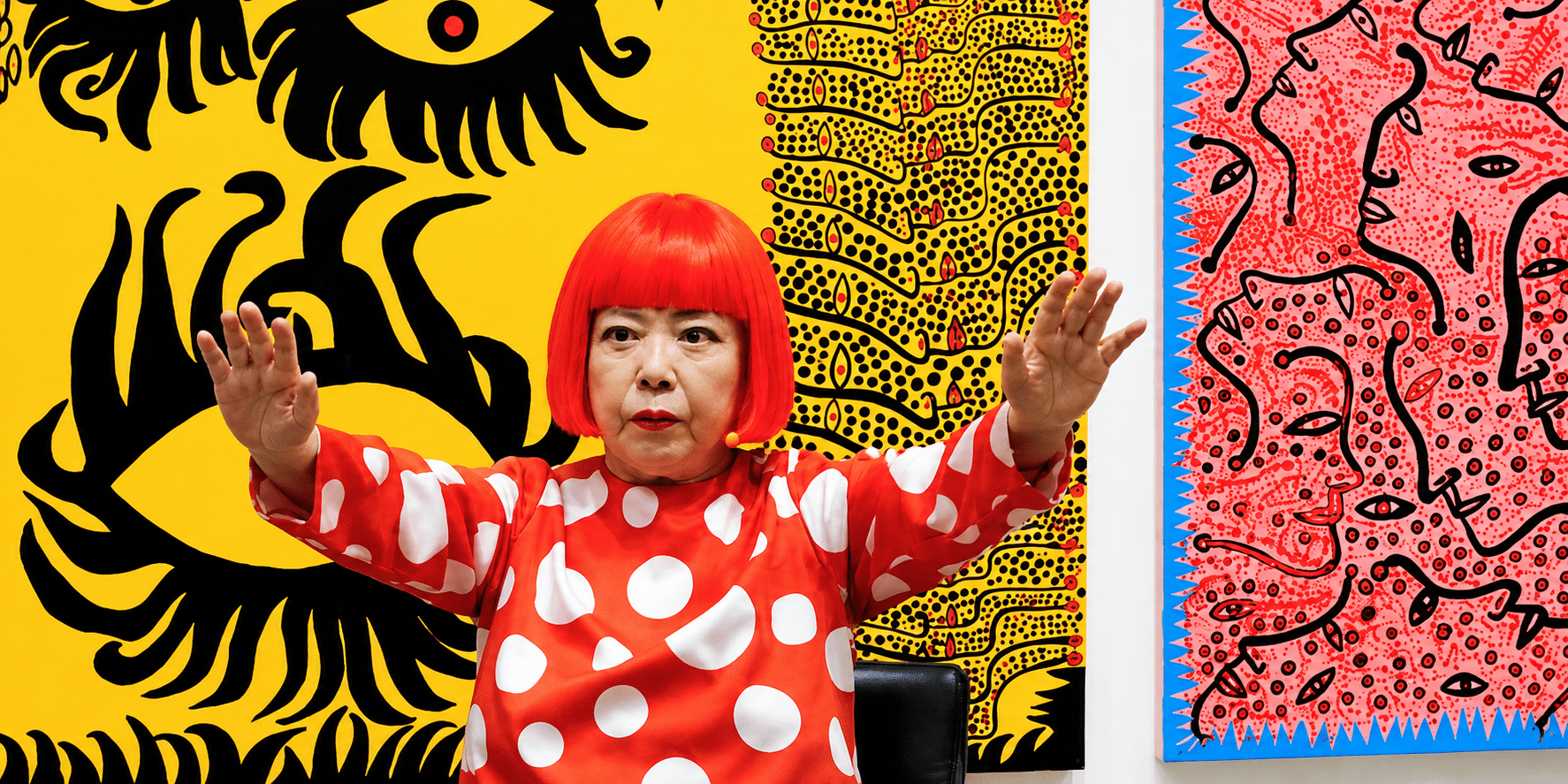
The Japanese artist Yayoi Kusama (1929–2026) has died in a Tokyo hospital on 14 August 2026 at the age of 97. The announcement was released by her studio a week after the artist’s death. She continued painting until her final days.
Her death closes one of the most extraordinary careers in modern art, and one of its most complicated legacies. Kusama was famous twice over, in two distinct phases separated by nearly two decades of near-invisibility, and the two versions of her public identity were so different that they almost seem to belong to different artists.
She was born in Matsumoto, Japan, in 1929, into a wealthy but deeply troubled family. From childhood she experienced hallucinations in which patterns proliferated across surfaces, walls, objects and her own body. She found in those experiences not just the subject matter of her art but its logic: the repeated dot was a way of externalising something internal, of mapping and thereby containing an overwhelming perceptual world. The dots were never simply a style. They were a coping mechanism that became an aesthetic, and then a philosophy.
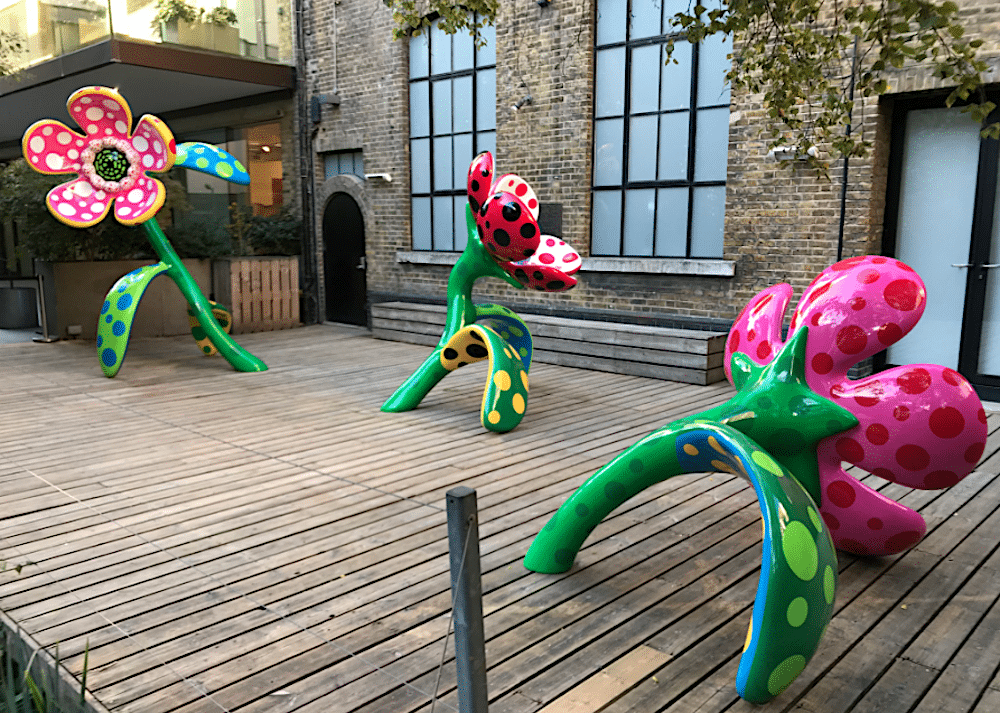
Yayoi Kusama Victoria Miro Gallery © Artlyst
Kusama arrived in the United States in 1957 and within eighteen months had placed herself at the cutting edge of New York painting. Her Infinity Nets, vast canvases covered edge to edge in compulsive networks of marks, earned serious critical attention and positioned her work in the movement beyond Abstract Expressionism. A 1962 Times review barely mentioned Warhol and Morris because Kusama was so obviously the more significant presence. Her phallic Accumulations, ordinary objects colonised by sewn fabric forms, were among the earliest feminist art being made anywhere, depicting a world saturated by maleness with a sharp and unsettling wit.
She was also, from early on, a sophisticated protector of her image. Long before Warhol had turned his public persona into one of his most central works, Kusama understood the relationship between visibility and value. She made sure to be in the frame when her work was photographed, sometimes nude and covered in dots. She organised happenings and spectacles, including body-painting events that became legendary in the late sixties counterculture. She was building something that went beyond individual works: a total artistic identity.
The recognition she deserved did not follow. Male artists absorbed and profited from ideas she had developed first. She received too little credit and too little money. In the early 1970s she returned to Japan, and in 1977 voluntarily entered the psychiatric facility where she would live for the rest of her life, continuing to work in a studio nearby. The international art world largely forgot her. By 1984, an article could describe her as “only vaguely remembered.”
When she re-emerged in 1989, the scene had changed. The work looked much as it always had, dots still multiplying across pumpkins, flowers and elaborately fabricated sculptures, but the critical language now foregrounded her illness rather than her ideas. The outsider narrative took hold, dramatically broadening her audience. People and suffering are more legible to a general public than avant-garde ambition, and Kusama’s story, filtered through the idiom of outsider art and psychiatric case history, became immensely accessible.
The Infinity Rooms, mirrored chambers in which visitors see themselves reflected into infinite recession, became her most widely experienced works. The first had been installed in New York in 1965, when it belonged to a broader moment of interest in Op Art and perceptual effects. In the 1990s and beyond, as social media created the conditions for their viral spread, they became phenomena of a different kind. Queues stretched round the block. The thirty seconds of allotted mirror time produced millions of photographs. Whether the experience generated anything beyond a momentary sensation of visual vertigo is a question worth asking, though perhaps not in the immediate aftermath of her death.
She collaborated with Louis Vuitton, dotted Coca-Cola cans, and appeared as an inflatable robot above a Paris boutique. Some read this as a betrayal of her earlier radicalism. In 1968, she wrote that mass production robs us of our freedom. But there is another reading: that in becoming one of her own dots, spreading her image into every corner of the culture, she was carrying out a project that was continuous with everything she had done before. The insider of the 1960s avant-garde did not disappear. She went underground into the outsider that a larger world came to know.
Kusama never stopped insisting that her world was worth seeing. For more than seven decades, she made art with a discipline and determination that deserve to be understood on their own terms, separate from the mythology of suffering that has sometimes obscured it. The Kusama Museum announced that her wishes will be carried forward and that her work will continue to bring hope to people around the world.
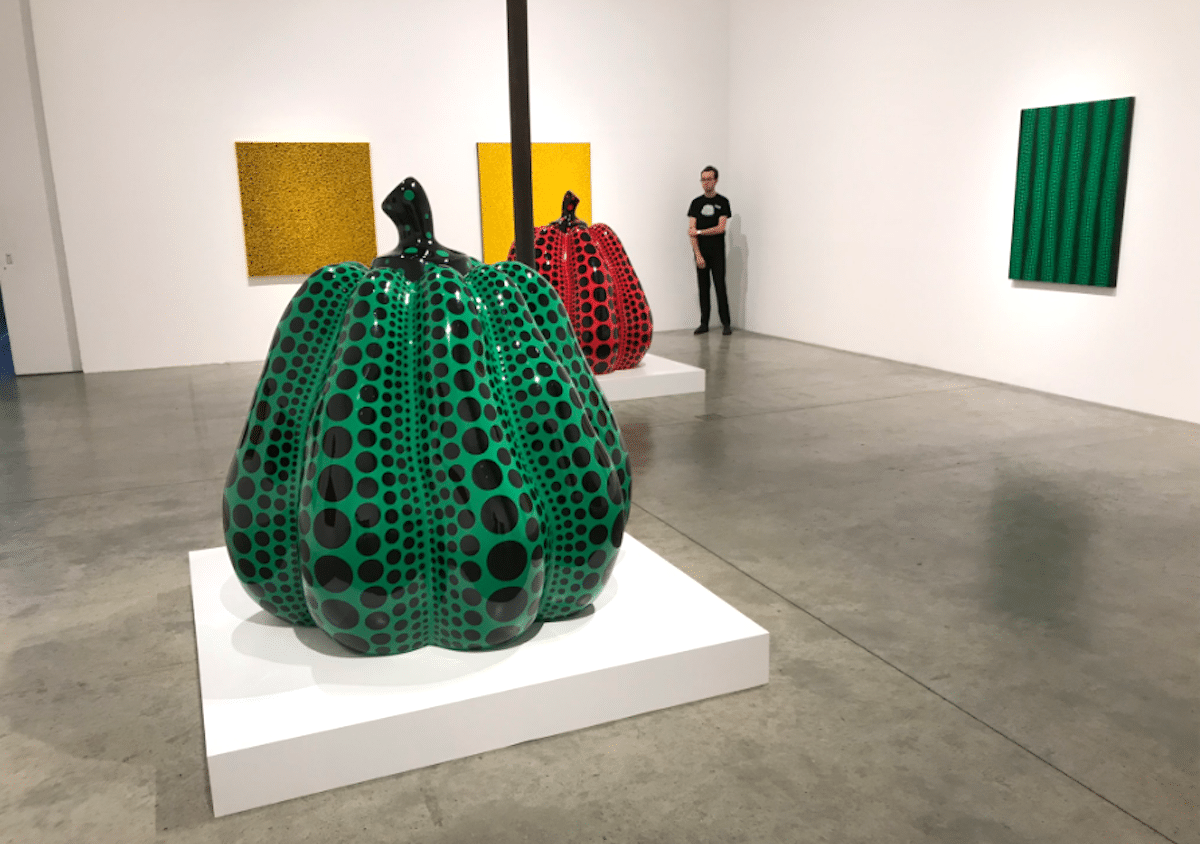
Yayoi Kusama Victoria Miro Gallery © Artlyst
The Yayoi Kusama Museum Put Out The Following Statement
It is with profound sorrow that we announce that Yayoi Kusama passed away at a hospital in Tokyo on August 14, 2026, at the age of 97. Throughout an extraordinary lifetime devoted entirely to artistic creation, Kusama pursued an internationally acclaimed career as a pioneering avant-garde artist whose creative practice encompassed visual art, performance, fiction, and poetry. She continued to paint until her final days, never setting aside her brush, and remained steadfast in her lifelong belief that love can save the world. We will carry forward Kusama’s wishes and, through art, continue to bring hope and strength for the future to people around the world. Please note that the exhibition “KUSAMA’s POP” will continue as scheduled through August 30. – Yayoi Kusama Museum
David Zwirner Gallery Stated:
It’s been one of the great privileges of my professional life to have been able to represent Yayoi Kusama’s extraordinary art for the last fifteen years. The last time Kusama visited New York, a city where she lived for many years, was in 2013. During that visit, she opened the first of many exhibitions in our galleries that had hour-long lines for the chance to experience her work. Her steadfast message of love and peace has now reached millions of admirers around the globe. At the time of her passing, Kusama was, without a doubt, the most famous living artist in the world.
Earlier this summer, I was reminded again of Kusama’s genius when I visited her career retrospective at the Museum Ludwig in Cologne; the exhibition presented more than 300 works, from her childhood drawings to the present. Kusama’s art influenced the histories of minimalism, pop art, and performance art; more recently, her large-scale installations single-handedly pioneered what is now referred to as experiential art. Shortly after my visit to the Museum Ludwig, they announced that this exhibition had become the most successful in its history. Kusama must have been pleased to read this. I will miss her terribly.
Top Photo: P C Robinson © Artlyst 2026
She had painted until the end.