The Duveen Galleries, one of the most imposing and architecturally demanding spaces in British public art, have been remade as an immersive installation drawing on the radical cinema culture that flourished in Algeria following its independence from France in 1962. Zineb Sedira’s When Words Fall Silent, Cinema Speaks, unveiled today at Tate Britain and running through 17 January 2027, is among the most ambitious and fully realised commissions the gallery has presented in recent years.
Sedira, born in Paris in 1963 to Algerian parents and long based in London, represented France at the 59th Venice Biennale in 2022 with Dreams Have No Titles, a critically acclaimed work that established her engagement with militant cinema as a central thread of her practice. The Tate commission extends that project into a larger, more elaborately constructed environment, one that synthesises architecture, film, sound, objects, and atmosphere into a sustained argument about cinema as a tool of political imagination and collective memory.
Visitors enter to find the commission’s title blazing in bright red lettering styled after Hollywood cinema signs of the 1940s and 50s. That visual language is immediately complicated by its surroundings. Sedira is working with the aesthetic grammar of Hollywood’s Golden Age to introduce something it was never designed to accommodate: Third Cinema. This anti-imperialist filmmaking movement emerged in the 1960s, deliberately opposing both Hollywood conventions and European art cinema. The collision of these two visual registers is productive and intentional, a way of making the politics of form visible to a viewer who might otherwise take either style for granted.
At the heart of the installation is a recreated cinema screening Sedira’s newly commissioned film, structured in four acts mirroring the stages of filmmaking: scriptwriting, shooting, editing and screening. The film weaves together archival imagery, scenes of Sedira both behind and in front of the camera, and the voice of Boudjema Kareche, who directed the Cinémathèque Algérienne from 1973 to 2004. Kareche’s memories of that institution, which became a vital platform for revolutionary cinema from Africa and the Global South, give the work a biographical texture and a human scale that pure historical argument could not achieve.
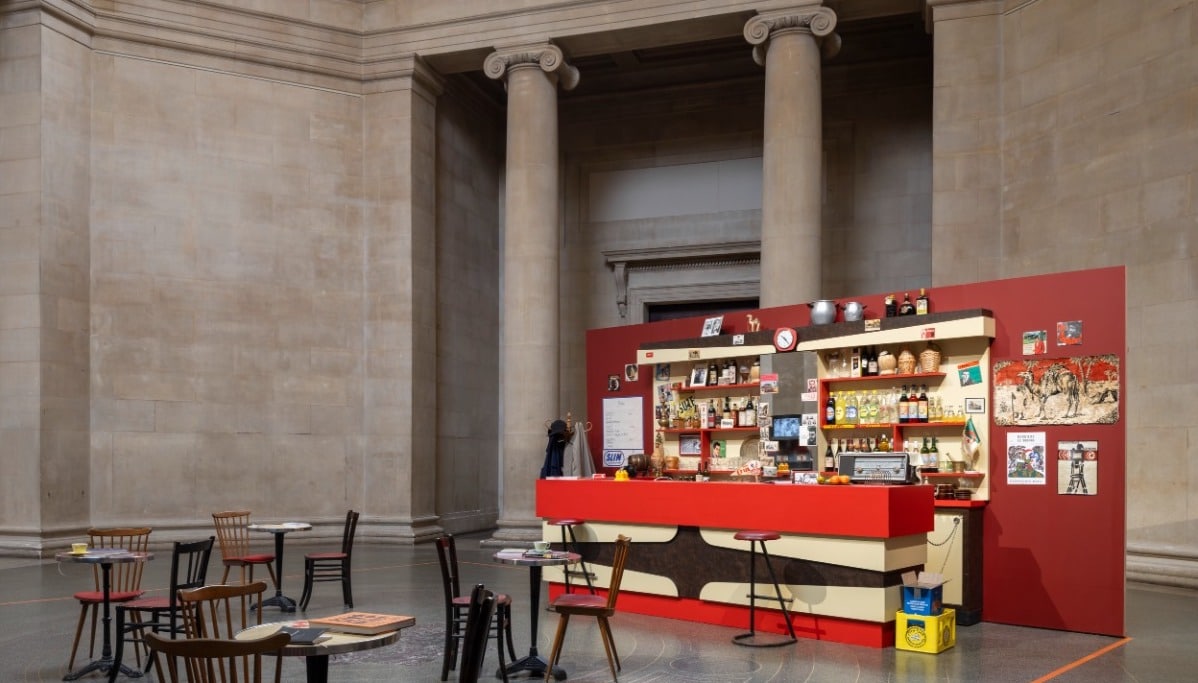
Elsewhere in the galleries, a 1960s Parisian café has been reconstructed, complete with bar, tables, chairs and books, paying tribute to the spaces that served Algerian exiles during the War of Independence as sites of political conversation and solidarity. A customised Scopitone, the video jukebox once popular with migrant workers, plays excerpts from Agnès Varda’s 1963 film Salut les Cubains, with animated still photographs pulsing to Afro-Cuban rhythms.
In the North Duveen, an Arabic cinema sign stands above vintage camera equipment. At the same time, a 1960s French van, reimagined as a mobile Ciné Pop unit, projects an interview with film historian Ahmed Bedjaoui. The history of these mobile projection vehicles is one of the commission’s most resonant threads: originally used by the French army to distribute propaganda, they were later reappropriated by the Algerian state to bring anti-colonial cinema to rural communities. The object and its history contain, in miniature, the entire argument Sedira is making about the political life of images and the institutions that carry them.
Tate Britain Commission: Zineb Sedira, When Words Fall Silent, Cinema Speaks is at Tate Britain, Millbank, London, from 13 May 2026 to 17 January 2027.