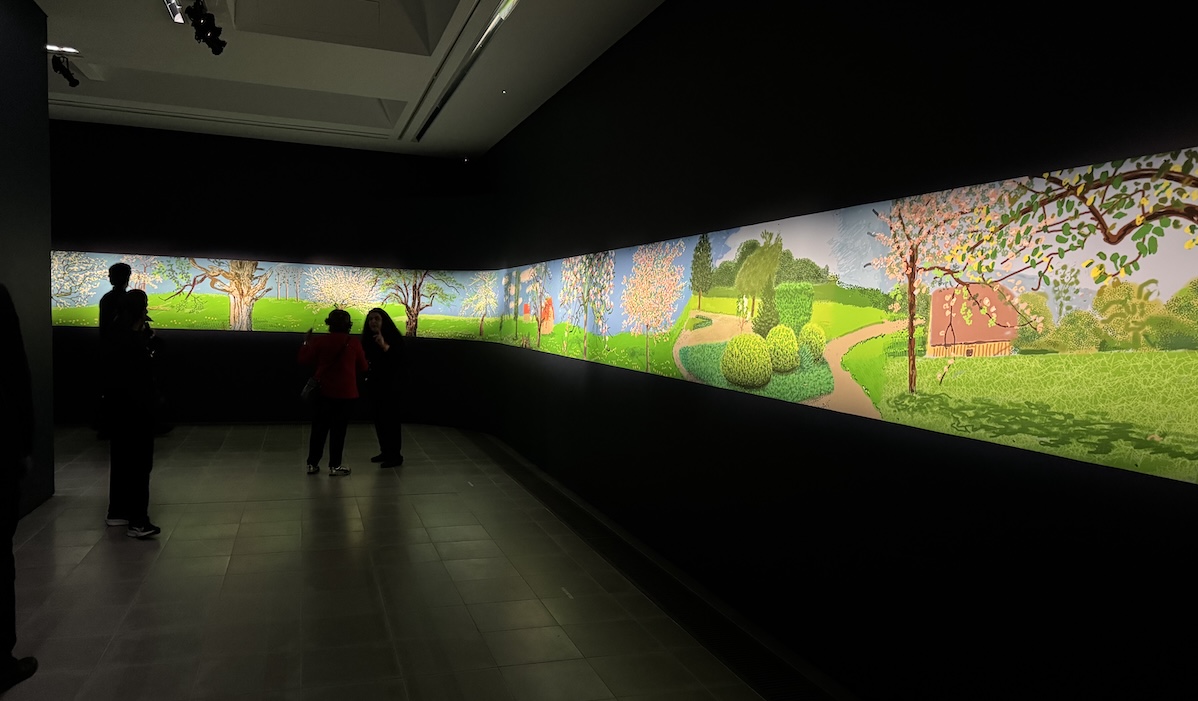
A Year in Normandy is David Hockney’s narrative of the seasons, of nature, all created within the bubble of Covid isolation, which began shortly after he arrived in Normandy in late 2019. Hockney made it like a diary built over time – image by image – step by step -a great homage to the land in all its multi-seasonal complexity. He began producing images of winter trees on his iPad and continued during the 2020 lockdown. Unlike the Bayeux Tapestry that inspired Hockney, with its stitched snaps of 1066 and all that, this 90-foot-long panorama comprises trees, hills, fields, houses, flowers, and a full-frontal look at the ongoing theatre of nature. Human history takes a back seat…
David Hockney: A Year in Normandie, Serpentine North
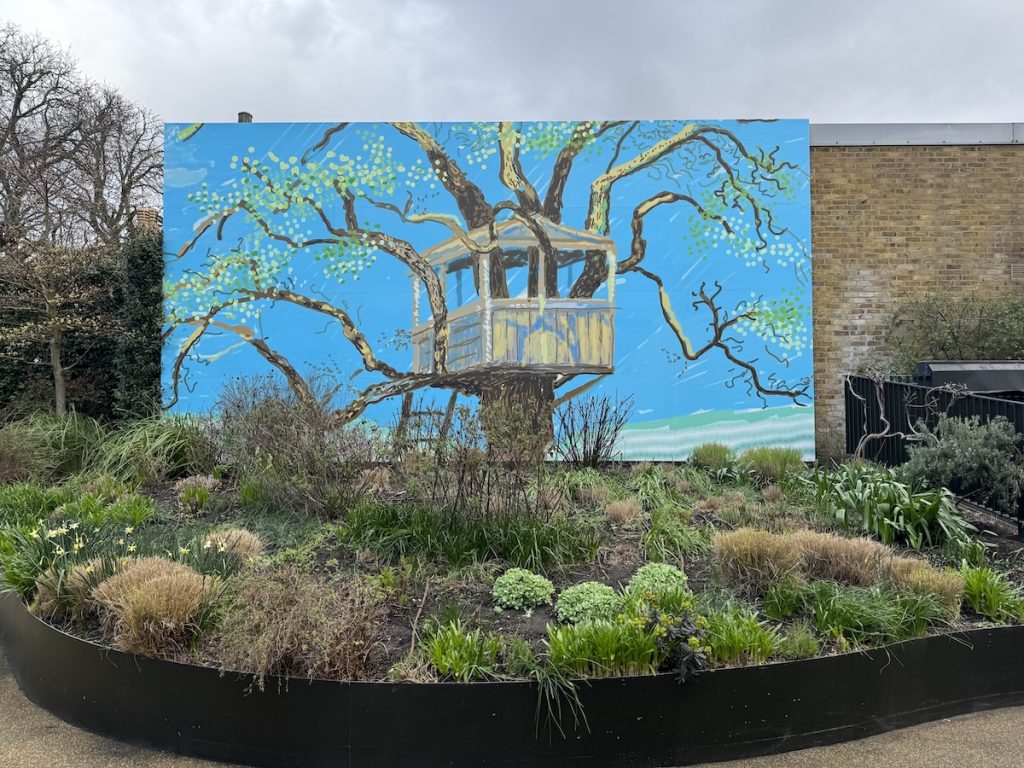
Hockney makes the ordinary extraordinary. It all adds up. Incredible squiggles, traces, lines, splotches and dots impacted by vivid living colours. Lines of rain are simply repeated notational diagonals – lines. Amid the meanders, there are old farm buildings, even a tree hutch with a roof (an expanded mural version of this is presented outdoors as a tableau in nature). Inspired by nature in nature, the scene goes on and on, (…) a woodpile, tree, another tree, then a tree – some leafy, still others leafless, according to the season. Diaphanous clouds, patches of land, then fields of land. The continuity we visualise as an immersive experience of the seasons… Some trees aren’t sumptuous, a bit worn out, while still others are blossoming. This immersion in landscape speaks of the glorious circularity of A Year in Normandy, something that recalls Monet’s Water Lilies at the Musée de l’Orangerie, where Hockney’s A Year in Normandy was earlier held. It’s a processional thing, walking the land in a gallery. Spring, summer, autumn, and winter, what a Covid-induced visual workout in the iPad scale!
Also in the show are five frontal portraits and five still-life works, each integrating the checkered gingham tablecloth motif. These portraits of friends, family and caregivers, integrate abstract with figurative. Joe Hage is depicted in front of Pieter Bruegel the Elder’s The Tower of Babel (1563). The most fun of the portraits is of Thomas Mupfupi, one of David’s carers, wearing an ‘END BOSSINESS SOON’ Badge. Cubist-inspired pieces like Abstraction Resting on a Red and White Checkered Tablecloth (2025) pepper the show, sometimes less successfully. The sheer surface treatment and jumble of patterns, lines, and colours have a graphic sense that harkens back to his Grimm’s Fairy Tales and the Rake’s Progress from the early days.
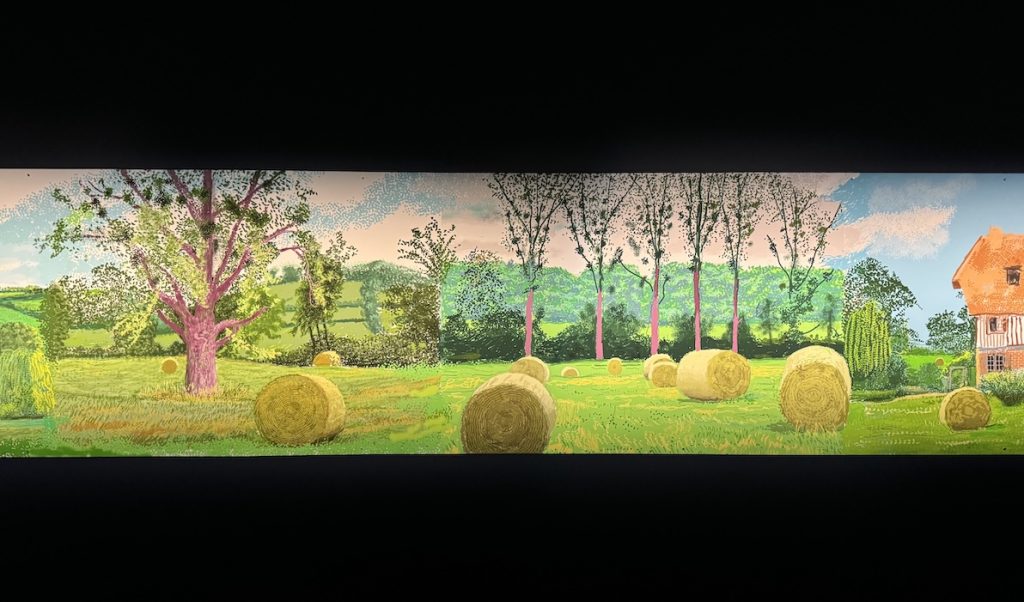
Hockney: A Year in Normandie, installation view, Serpentine North
A fantastic innovator over the years, Hockney produced his immensely popular paper pulp pieces with Ken Tyler, using moulton coloured paper pulp and metal moulds, then transferring them using a hydraulic press. These one-off paper pulp works, used by Kenneth Noland, Ellsworth Kelly, and others, have a tactile feel. Earlier pre-iPad experiments included those by the BBC Producer Michael Deakin, who encouraged David to use the Quantel Paintbox. Hockney drew with an electronic pen, painting directly onto a TV monitor, some of which was caught in the Painting with Light series of programs. The Polaroid joiners, as Hockney called them, were fun and in your face, a kind of anthropologist’s view of the world and people as you experienced it. Christopher Isherwood and Don Bachardy featured in these series, captured in fragment-like bursts amid Hockney’s California residence and pool. Exhibited at the Pompidou in 1983, one always had the sense Hockney was breaking open new ways of working for other artists of his era.
A Year in Normandy is Hockney simply looking at nature. The rambling painter and iPad man, David Hockney, has built this enigmatic processional panorama of nature to tell a story of life. The characters in this theatre of nature are not from Canterbury Tales, or the Bayeux Tapestry, but nature itself in all its diversity and seasonal variation. A life cycle is alive and well in this narrative of the Earth. David Hockney has proven that landscape is not outmoded. What a colourist! And what an irony that 17 iPad works from Hockney’s The Arrival of Spring at Woldgate, East Yorkshire series sold for more than $8 million at Sotheby’s in 2025, given the novelty of the medium. As Hockney says, “We have lost touch with nature rather foolishly, as we are a part of it, not outside it. This will, in time, be over, and then what? What have we learned?”
We look forward to seeing the theatre designs for productions of works by Mozart, Wagner and Stravinsky done in the 1970s for his 90th anniversary show at the Tate Modern in the Turbine Hall!
David Hockney: A Year in Normandy and Some Other Thoughts about Painting, Serpentine North, 12 March – 23 August 2026
Visit Here