
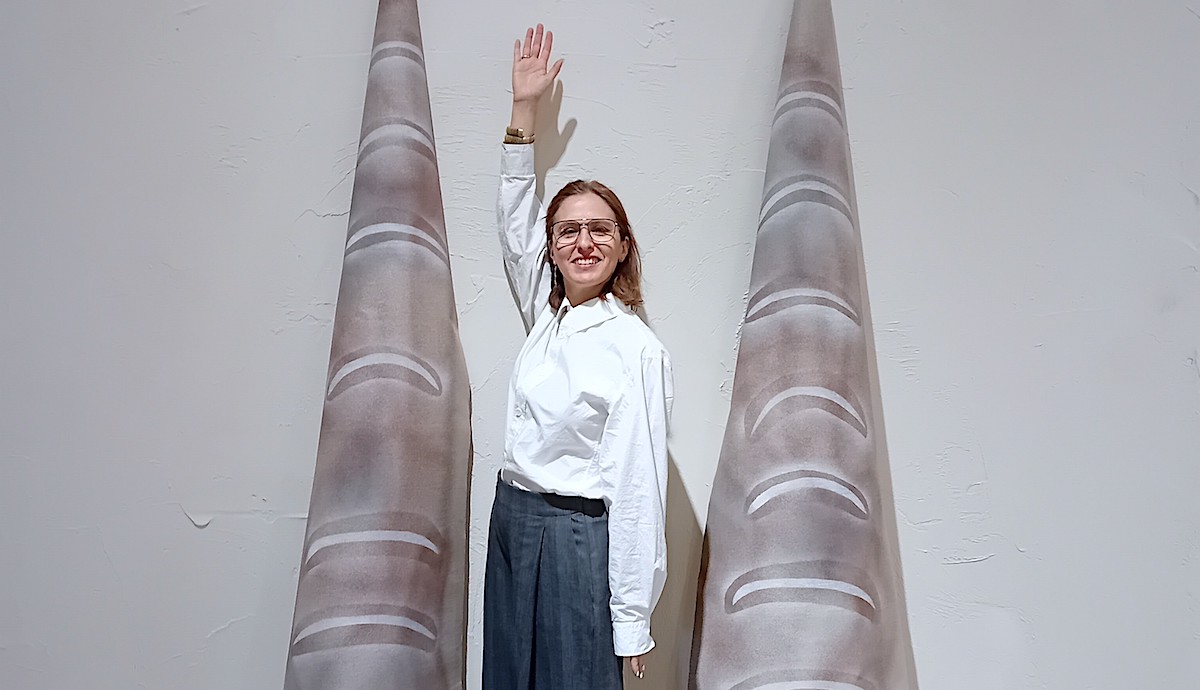
Venezuelan-born, London-based artist Lucía Pizzani presents her first institutional UK exhibition at Focal Point Gallery in Southend-on-Sea. Through a series of new installations and in collaboration with artists Cecilia Bonilla, Jaime Gili, Javier Weyler and local community groups and schools, Pizzani reimagines the Essex coast through a ‘deep time’ lens, linking geological transformation with contemporary questions of climate change, migration, and social transformation. For Pizzani, this becomes a framework for rethinking contemporary human and ecological crises, revealing borders and national identities as constructed and recent concepts.
The show is called ‘Faunal Succession’. What’s that?
It’s the geological principle stating that fossils appear in rock layers in a clear order over time, so you can understand the prior life and determine the age of a place by looking at the layers in its land. I find this concept beautiful because it also allows me to speak about my own layers as a migrant. I think about how permeable I am, and how I have absorbed the cultures of all the places I have lived, and how the ground we all step on also contains these multiplicities. If we were able to cut through the earth transversally, we would see all these layers, and each one would tell us something about what has happened in the past.
In your home country of Venezuela, for example?
Yes, as the layers of the ground speak about how the Venezuela’s resources have determined much of its modern history: the remains of dead organisms that, over time, have become the source of oil. This makes me think about how many things in our daily lives remain invisible yet shape our present and our future. The title plays with these ideas: the word faunal refers to animals and it invites us to remember humans as animals. And the word succession, for me, points toward the future as well. I also found myself thinking about how the movement of tectonic plates has shifted masses of land over the years, how our position in the northern hemisphere is not fixed in any absolute sense, that this place once belonged to the tropics. And these thoughts became a way of situating myself simultaneously within the past and the future.
You are showing three installations in separate spaces, leading to three different experiences. What are they?
I call them the Window Space, the Chalk Room, and the Amber Room.
Installation view of Lucía Pizzani ‘Faunal Succession’, Focal Point Gallery, Southend-on-Sea, 2026. Photo: Anna Lukala
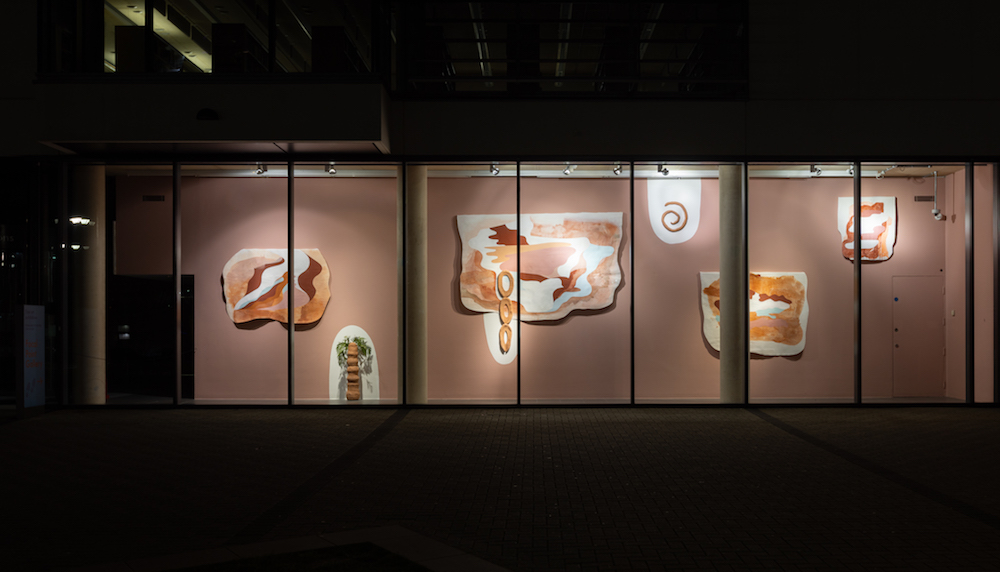
The Window Space is what the visitor sees first, visible 24/7 as they approach the gallery. You often work collaboratively, and here I assume it was a harmonious process as the joint production was with your husband, Jaime Gili?
Yes… it’s a marriage of his expanded paintings and my sculptures. I was thinking about the way we grew up in Caracas, in a city full of public art and murals, where there really is a union between architecture, art and the land. The paintings reference William Smith’s 1815 geological map of England and Wales, the first to map the resources below ground rather than just the surface. That can be useful, for example the builders of the Eurotunnel needed to know that there are seven types of chalk, of varying hardness. They might be seen as aerial views as much as geological strata, so micro and macro levels. They have been cut into organic shapes and painted using the same minerals and pigments as my clay sculptures in the space. The ceramics depict the snake and the spiral, symbols that I always go back to that are linked to our own DNA on a micro level, but also to the galaxy, the macro… They are very universal shapes that have always been linked with transformation and healing, themes that are recurrent in my practice.
Installation view of Lucía Pizzani ‘Faunal Succession’, Focal Point Gallery, Southend-on-Sea, 2026. Photo: Anna Lukala
What about the Chalk Room? Why sculpt in chalk?
I am drawn to the stories that materials contain, and I have a vivid memory of the White Cliffs of Dover when I arrived in the UK, of thinking of them as a physical barrier beyond being a symbolic image of the country – this is the same coast that receives migrants and that is increasingly politically disputed. Chalk is made of shells of tiny marine organisms, which time has transformed into giant land masses that now form geographical borders within the current human arrangement of the territory. And the concept of migration derives from the existence of countries, as before there was just movement, travel, walking, exploring, relocating….
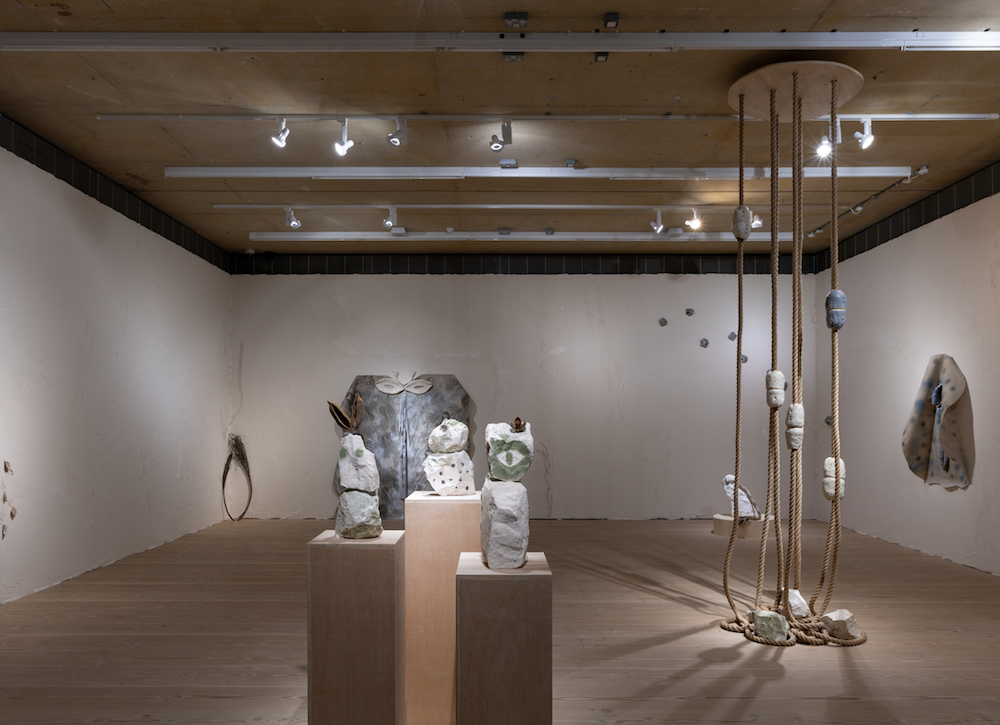
When I was given the permission to collect some of the fallen chalk to sculpt, we all thought it was going to be very light – but it turned out to be incredibly heavy! The sculptures I have made with chalk follow the natural shape and forms of each piece, in a similar way prehistoric humans used the cave’s reliefs. There is an act of transformation but mostly through precise carving, assemblage and by painting them with acrylic green tones that match the natural moss growth. Some are becoming faunal chalk beings, others are more abstract, and I have added empty dry seed pods from South American plants such as mahogany and the Australian kurrajong tree. The works become a place of convergence, having three continents represented. I am also including jute ropes as part of the space. They suggest long tentacles. Jute is – after cotton – the second most widely used natural material, with a history marked by colonisation and trade and linked to marine vessels.
Those materials come together to suggest we have stepped into an aquarium, or are under the sea?
I imagine we are in a post-human environment. There’s the idea of someone arriving in millions of years and finding the traces of something that happened, but they don’t know what that was. I also refer to movements of tectonic plates, and how something in Britain could have been tropical in the past – people, seeds, geology kept on moving.
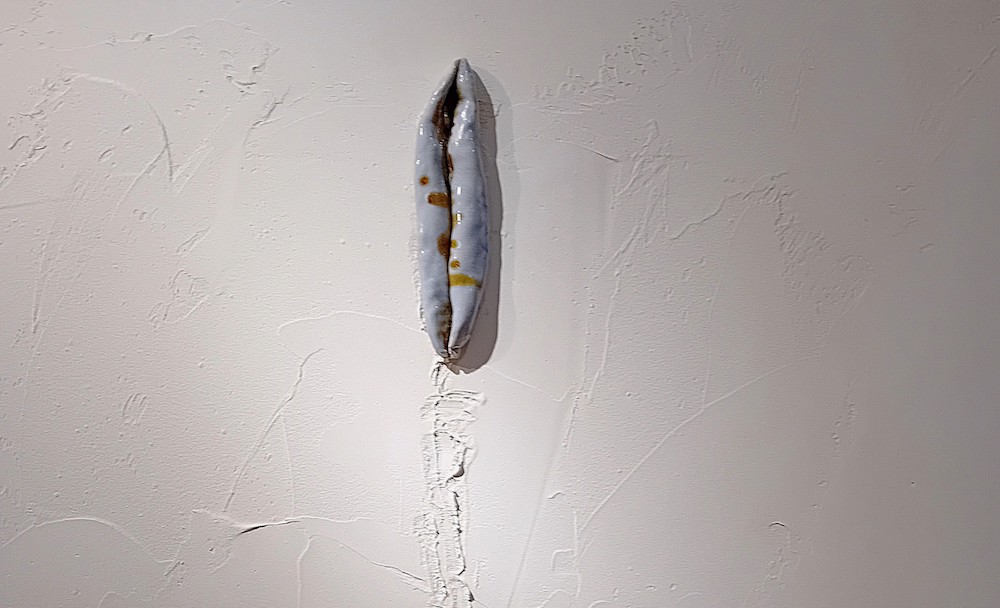
Installation view of Lucía Pizzani ‘Faunal Succession’, Focal Point Gallery, Southend-on-Sea, 2026. Photo: Anna Lukala
What are the marks on the walls?
I made my own body imprints to represent the tracks of the people who were here, and we can also see the marks formed by trace fossils. You can find fossils that are the actual organism, fossilised, but also traces from when the animal is moving, so it looks as if the squid-like form, for example, has climbed up the wall. If you think of the millions of years over which things have evolved, with the land and its fauna moving around, you see that we need a bit of perspective when we get exercised about migration.
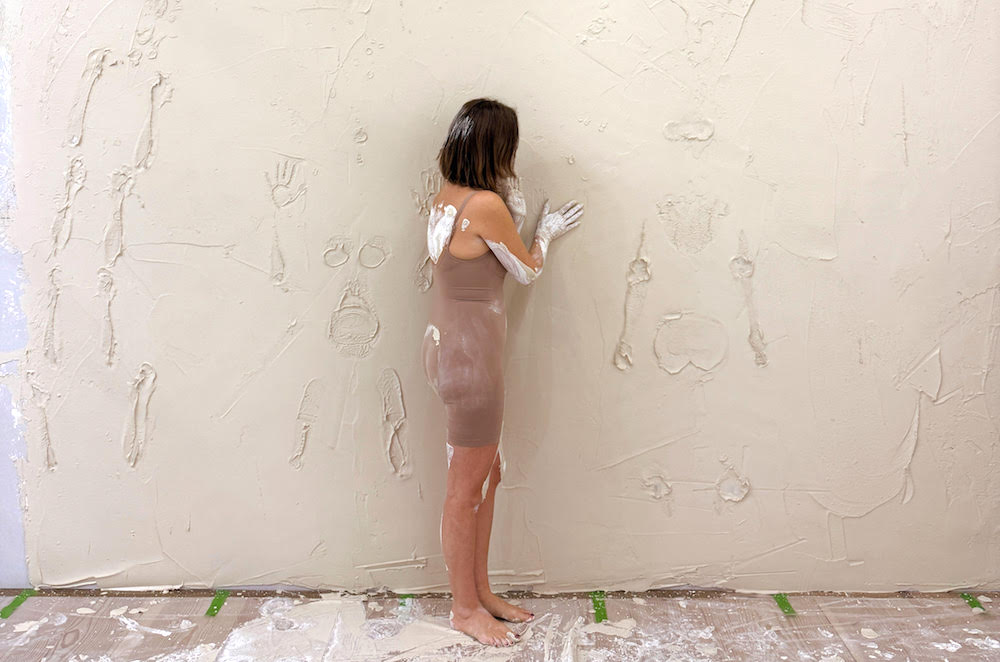
Lucia Pizzani making the marks – photo Ines Costa
Nigel Farage is not going to like the show, is he?
No… I don’t think so, as the exhibition strongly shows that nothing is homogeneous; it’s about diversity and hybridity. There is a desire to embrace the mix, overlap and exchange of cultures. Latin America, where I come from, has grown in a total blend of religion, food, music and art. Cultural production represents our state of flux, change and transformation, and that multiculturalism is an essential and beneficial part of society.
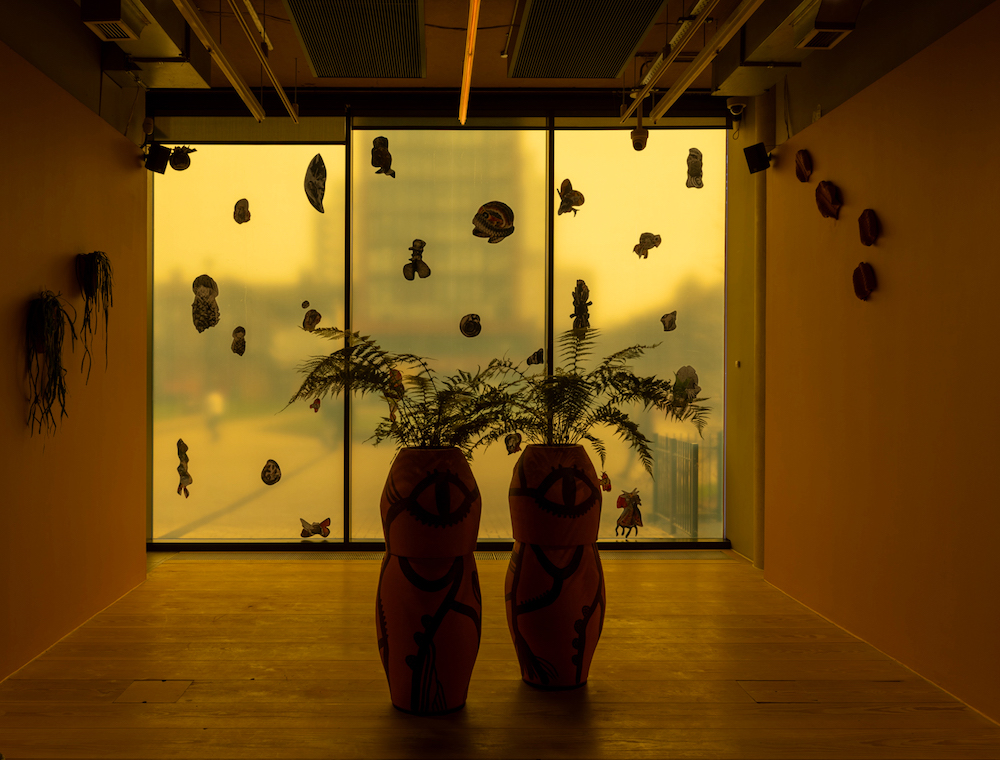
Installation view of Lucía Pizzani ‘Faunal Succession’, Focal Point Gallery, Southend-on-Sea, 2026. Photo: Anna Lukala
What about the Amber Room?
That is inspired by how amber can trap things, acting like a time capsule. I was reading a book about deep time, explaining how the forest was created, and it came from the sea – from a plant climbing onto a rock… many millions of years later they formed a forest. So the room combines new ceramic sculptures with real plants to make vegetal beings – that’s why we have the white ‘glow lights’ to ensure the plants have enough light to thrive, as well as the amber lights that heighten the colour. Some plants are from South America and there are sculptures that integrate photos of the Turgua forest, where my father lives, printed on fabrics.
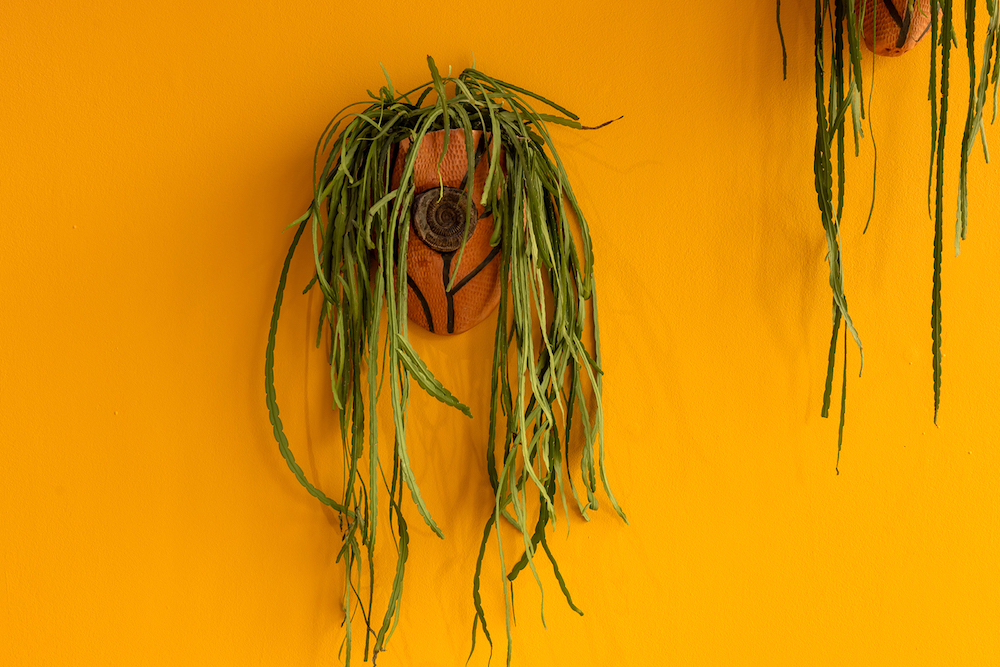
Installation view of Lucía Pizzani ‘Faunal Succession’, Focal Point Gallery, Southend-on-Sea, 2026. Photo: Anna Lukala
What is that unusual plant?
It’s a Bolivian Forest Cactusm a type of cactus that grow on trees and rocks. Being cacti, they store water and only need it once a month. They are accompanied by ferns in the show – one of the oldest species of plants, from 350 million years ago – while the cacti family appeared 50 million years ago in the American continent.
You and the Kent-based Uruguayan artist Cecilia Bonilla collaborated with local migrants. How did that work?
Thinking of the coast as a recipient of migrants, I invited Cecilia to help deliver workshop sessions through Welcome to the UK, an Essex-based charity that helps newly arrived migrants and their families to navigate life. We chose marine and fossil images, then the women – from eight different countries – decided what to combine into collages. We discussed how unexpected combinations often happen through evolution, and how we have always been a migrant species.
What do people make of your Venezuelan background?
They don’t imagine my private life and the difficulties faced – a third of the population has left in the last ten years, and everyone has a story such as ‘my father was kidnapped’. You have a dual personality where everything is OK here, but you worry about what happens there. It’s the very opposite of how the show talks about deep time – before nations, before politics…
Lucía Pizzani: Faunal Succession continues at the Focal Point Gallery, Southend, to 30 May 2026