The April 2026 Art Diary examines several exhibitions related to spirituality. Kettle’s Yard recently commissioned an essay exploring their collection through the lens of spirituality, while an exhibition at ICA LA is currently examining art as a conduit to the spiritual. Performances and exhibitions involving Maurizio Cattelan, El Greco, William Blake, Henri Matisse and Lillian Delevoryas, among others, explore related themes. Exhibitions by Mirna Bamieh and Theaster Gates engage with themes of discrimination, while several other exhibitions and a sculpture unveiling explore aspects of our relationship with our environment. These include ‘Gainsborough, Turner and Constable’, a Constable 250 exhibition at Gainsborough’s House that explores the emergence of landscape painting in Britain, led by three of its greatest exponents.
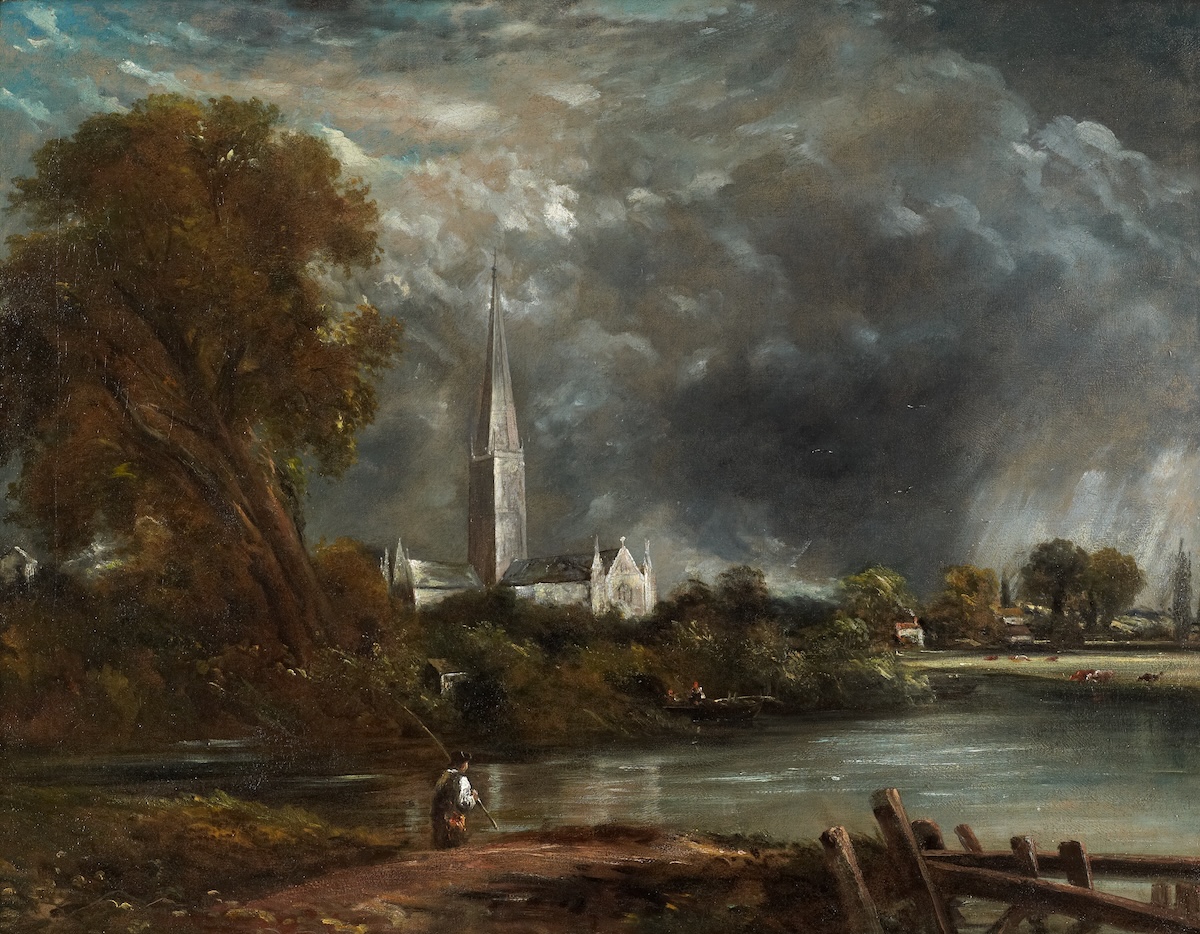
John Constable (1776–1837). Salisbury Cathedral from the Meadows, c. 1830s. Oil on canvas. Private Collection.
‘In Search of God Through Artists’ is a specially commissioned essay in which Hassan Vawda explores the Kettle’s Yard house through the lens of spirituality, reflecting on the extent to which the religious beliefs of Jim and Helen Ede are visible to today’s visitor through the objects on display. Vawda situates Jim Ede’s personal beliefs in the context of the changing religious landscape in the UK in the decades after the Second World War. During this time, Vawda argues, the perception of waning religious belief can more accurately be characterised as a diversification of the types of beliefs held and the practices through which they were sustained. Kettle’s Yard, Vawda argues, can fruitfully be understood as an expression of this transformation.
Vawda explains that the Ede’s lived: “A way of life that positioned art as a portal to beauty, and beauty as a gateway to divinity. This sense of the divine was subtly embedded within the typography of Christianity – always present yet never framed in a way that felt like preaching.” He concludes: “The space they created and the purpose they envisioned it serving positions the house as a response to the rapid reconfiguring of religion and the dominant ideas of secularisation that increasingly took hold in intellectual and cultural spheres in post-war Britain.” As such, his text explores Kettle’s Yard as an “open house” in this context and “reflects on what it can maybe teach us about creating spaces to find meaning in religion, belief, and secularism in today’s world.”
The ICA LA is creating just such a space by presenting ‘Speaking in Tongues’, an exhibition featuring an intergenerational, international group of contemporary artists who embrace art as a conduit to the spiritual. Exploring and expanding notions of the sacred and the divine, the exhibition includes both new and pre-existing works by artists engaging with embodied and ecstatic forms of expression, ritual, and translation. At a moment when religion is increasingly weaponised as an instrument to divide, ‘Speaking in Tongues’, as did the Ede’s, celebrates the spiritual as a tool for survival, kinship, and communion.
The exhibition centres the work of indigenous and diasporic artists from the Global South to trace shared connections across geographies, cultures, and time. The exhibition’s title, Speaking in Tongues, references a term commonly associated with the Pentecostal church and said to describe someone who becomes so consumed by their encounter with the Holy Spirit that they respond in indecipherable languages and uncanny movements. While language, like religion, has often been a tool of colonisation and erasure, ‘Speaking in Tongues’ points to mother tongues that evade capture, honouring those whose communities, native languages, and sacred rituals have been systemically riven by colonialism.
This evocative phrase has been used previously in relation to several other exhibitions. ‘Speaking in Tongues’ at Glasgow’s Centre for Contemporary Arts in 2014 reflected on the history of the avant-garde arts in Glasgow and its potential to represent only a very specific version of the past. By contrast, a 2021 exhibition at Blake & Vargas brought together work by artists who explore the body as a transformative vessel. In a 2022 solo exhibition, Indonesian artist Albert Yonathan Setyawanto used the phrase to highlight the fact that one’s spoken language needs to be unpacked and decoded for another person to understand.
While recalling the ceremonies, altars, and scriptures common to a spiritual life, the artworks featured in the ICA LA’s ‘Speaking in Tongues’ exhibition enhance our understanding of the sacred beyond — and often in contrast to — spaces like the church, temple, synagogue, and mosque. In celebrating forms of knowledge and expression that have traditionally existed outside of art historical textbooks and museum walls, ‘Speaking in Tongues’ — together with its catalogue and related programmes — expands and deepens the field in timely and meaningful ways that illuminate the spiritual as a method for remembering, storying, and living in this world together.
Maurizio Cattelan, the Italian provocateur known for his art world stunts and pranks, is returning to engagement with religion by taking confessions from sinners in the United States. ‘The Confessional’, the artist’s latest performance artwork, asks the guilt-ridden to call a hotline and divulge their wrongdoings to the artist. The hotline, which opened on 2 April and can be dialled by anyone in the US at +1 601-666-7466, will remain open to 22 April. Those outside the US are advised to use WhatsApp. Cattelan will then choose a number of confessions to be livestreamed on 23 April, when Cattelan will take on a symbolic, priest-like role and offer a form of “absolution”.
Cattelan, whose 1999 work ‘La Nona Ora’ was accused by some of blasphemy, is playing down the idea that with this new project, he’s trying to shock. He has said, “I don’t see it as absolution. It’s not religious authority, it’s a shared gesture. Confession exists in different forms everywhere, even outside religion.” The new performance piece, however, is linked to the resurrection or re-release of ‘La Nona Ora’, a wax sculpture of Pope John Paul II lying on a red carpet, struck down by a meteorite. This work’s title translates to ‘The Ninth Hour’ and so refers to the moment Christ died on the cross.
To mark the 21st anniversary of John Paul’s death and just prior to Easter, Cattelan has issued a miniature version of this sculpture in partnership with Avant Arte. This London-based online platform specialises in collaborating with artists on editions. The opportunity to purchase the figurine is allocated by a random draw, but those who submit a confession gain early access, while those selected to confess on the livestream receive a free ‘La Nona Ora’.
Despite the controversies that his religious-themed works have generated, the Vatican commissioned Cattelan in 2024 to create an artwork for its Venice Biennale offering. Launching that exhibition, Cardinal José Tolentino de Mendonça, the Vatican’s culture minister, said that “what religious and artistic experience have in common” is vision, which “involves us directly in reality and makes us not spectators, but witnesses.”
The Papal Palace of Castel Gandolfo is currently hosting ‘El Greco in the mirror. Two paintings compared, an exhibition intended to create a dialogue between two small masterpieces by the great artist. A previously unseen painting by El Greco, ‘The Redeemer’, held in the Ambassadors’ Hall of the Papal Audience Apartment of the Apostolic Palace, has been placed in relation to a small tempera on wood depicting Saint Francis, on loan from the A. and M.A. Pagliara Foundation of the Suor Orsola Benincasa University.
El Greco was born in 1541 in Candia (now Iraklion) on the island of Crete, and died in Toledo, Spain, in 1614. The tempera on wood panel depicting Saint Francis is an early masterpiece dating from around 1570, when the artist was documented in Rome and had already passed through the Venetian workshops of Titian and Tintoretto.
‘The Redeemer’, by contrast, was created around 1590-1595. The work belonged to the collection of the Spanish Catholic intellectual and politician José Sánchez de Muniáin, who donated it to Paul VI in 1967. The oil painting on panel, poorly understood due to a lack of research and studies to decipher the image and evidently unfinished, suffered inevitable deterioration until the 1960s, when it was presumably repainted. The re-evaluation of the great Cretan artist increased demand for his works and, with it, the production of fakes. It is in this context that this painting was remade by an unknown forger, who concealed the original layers by roughly tracing the image of Christ.
‘The Redeemer’ has recently undergone restoration in the Vatican Museum’s Painting and Wood Materials Restoration Laboratory, directed by the Master Restorer Paolo Violini. The conservation work, carried out by the Master Restorer Alessandra Zarelli and accompanied by scientific analyses conducted by the Cabinet of Scientific Research directed by Fabio Morresi, has enabled the unexpected and exciting discovery of a true pictorial palimpsest beneath the surface of the painting, which features two underlying layers with sketches of two other works by El Greco. The cleaning carefully recovered the original layers, gradually revealing even those whose presence was uncertain. All the data, compared with that of other paintings by the artist, confirmed the work’s full authenticity.
For a greater appreciation of El Greco’s achievement, see Patrick Pye’s ‘The Time Gatherer’, an extended meditation on the work of El Greco which: “explores the way in which El Greco’s faith and theological vision becomes real in the context of his painting. It is a beautiful essay, continually illuminating about how an artist resolves that fundamental issue of religious painting: how do I represent a reality, a mystery that ultimately transcends all representation? How do I point to, evoke that reality effectively in paint? How have others so resolved it and how can I?” The depth of this essay is enhanced by being written by a practising artist, himself, a man of faith who faces, though in a modern context, precisely the same questions that El Greco faced and an artist who has been admiring and pondering El Greco’s work over many years.”
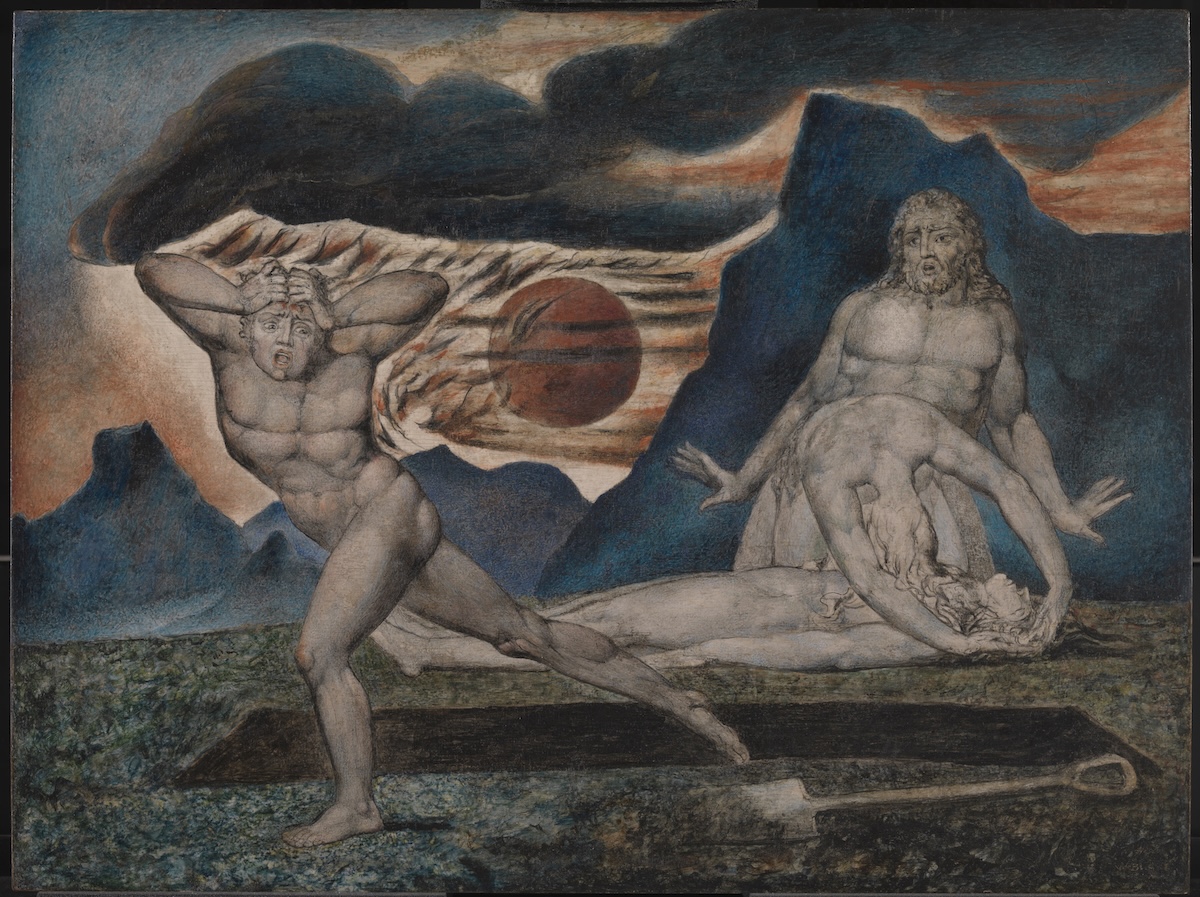
The Body of Abel Found by Adam and Eve, c.1826. William Blake. Image Credit Line: Tate, Bequeathed by W. Graham Robertson 1949. Photo: Tate.
‘William Blake: The Age of Romantic Fantasy’ at Dublin’s National Gallery of Ireland highlights how, as poet, painter and printmaker, Blake has given us some of the most striking images and memorable words of British Romanticism. Through a selection of Blake’s iconic works, hung alongside those of his peers, the exhibition explores the late 18th- and early 19th-century fascination with the supernatural, fantasy, and the Gothic. The influence of this idiosyncratic British visionary can still be seen in the work of renowned musicians such as U2 and Bob Dylan, iconic writers like J.G Ballard and Alan Ginsberg and film-makers Ridley Scott and Martin Scorsese. Visitors will be enticed by soaring angels and dream-like fairies and plunged into nightmares and hellish visions. Ghosts, ghouls and muscular bodies play on mysticism, horror and theological disputations to create a world of creation and destruction.
A significant focus of Blake’s work was his rendering of religious imagery. He explained that the Old and New Testaments were the great ‘code of art’. His interpretations demonstrate how he could create new and unusual images using well-known iconography. His imagining of Job’s torments in ‘Satan Smiting Job with Sore Boils’, the death of Christ in ‘The Entombment’, and a mother’s grief and despair in ‘The Body of Abel Found by Adam and Eve’ are wholly unique. Blake also had a deep connection to Gothic architecture from his time as an apprentice, spent sketching the Gothic churches and tombs of London, particularly Westminster Abbey. His drawing ‘Detailed Drawings for “A Figure Standing in a Gothic Apse”‘ depicts a female saint looking upwards.
He made many depictions of the underworld, drawing inspiration from mythology, the Bible and his own imagination. In the final years of his life, he was commissioned to illustrate Dante’s ‘The Divine Comedy’. The resulting works include giants trapped in soil, and a vision of Dante and his companion standing under the entrance to the gates of hell, rendered in pure black. These were the last watercolours he completed before his death.
Works by artists who influenced Blake also feature in this exhibition, including Cork-born James Barry’s etching ‘Satan, Sin and Death’ and Swiss-born Henry Fuseli’s painting ‘Lady Macbeth Seizing the Daggers’. The art of Blake’s contemporaries highlights a general fascination with the Gothic and reflects the turmoil of a world torn apart by war. Together, their work demonstrates the range of unconventional art produced by British, Irish, and European artists at the height of Romanticism.
The exhibition ‘Matisse. 1941-1954’ at Grand Palais Paris sheds light on the final years of Henri Matisse’s career, between 1941 and 1954, through more than 300 works – paintings, drawings, cut-out gouaches, illustrated books, textiles and stained glass – from the Centre Pompidou collection and major international loans. It reveals the multidisciplinary scope of his practice during this period, while bringing together an exceptional group of cut-out gouaches. At nearly eighty years old, Matisse reinvented himself through the medium of the cut-out gouache, which he elevated into an autonomous visual language, free and capable of reaching the universal through its simplicity. Adapted to both reproduction and monumental commissions, this technique enabled him to fully express the decorative dimension of his art.
The exhibition shows how painting remains at the heart of his approach, far from being supplanted by cut-outs: on the contrary, it unfolds with ever greater space, intensity and colour. Among the major ensembles gathered here are the majestic and final of ‘Intérieurs de Vence’ series from 1947-1948, the album ‘Jazz’, the series of ‘Thèmes et variations’ as well as the brush-and-ink drawings; the main elements of the Chapelle de Vence program; the monumental panels of ‘La Gerbe et des Acanthes’, and as as a crowning moment, brought together exceptionally, the great cut-out figures: ‘La Tristesse du roi’, ‘Zulma’, ‘La Danseuse créole’ and the famous Nus bleus. Conceived as a journey through the painter’s universe, the exhibition recreates the vibrant atmosphere of his ever-changing studio.
Everything in Matisse’s Chapelle de Vence looks light. The walls are white. The decorative murals consist solely of black lines. They look simple, as if they were painted effortlessly, yet Matisse painted them from his rich experience. He was also limited because he had to work seated in a wheelchair, his brush attached to a stick. On one of the shiny, tiled walls, we see the fourteen stations of the cross brought together into one composition. On another wall, a ‘Madonna with Child’ has been painted in the same line-drawing style, surrounded by clouds. Matisse used just three colours for the stained glass, yellow, green, and blue, so that the light would fall serenely from the windows into the spaces. Peace and stillness were essential for this project. Throughout his life, Matisse had been searching for rest for his restless soul, for “a comfortable armchair,” as he called his art. Finally, that rest could be found here.
Lillian Delevoryas completed her ‘Mary Magdalene’ series of artworks in the last year of her life, drawing on her 70 years as an artist. Fourteen of the original 80 artworks have been chosen for exhibition at Chester Cathedral in ‘Mary Magdalene: Apostle to the Apostles’. They represent the essential elements of the Mary Magdalene story. Among them, we find ‘The Alabaster Jar’ signifying devotion and surrender; through Kenosis or self-emptying, we discover love and humility. There is ‘Koinonos’, the promise of participation in divine life, and ‘Pieta’, faithful presence and hope amid grief. When Mary exclaimed “Rabboni” on seeing Jesus in the garden after the Resurrection, we find the possibility of recognition and awakening. Also, inspired by the imagery of the Song of Songs, we find that, just as Christ loves Mary Magdalene, so are we loved by Him in the same way.
‘Light in the Darkness’ is an exhibition by Tracey Walker at St Andrew’s Church in Wickford, Essex. From a traditional art background, through a long career in commercial art, Walker now finds freedom in her artistic practice, allowing her to express her joyful, spiritual creativity. She loves to explore themes of light, faith and hope in her paintings, using colour, form and texture to evoke emotions and create atmospheres, drawing the onlookers into a bright and beautiful world. She is also passionate about encouraging people to explore their own creativity through a variety of art groups and workshops.
‘Small Returns’ is an exhibition of paintings and works on paper by Turner Prize-nominated artist George Shaw. It follows a cycle of leaving and returning that has emerged in his work in recent years, revisiting locations from his past as well as images, themes, motifs, and memories. For Shaw, this process of repetition allows him to reflect on everyday shared experiences and the meaning (or meaninglessness) of being ourselves. This exhibition in Sheffield is another return for Shaw, who studied at Sheffield Polytechnic. It features a display of photographs, objects and video which capture that period, giving visitors an insight into some of Shaw’s formative years as a student and artist. Some of the paintings in ‘Small Returns’ will be shown publicly for the very first time, alongside other relevant pieces that reflect Shaw’s iconic body of work.
Among Shaw’s early works was ‘Scenes from the Passion’, a series of fourteen paintings that obliquely referenced the Stations of the Cross. In these landscapes of Coventry, Shaw expressed “his unconditional love for the place he was brought up, his gratitude for the life he’s been given”.
The ongoing ‘Sour Things’ series by Palestinian artist Mirna Bamieh, initiated in 2023, examines preservation as both culinary practice and political condition. NIKA Project Space, Paris, is presenting ‘Sour Things: The Door’, a new installation which, through sculpture, video and drawing, addresses migration and the condition of being held at a threshold. Inside the gallery, a monumental doorframe stands partially obstructed, staging the instability of entry and refusal, recognition and invisibility — the terms on which movement is so often determined.
Renowned for her socially engaged practice, Bamieh is the founder of the Palestine Hosting Society, established in 2017 to preserve Palestinian recipes at risk of disappearance. Since leaving Palestine in 2023 and relocating to Portugal, she has been navigating a prolonged residency process. That period of uncertainty informs the work’s underlying tension.
While grounded in Bamieh’s lived experience, the installation resonates with broader conditions of displacement and the precarious terms on which movement is granted or denied. It also directs the viewer’s physical movement; porcelain elements appear underfoot and hang in suspended formations, requiring careful navigation through the space. This subtle choreography introduces a heightened awareness of movement, echoing the emotional tension of waiting, uncertainty, and conditional access. Bamieh says, “The door is never neutral. It decides who it welcomes and who it does not, who is permitted and who is not. It renders you visible or invisible. Even when it appears open, it carries the weight of permission.”
‘Dave: All My Relations’ is an exhibition organised by Theaster Gates at Gagosian New York that celebrates David Drake, an enslaved ceramicist from Edgefield, South Carolina, known as Dave the Potter. The exhibition traces Dave’s impact on Gates’s own practice and commemorates the gift of a historic work by Dave from Gates’s personal collection to the artist’s descendants. That vessel is shown alongside another recently returned to Dave’s family and two new works by Gates.
Now recognised as a significant figure in the history of American ceramics, Dave was a skilled potter who made some of the finest examples of the alkali-glazed stoneware for which the Edgefield area is known. Yet, beyond his mastery of craft and scale, Dave left a mark that set him apart for its daring and beauty: he not only signed his work, but, in some cases, incised it with verse. This act was illegal in the antebellum South, where laws prohibited enslaved individuals from being taught to read or write.
Gates first encountered Dave’s work in 2008 while studying ceramics under Ingrid Lilligren. Having explored the work of many of the pioneers in the field, he asked her about the great historical Black ceramicists, and she directed him to an obscure catalogue for a 1998 exhibition presented at the McKissick Museum at the University of South Carolina in Columbia: ‘I made this jar …: The Life and Works of the Enslaved African-American Potter, Dave’. This revelation would strike a chord within Gates, and its reverberations continue to this day in his practice.
Gates’s discovery of Dave’s life and legacy was foundational to his practice. In his acclaimed 2010 exhibition ‘To Speculate Darkly: Theaster Gates and Dave the Potter’ at the Milwaukee Art Museum, Gates began a dialogue with Dave through both form and performance. The exhibition included a vessel by Dave as its centrepiece, and Gates composed a series of hymns that included and responded to select couplets from Dave’s pots. These hymns were performed during the exhibition by a gospel choir and later compiled and published in a hymnal, which is included in the current exhibition. Gates’s ceramics have also continued to be inspired by Dave’s, echoing their use of glazes and unique forms. His early incorporation of the spirit and practice of Dave’s work helped ignite a renewed interest in the artist, which culminated in numerous recent institutional exhibitions.
For this exhibition, Gates worked with a team to pulverise some forty-five of his own pots into pieces, combining these into a conglomerate to form monolithic sculptures, one of which is included in the exhibition. In a conversation for the Gagosian Quarterly with Jessica Bell Brown, executive director of the Institute for Contemporary Art at Richmond’s Virginia Commonwealth University, he said: “I will be the plinth, and Dave will be the story.” The sacrifice of his works and labour represents for Gates the weight of Dave’s legacy upon his own career.
A 13ft-high sculpture by sculptor Nicola Ravenscroft was unveiled recently in the gardens of the Royal Free Hospital in London as a national memorial honouring the NHS and healthcare workers who gave their lives on the COVID-19 front line. This striking bronze sculpture stands as a lasting tribute to the courage, compassion, and dedication of NHS staff. The unveiling of the sculpture was a moment to come together to honour, remember, and reflect on their extraordinary contribution.
‘Breath’, the national memorial sculpture, features two children beneath two tall trees, as Ravenscroft knew her design must portray the lives of those on the covid frontline who sacrificed their futures to save others. In the tender symbolism of this sculpture, two trees touch, intricate as one, soaring ancient beyond two young children who sit in simple dappled shade and light. Like them, in ongoing gratitude and hope, she celebrates the collective sacrifice of NHS and care workers through an image that lives singing into our future; a new life, their new life.
Ravenscroft places the potential of a child’s clarity of vision at the heart of her work. A graduate of Camberwell School of Art, a songwriter, and an art teacher, she has nurtured many young people to celebrate their inherent creativity, courageously embrace their differences, and imagine, with compassion, possibilities beyond boundaries. Her work has been exhibited at locations as diverse as churches and corporate HQs, colleges, galleries and schools, race courses, street parties and summits. These include: St Martin-in-the-Fields; St John’s College, Cambridge; HSBC global headquarters in Canary Wharf; University of Cambridge Primary School; and Talos Art Gallery in Wiltshire, among others. Her sculpture installation ‘With the Heart of a Child’ was part of a project exploring what the arts in transdisciplinary learning spaces can contribute to primary education.
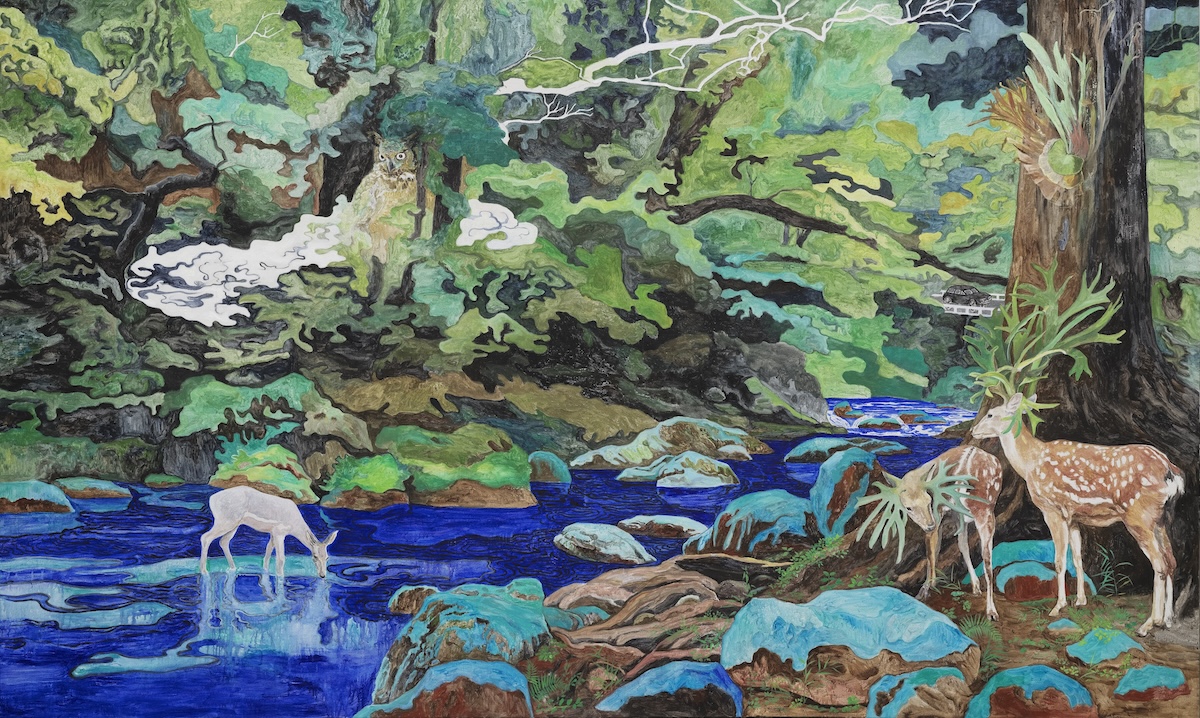
QIU ANXIONG邱岸雄b. 1972 Fading of God – Deer Calls in the Secluded Valley 神隱–鹿鳴幽谷, 2026 Acrylic on canvas 180 x 300 cm (70 7/8 x 118 1/8 in.
Qiu Anxiong re-examines our relationship with nature and the desire to dominate and control it at a time when the use of artificial intelligence increasingly blurs what is real. ‘Qui Anxiong: Bearing the Unseen’ at Pearl Lam Projects in Hong Kong coincides with Art Basel Hong Kong.
Qui does not abandon tradition in the face of modernity; instead, he draws on classical sources, Western anthropology, ancient Chinese mythological texts such as the Classic of Mountains and Seas, and Zhuangzi’s notion of the equality of all things to rescript the chaotic phenomena of the contemporary world. Guided by the aesthetics of Chinese ink painting and deeply rooted in classical Chinese philosophy, Shanghai-based Qiu has developed a singular artistic language that moves fluidly between painting, animation, installation, and time-based media. Known for merging traditional ink painting with experimental animation and video, throughout his work, he articulates a condition he describes as “modernity in flux,” marked by instability, mutation, and profound moral ambiguity. To him, modern civilisation is an unsettled terrain haunted by spiritual dissonance.
‘Bearing the Unseen’ presents a new body of landscape paintings depicting a dystopian natural world inhabited by displaced animals and human figures, addressing our fractured relationship with nature. Drawing formally on the literati tradition of Chinese ink painting, Qiu’s visualisation no longer resorts solely to mountains and rivers; instead, cities, industrial zones, surveillance, and digital networks have become the new infrastructure for defining contemporary life.
‘Anna Ruth: Close Quarters’ at GRIMM, Amsterdam, explores the relationship between materiality and the human condition, mapping the duality of the emotional landscape we inhabit. Drawn to the senses and her own emotional psyche, Ruth’s paintings present an undefined space haunted by spectral figures, insects, and animals. Somewhere between concealment and revelation, Ruth returns to the body and nature as a site for conceptual reflection.
The title of the exhibition suggests both the home and physical closeness – two ideas that shape the emotional subjects featured in Ruth’s new works. Traditionally, ‘quarters’ refers to living spaces within a house, designated for servants or guests. In ‘Close Quarters’, Ruth instead invites us to explore the metaphorical quarters of her world, where reality, dreams and sensations collide. Through delicate veils of paint, Ruth’s creatures appear as earthy, whimsical visions, half suspended between fantasy and reality.
‘Time’s Scythe’ is a brand-new installation by British artist Nicola Turner that breathes new life into the 18th-century Chapel at the Yorkshire Sculpture Park. Beginning outdoors, the work spills from the Chapel bell tower and enters through an upper window, before cascading over the balcony to fill the gallery space. Made from over 1km of wool and horsehair tendrils, the natural, earthy smell of the wool creates a sensory experience as you walk around the flowing tentacles. Additional layers of meaning resound in the location as a flock of sheep grazes the landscape surrounding the Chapel.
Turner’s work grows out of the interplay between materials and the body, considering ideas around skin, the dissolution of boundaries, cycles of life and death, and the relationship between the human and non-human. She is fascinated by how objects hold memory and by our deep-rooted, often unconscious connections to our environment. The artist’s works provoke visceral responses and walk a line between attraction and repulsion, familiarity and strangeness. This is Turner’s first installation at such a significant scale to use pale wool and creates a different energy to her dark sculptures, moving away from their heavier, more melancholic character. She sources hair from old upholstery filling and mattresses that have existed in close contact with generations of bodies as part of people’s everyday domestic and intimate lives; a history she feels passes into and becomes part of the material. This life force is animated through its use in the artist’s work, bringing a palpable sense of vitality, stemming from these tactile associations as much as from its fleshy contours.
Another exhibition held in a Chapel is ‘Society of Portrait Sculptors: FACE 2026’ at The Garrison Chapel, Chelsea Barracks, London. This annual exhibition of work by the world’s leading contemporary practitioners showcases around 100 exhibits and reveals several prizes for excellence, including the £5000 Sedlecka Award for the Best Three-Dimensional Human Portrait. The exhibition shines a spotlight on three distinct categories of sculpture: portrait, figure and relief, in all shapes and sizes. This year’s exhibition attracted 267 entries, with 107 submissions from sculptors in 25 countries outside the UK, across Europe, the Americas, Asia, Africa and Australia.
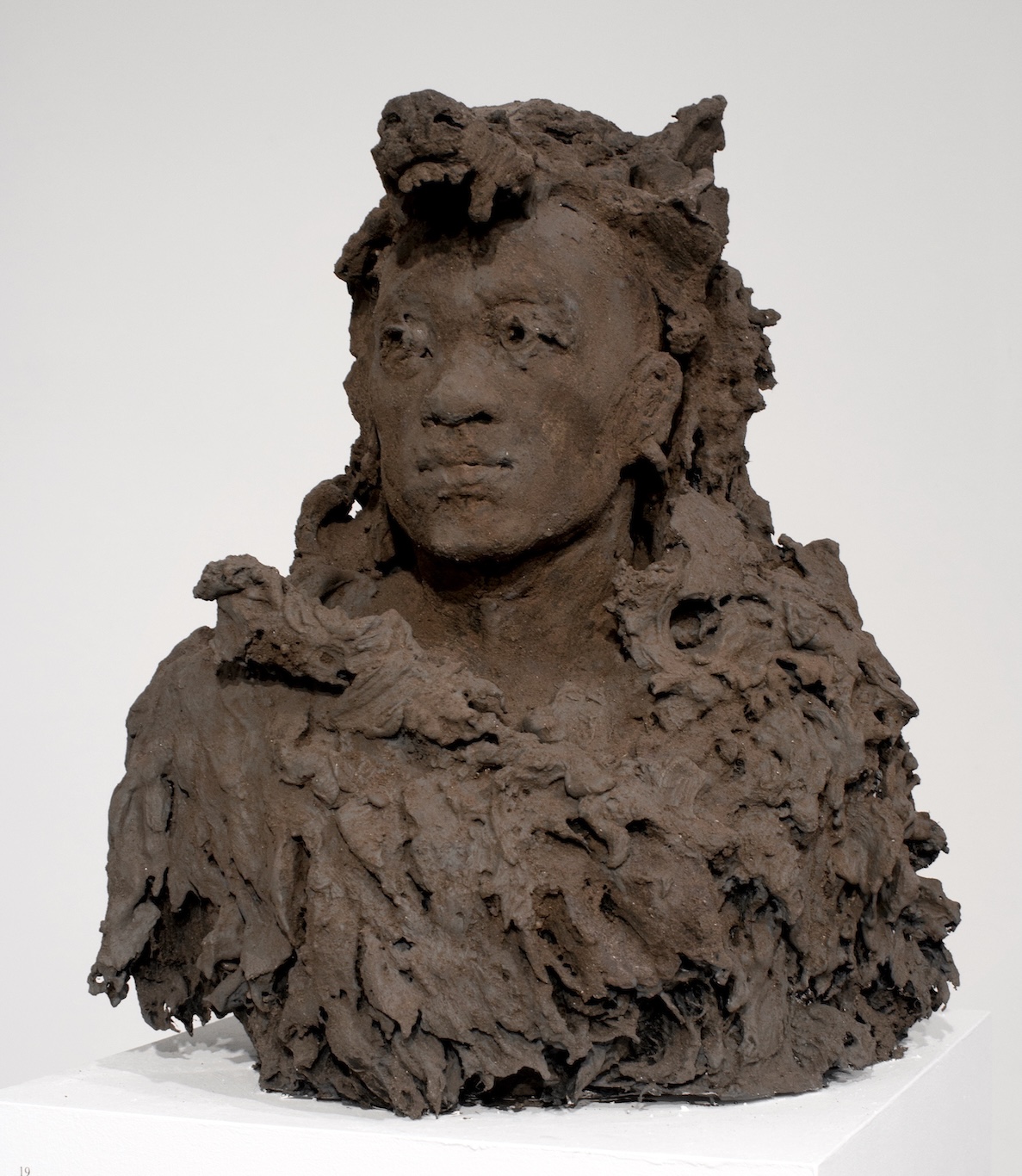
Nicola Hicks, Head of Aesop © the artist
While many of the pieces on display have been made using materials traditionally associated with sculpture – such as plaster, marble and bronze – today’s sculptors are also incorporating more unusual, sustainable products into their work. Last year’s Sedlecka Award winner, Deanne Doddington Mizen, used felted Welsh wool to make her showstopping entry, ‘Audite sine iudicio’, a larger-than-life sculpture of an elderly man mounted on a base made from reclaimed wood. A key highlight this year is Nicola Hicks’ Head of Aesop. Hicks is one of Britain’s best contemporary figurative artists, known for her works in plaster and straw. Her work often has a feeling of metamorphosis, with animals transforming into human forms and vice versa. These themes are very much informed by the ancient Greek fables of Ovid and Aesop.
For the 250th anniversary of John Constable’s birth, Gainsborough’s House, situated at the heart of the Stour Valley in Suffolk, is celebrating with a rich programme of landscape exhibitions. The area, characterised by the River Stour, is famously the birthplace and inspiration of two of Britain’s most influential landscape painters, Thomas Gainsborough and Constable. Their current exhibition features both these artists, and others – notably JMW Turner – and is being held alongside two exhibitions of contemporary art, showing how their influence is still felt by artists today.
The main exhibition at Gainsborough’s House explores the emergence of landscape painting in Britain, led by three of its greatest exponents: Gainsborough, Turner and Constable. It features over 40 oil paintings, watercolours and drawings, mainly from private collections and therefore rarely seen, by these three, as well as by their contemporaries, including the likes of Alexander Cozens, Francis Towne and Thomas Girtin. It also includes several works by their European forerunners, such as Antonio Joli and Claude-Joseph Vernet.
Key works include Gainsborough’s idyllic scene, ‘Landscape with Cattle, a Young Man Courting a Milkmaid’, which has not been exhibited in the UK since 1952; Turner’s large-scale watercolour, ‘Abergavenny Bridge’ which has not been on public display since 1799 at the Royal Academy; and Constable’s dramatic oil sketch, ‘Salisbury Cathedral from the Meadows’, a variant of his ‘great Salisbury’ painting thought to be a study for the mezzotint developed with David Lucas. The exhibition culminates in Constable’s magnificent ‘The Leaping Horse’ from the Royal Academy — in Suffolk for the very first time. This was the final and perhaps greatest of the series of ‘six-footer’ paintings painted between 1819 and 1825 that sealed Constable’s reputation, and which Lucian Freud thought to be Constable’s greatest achievement.
Within their oeuvres, both Constable and Turner, in different ways and different styles, depict the experience of storms and the hope of salvation found within them. For Constable, these storms are personal and political, meaning that the experience and hope found is temporal. For Turner, his storms are reflective of God’s judgment and covenant, meaning that the experience and hope found is eternal. Bendor Grosvenor has described Constable’s ‘Salisbury Cathedral from the Meadows’ as “an emphatic demonstration of the religious sublime”. Constable, himself, commended the understanding that we are “endowed with minds capable of comprehending the ‘beauty and sublimity of the material world’ only as the means of leading us to religious sentiment”.
Constable’s art continues to resonate with contemporary artists and, to accompany this Constable 250 anniversary exhibition, Gainsborough’s House is presenting two exhibitions of contemporary landscape art by David Dawson and Kate Giles respectively.
Dawson has been creating works en plein air in his home country in Montgomeryshire, Mid Wales, and a selection of these will be on display. Painted outdoors in each season of the year, the artist then continues working on them in his London studio before completing them back in the Welsh countryside, taking several years for each one. Having left Wales for London, where he was a student at the Chelsea School of Art, and later becoming a model and assistant to Lucien Freud, these paintings depict an artist returning to their childhood home to explore the nature and solitude of its surroundings.
Suffolk-born and Norfolk-residing artist Kate Giles creates expressive work rooted in her native landscape, specifically drawing on the legacy of Constable. Varying densities of paint contrast and interplay to create seasonal landscapes of twisted trees and chaotic clouds. New work by Giles allows visitors to chart a view of East Anglia from Constable to the present day.
‘In Search of God Through Artists’ by Hassan Vawda – Visit Here
‘Speaking in Tongues’, 4 April – 23 August 2026, ICA LA – Visit Here
Maurizio Cattelan: Confessional hotline 2 April until 22 April – Visit Here
‘El Greco in the mirror: Two paintings compared’, 14 March – 30 June 2026, Papal Palace of Castel Gandolfo, Rome – Visit Here
‘William Blake: The Age of Romantic Fantasy’, 16 April – 19 July 2026, National Gallery of Ireland – Visit Here
‘Mary Magdalene | Apostle to the Apostles’, 8 March to 12 April 2026, Chester Cathedral – Visit Here
‘Light in the Darkness’, 8 April – 17 July 2026, St Andrew’s Church, Wickford – Visit Here
‘George Shaw: Small Returns’, 14 March — 25 April 2026, Persistence Works Gallery, Sheffield – Visit Here
‘Matisse: 1941 – 1954’, 24 March – 26 July, 2026, Grand Palais, Paris – Visit Here
‘Sour Things: The Door’, 17 April – 23 May 2026, NIKA Project Space, Paris – Visit Here
‘Dave: All My Relations’, 26 March–2 May, 2026, Gagosian, New York – Visit Here
‘Qiu Anxiong: Bearing the Unseen’, 24 March – 30 May 2026, Pearl Lam Projects, Hong Kong – Visit Here
‘Anna Ruth: Close Quarters’, 10 April – 23 May 2026, GRIMM, Amsterdam – Visit Here
‘Nicola Turner: Time’s Scythe’, 28 March – 27 September 2026, YSP Chapel – Visit Here
‘Society of Portrait Sculptors: FACE 2026’, 13 – 26 April 2026, The Garrison Chapel, Chelsea Barracks, London – Visit Here
‘Gainsborough, Turner and Constable’, 25 April – 11 October 2026, Gainsborough’s House – Visit Here
‘Inspired by the artwork of Constable and his contemporaries’, 25 April – 11 October 2026, Gainsborough’s House – Visit Here and Here
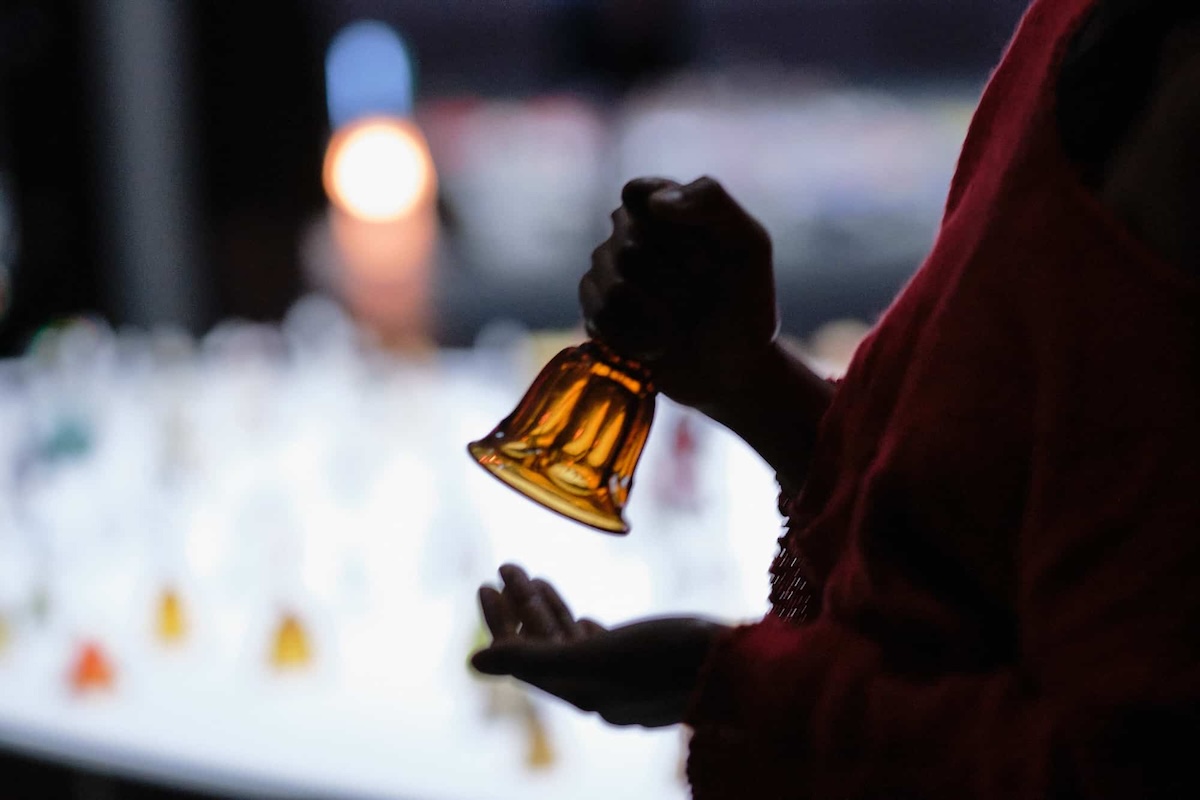
Lead image: Aki Onda, Bells, (2021). Glass, ceramic, and clay hand bells. Commissioned by Portland Institute for Contemporary Art (PICA). Photo: Tojo Andrianarivo.