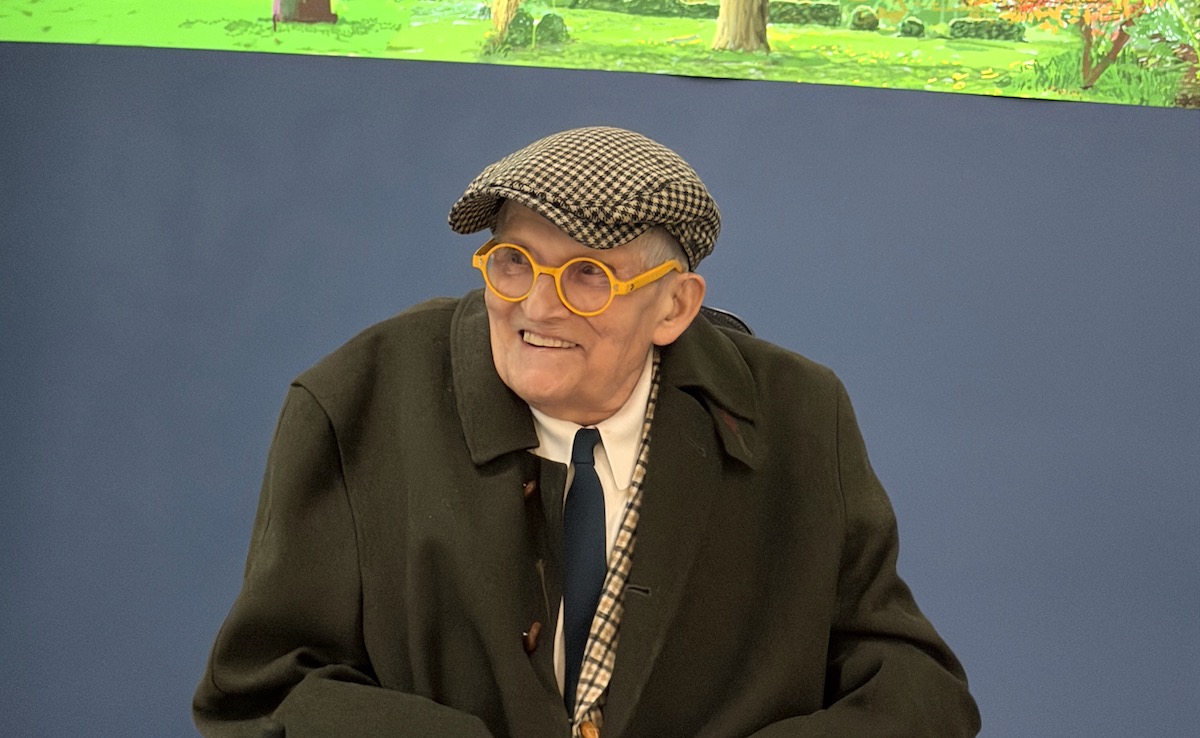
The British Artist David Hockney has died peacefully at home in London, one month before his eighty-ninth birthday. He was perhaps the most celebrated British artist of his generation and, by most measures, one of the most significant painters of the twentieth and twenty-first centuries. His death closes a career spanning seven decades, an output of extraordinary range and restless invention, and a life lived with the kind of open, argumentative, pleasure-seeking intelligence that made him as compelling to listen to as to look at.
He was born in Bradford on 9 July 1937, the fourth of five children, and trained first at Bradford School of Art before winning a place at the Royal College of Art in London, where he graduated in 1962 with the Gold Medal. He arrived at the RCA at an important moment, as part of a generation about to change British art. He stood out immediately. His early work drew on abstract expressionism before he moved decisively toward figuration and linear mark-making, both deeply unfashionable at the time and both entirely his own.
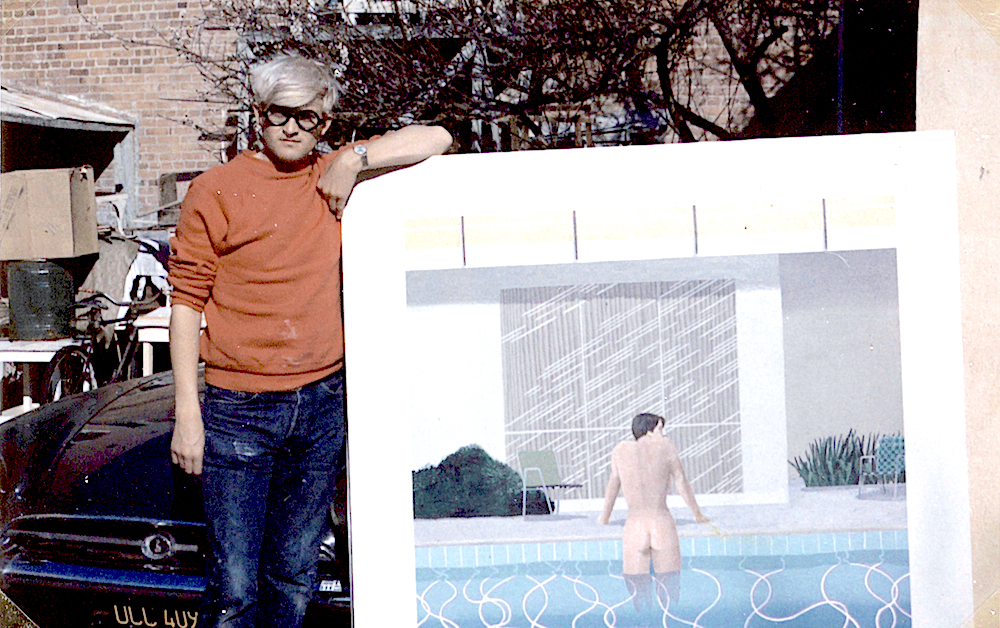
David Hockney (1937–2026) In Memoriam
He moved to Los Angeles in 1964, garnering the subject matter that would make him famous worldwide. The light, the swimming pools, the flat geometries of the California landscape, and the particular quality of life, conducted largely outdoors and largely by the wealthy, produced some of the most immediately recognisable paintings of the century. A Bigger Splash from 1967 and the large double portraits that followed, including Mr and Mrs Clark and Percy from 1971, turned observation into something more complex: an investigation of how people occupy space, how intimacy looks from the outside, and how paint can slow time to a stop. He came out as gay in his early twenties, several years before homosexuality was decriminalised in the U.K. His work often depicted Queer sitters and was unafraid to explore LGBTQ+ themes.
Opera and theatre design ran parallel to the painting throughout his life. Beginning with Ubu Roi for the Royal Court in 1966, he went on to create landmark stagings of The Rake’s Progress for Glyndebourne in 1975 and Turandot for LA Opera in 1990, among many others. His designs for ten productions are still performed decades after their premieres and are widely regarded as definitive visual interpretations of the works.
His intellectual curiosity consistently drove him beyond painting into questions about how images are made and how seeing itself works. The photographic collages of the 1980s used a Cubist logic to challenge the fixed-point perspective of the camera, combining multiple viewpoints into single images that suggested the passage of time. Pearblossom Hwy from 1986 remains one of the most original photographic works of its era.
From the late 1990s, he turned this same investigative energy toward art history, arguing in Secret Knowledge, published in 2001 and developed with physicist Charles Falco, that Western artists had been using optical devices, including camera obscuras, concave mirrors, and camera lucidas, as early as the 1420s. The thesis was initially dismissed by most art historians, who suspected Hockney was implying the Old Masters had somehow cheated. In fact, his argument was more nuanced and more interesting than that: he was pointing out that the ability to capture projected light predated the chemical invention of photography by four centuries, and that the sudden appearance of convincing shadows and naturalistic modelling in European painting around 1420 was not coincidental. Younger scholars have since taken the thesis seriously, and the debate it opened has not closed.
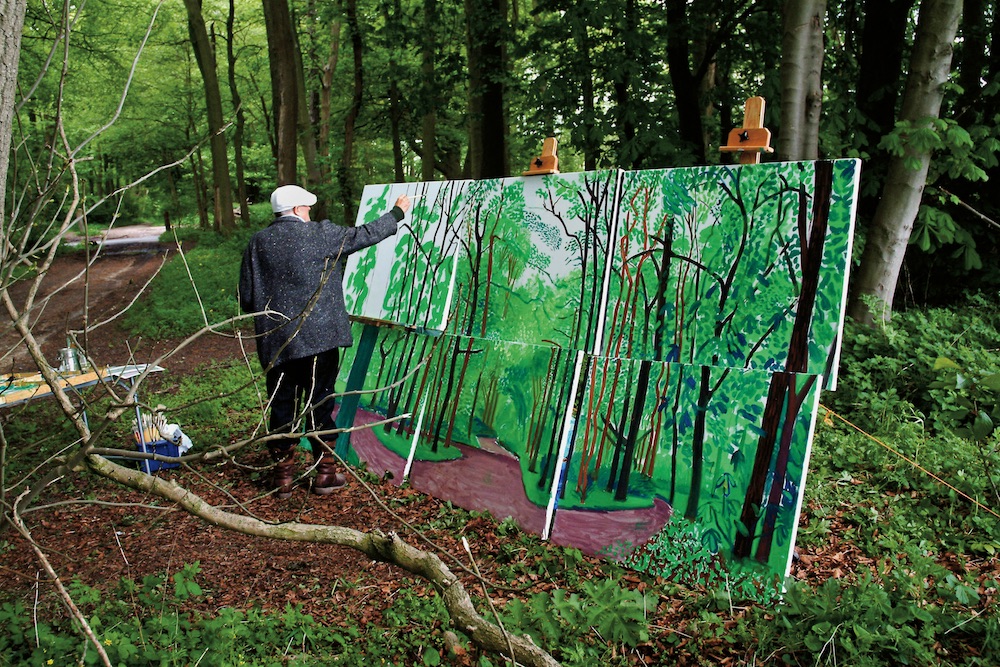
David Hockney Painting, May 17th 2006, Woldgate Woods, East Yorkshire Photo Credit: Jean-Pierre Goncalves de Lima
His return to Yorkshire in the early 2000s produced the large multi-canvas oil paintings of the East Yorkshire landscape and the Midsummer watercolour series. When the iPhone and then the iPad arrived, he adopted them immediately for plein air drawing with a speed and enthusiasm that surprised people who had assumed digital tools were for younger artists. The Arrival of Spring in Woldgate from 2011 and A Year in Normandie, the ninety-metre iPad painting begun in 2020 and partly inspired by the nearby Bayeux Tapestry, demonstrated that he was still finding new ways to think about observation, time and the landscape.
Hockney moved to Normandy in 2019 and then returned to London in 2023. He continued producing new work until the end. The show at Fondation Louis Vuitton in Paris in 2025 was followed almost immediately by two further exhibitions in London, the most recent of which, at the Serpentine North Gallery, is still on view. The paintings in those shows represented the most developed stage of his long engagement with reverse perspective as a pictorial device, work that arrived not as a late summation but as a continuation of the same inquiry that had driven him since the 1970s.
He was appointed Companion of Honour in 1997 and received the Order of Merit in 2012. Earlier this year, he became one of the very few non-French citizens to receive the rank of Officier in the Légion d’Honneur. He was a committed and entirely unapologetic smoker to the end, and a vigorous critic of what he considered the health establishment’s interference in personal freedom.
He is survived by his long-time partner, Jean-Pierre Gonçalves de Lima; his great-nephew, Richard, who worked as his studio assistant in his final years; his brothers, Philip and John; and numerous nieces, nephews, and their children.
Details of memorial events will be announced in due course.