
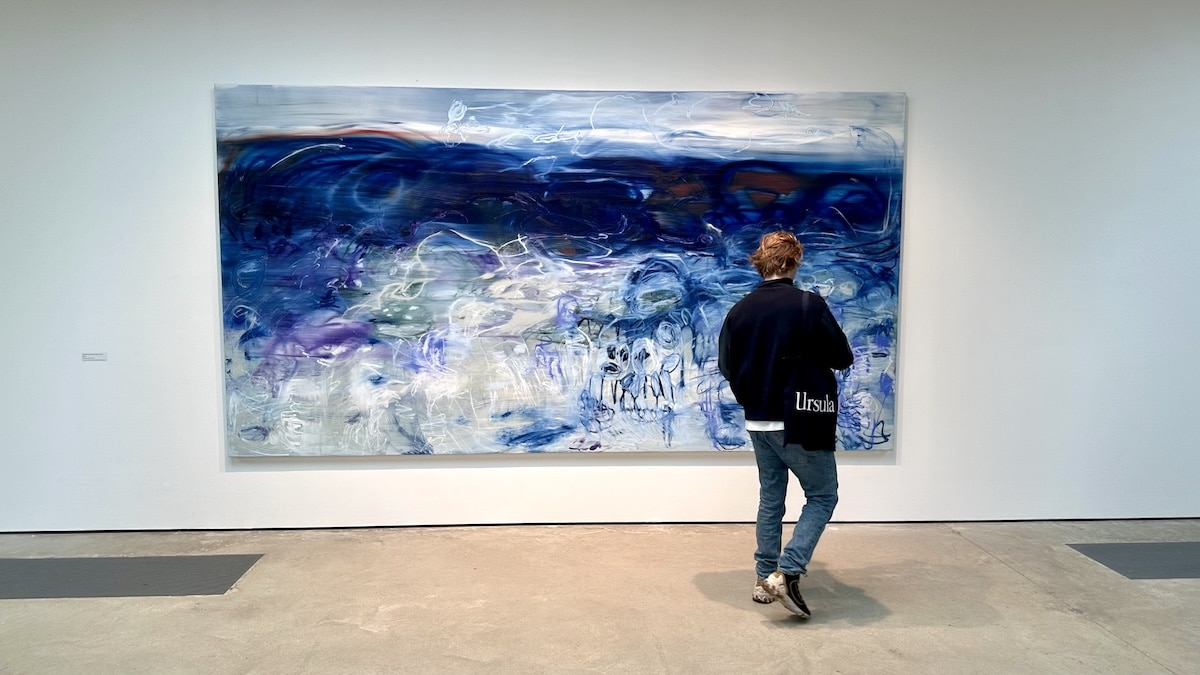
Jude Montague has visited Hastings Contemporary and the De La Warr Pavilion in East Sussex to see their latest exhibitions.
Janaina Tschäpe: Conversations with the Sea / Miguel Roschchild: Undercurrents / Henry Moore / Lucian Freud: Monumental Intimate Truths
Hastings Contemporary
13 June – 13 September 2026
For a gallery situated on the beach, exhibitions about the sea are an obvious fit. These two shows by Janaina Tschäpe and Miguel Rothschild both impressed with their style, scope and technical ambition but in different ways.
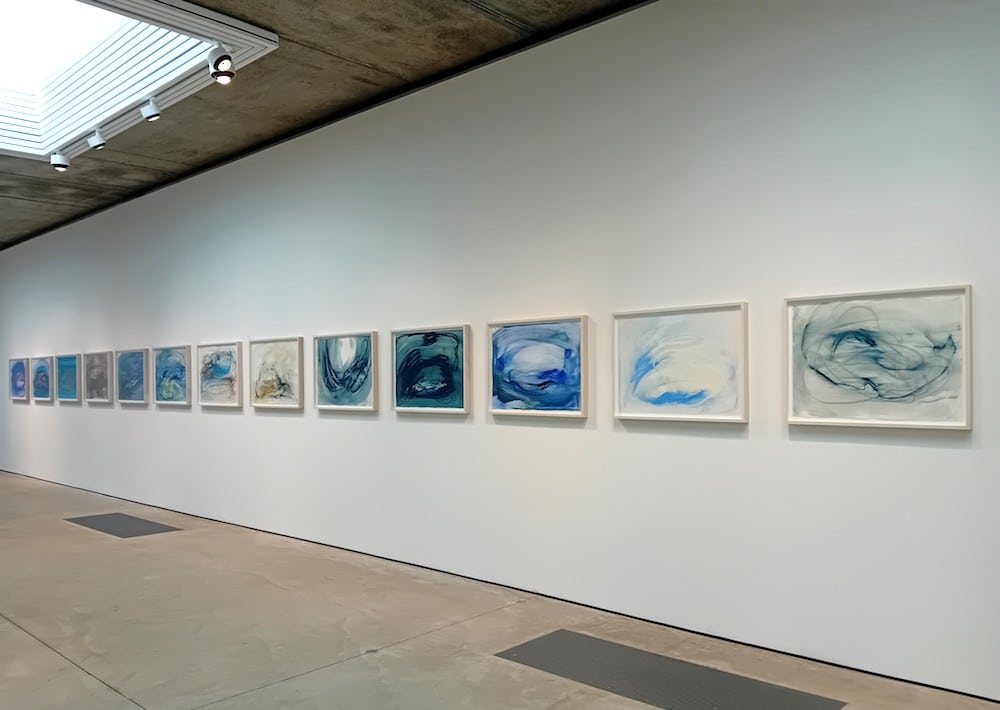
Janaina Tschäpe
This is Tschäpe’s first major solo exhibition in a UK institutional gallery and occupies the largest gallery space of the Contemporary. Yet with the hand-drawn, fluid scribbles of line and colour, the mark-making made from observing the movement and drag and drive of the sea, it felt warm and affectionate. There is love for the sea in every moment of the friendly and charming lines. The series has an abstract quality because there is no human or animal representation, merely close-up different notes of the multiple movements of the ever-changing deep, or rather its surface where sea meets sky. This is not a deep-sea exploration but a study, I imagine, over multiple visits to the dance at the surface of the ocean.
Tschäpe says, ‘For this exhibition by the sea, I have been thinking about water not as image, but as force – as movement that folds, accelerates, disperses and returns. Water organises space through rhythm rather than contour. It resists fixation.’ This statement goes alongside the artist’s visual swirls and scratches, the gestures in oil stick and watercolour, in a long series that could be described as having a musical quality or perhaps a graphic score.
Tschäpe has a multimedia practice, and I was mesmerised by her video piece, He drowned in her eyes as she called him to follow, 2000, Single Channel Video – Tape (Edition of 3, Exhibition Copy). The movie is 20 minutes long, and the cycled tune, a Russian folksong, sung to her mermaid by an older gentleman in a bar serenading her, helps keep the listener focused in on the mesmeric washing images. Watch the whole thing to grab onto the ungrabbable mermaid-self, which disappears into the magical depths of the sea to be called out by the imagination. Or perhaps it will wander, unsummoned, into your dreams. The video shows how Tschäpe’s surface water patterns are a portal, a force that may pull the unsuspecting into the deep, a portal between worlds, dangerous but inviting.
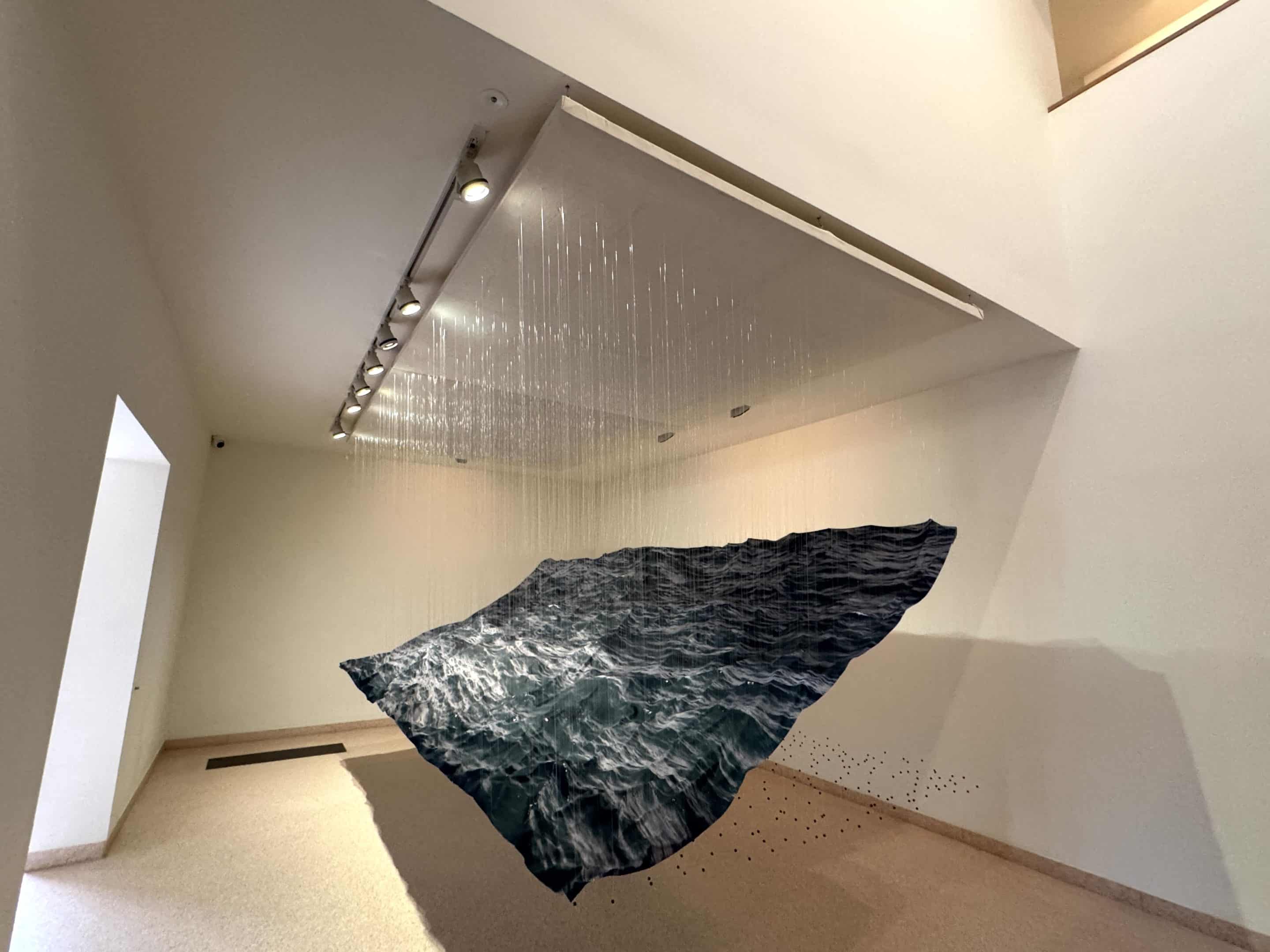
Miguel Rothschild, From the Depths of the Sea
Entering the air-conditioned rooms where Rothschild’s work is hung feels like entering cold water after the warm sea air of Tschäpe’s exhibition area. The media is complex and very impressive; these works of expanded photography are ingenious, craft-intensive and carefully managed.
The scale of his works, in particular, ‘From the Depths of the Sea (2026)’, a meticulously hung piece of printed fabric, weighted with lead balls and suspended on multiple fishing lines, is tactile, vulnerable and tempting to touch; hence the strong message given to not touch. It’s an effective piece, and spending time looking at its structure and texture suggests the power of the sea to awe with its natural aesthetic and wonder from viewing its vast rolling waters.
Rothschild’s pieces suggest the movements of the deep that cannot be seen, and the sense of danger beneath. This is also present in Tschäpe’s work, as both artists use their work to suggest the unseen energies of the ocean. Still, the structures and the cold, restless silence of Rothschild’s photographs have a different emotional draw down to the bottom of the ocean. The two shows work well juxtaposed as they both encourage meditation through gazing at the sea.
Rothschild says, ‘In these works I wanted to confront two dimensions of the sea: the luminous, seductive surface, and the silent, dense, vulnerable depths. Like the front and reverse of a single presence, the ocean reveals and conceals itself in equal measure.’
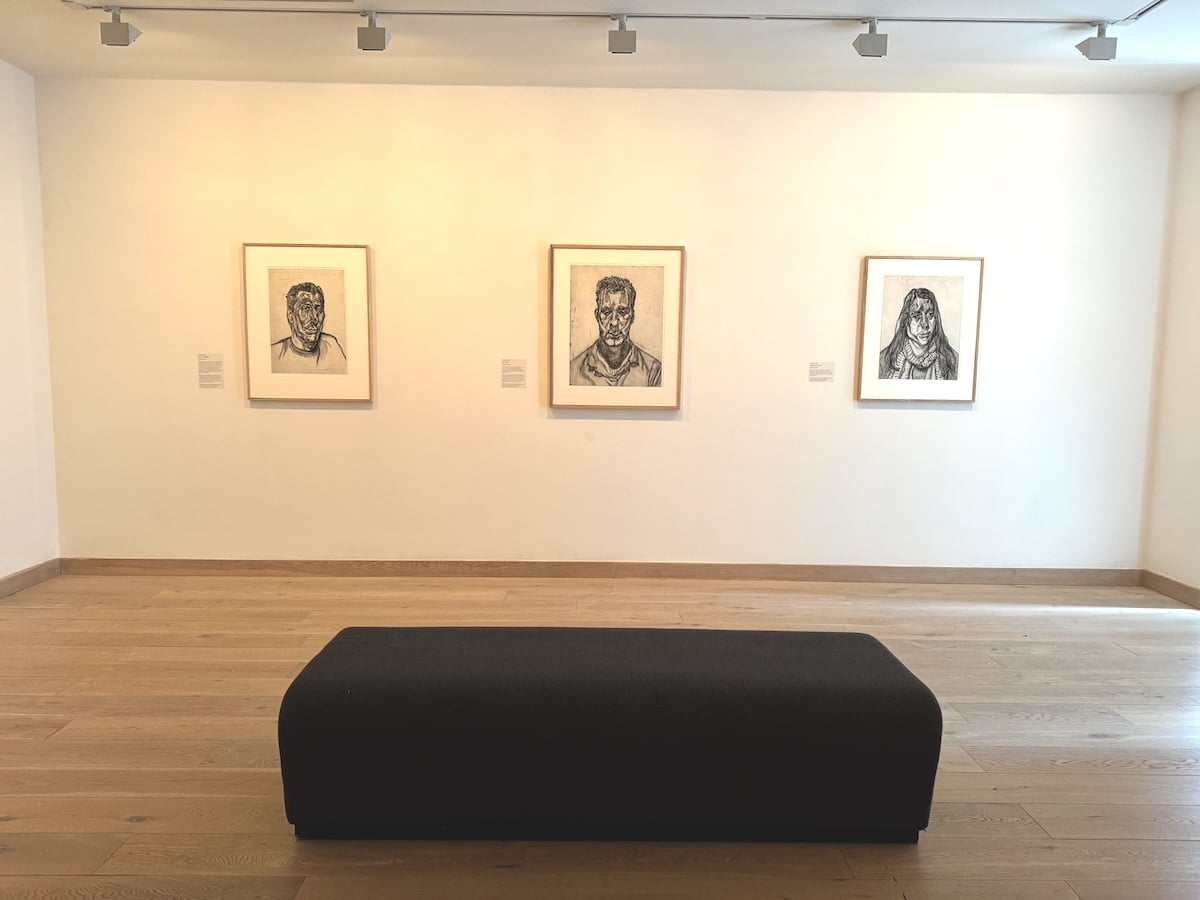
Lucian Freud Drawings, installation view
Upstairs, the works of the British luminaries Lucian Freud and Henry Moore are displayed side by side, of interest to all those interested in drawing the human form. The two artists have been highly influential on contemporary drawing and demonstrate two styles, each artist bringing out different aspects of form. Freud’s angular, particular faces draw out individual qualities and present character in folds, muscles, and contours. Moore’s figures are rounded, mythical and general.
The show foregrounds an amusing pose by Lucian Freud, ‘being a Henry Moore’, captured by the photographer Bruce Bernard in 1983. It’s tongue-in-cheek, a little sarcastic and despite the idea that the painter is becoming the object, there is so much attitude and robust appropriation of the power of art by Freud that he becomes not a Moore but a Freud, Freud being Freud. It’s a fascinating work in any case, and it was this image that inspired Kathleen Soriano, the director and curator of Hastings Contemporary, to bring the two artists together in the show. She chose the subject of family as the theme of the works, and this emphasises the differences in their approach to art and life. The intimate nature of motherhood, successful and frustrated, the roles of lover, children and muse rub uncomfortably against each other.
In current Art History conversations, I hear much judgement on the morality of artists in their own family lives. We not only know more about people’s family lives outside their biographies, but their behaviour is put up for comment. Freud has a famously controversial family life.
Freud fathered at least 14 children by 6 women and was a complex and distant father. The room titled ‘Family’ presents examples of Freud’s detailed etchings. In long sessions in his studio, he drew onto copper plates. Many of the models are friends, but there are many family members; their features are considered and amplified. This long process was when his relatives could spend time with him and occupy the centre of his attention. His daughter, the writer Esther Freud, is pictured here, but not the poet Annie Freud, who was also the granddaughter of the sculptor Jacob Epstein. Annie has written very candidly about how uncomfortable and unusual her relationship with her father was, and about the shock of learning from her siblings themselves about their existence. I would personally have liked to see an etching of her in this room. Perhaps she was not part of this series. But there is an etching of his son Alexander Boyt (Head of Ali, 1999), who was the sibling who introduced himself to Annie, surprising her while she was out. This portrait of Ali shows his struggle with drug dependency. Apparently, his father made a concerted effort to spend time with Ali after he went off the rails, and this time was significantly spent in the studio, being drawn. Knowing the background of this family story adds a real sadness and poetic depth to the power of this dramatic portrayal. He was a dominating parent despite his distance, but famously remarked to Victor Chandler that he felt no guilt over his own behaviour as a father, despite asking his 14-year-old daughter Annie to remove her clothes and teenage inhibitions so he could draw her.
In contrast, Henry Moore was a monogamist. He had one beloved wife, Irina Radetsky, and one much-awaited child, Mary, born after many years of miscarriages. The contrast between the two artists highlights the Christian values of compassion and mercy towards others, and his mother-and-child works echo Renaissance treatments of this holy bond. Moore came from a coal-mining background in Castleford, Yorkshire. Irina came from Kyiv, and her father had been killed in the Russian Revolution, but she found security in her marriage to Moore. She continued to be his model, and after Mary’s birth, he produced many more mother-and-child figure groups. I think it is Moore’s connection with the long history of art, reaching from images of the Christ-family and the Madonna-and-child to the early figurines of pagan mother goddesses, that makes his work so loved as public art in outdoor spaces. The generic, rounded, eternal aspect of his work, which looks through the image of the family into the infinite, is relatable to all, seeing the world in a grain of sand.
Soriano, by juxtaposing the two artists’ work, brings out the qualities of both. Her curation encourages reflection and an individual but educated response (for those who wish to read the carefully written and informative notes) from those who visit. The activity room, with pens and paper and exhibition-hanging lines for visitors to draw their own portraits and life-drawing, is popular, and the displayed pieces show how Freud’s portraits stimulate and inspire others to create their own portraits. On my perusal, I felt that Freud’s approach was most inspiring to visitors in their sketching.
Visit Here
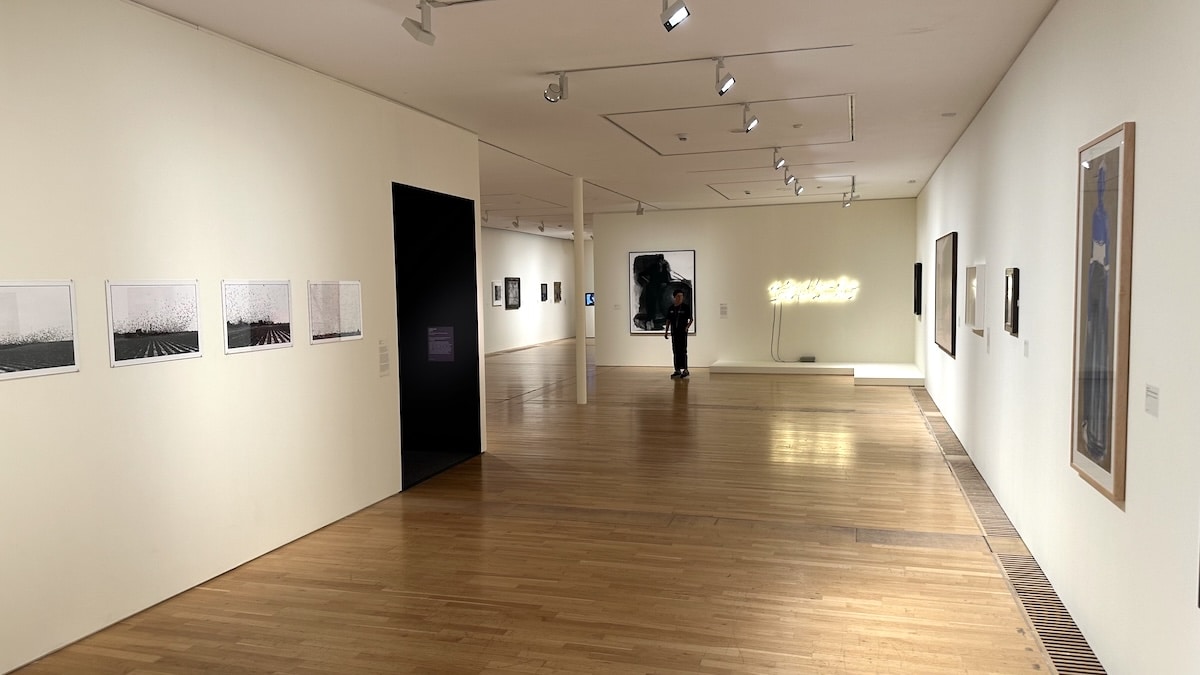
To Improvise a Mountain: Lynette Yiadom-Boakye Curates, installation view
To Improvise a Mountain: Lynette Yiadom-Boakye Curates
De La Warr Pavilion, Bexhill-on-Sea:
27 June – 13 September 2026
The Hayward Gallery Touring has worked with Lynette Yiadom-Boakye, one of the foremost painters in the UK and internationally, to present an exhibition of paintings and mixed-media works, shown alongside selected works by the artist.
I first encountered Yiadom-Boakye’s work at the Guggenheim in Bilbao. I was struck by her theatrical, thought-provoking characters, the inner worlds they presented, and her expert use of paint and colour. In this exhibition, I was excited to learn more about her process and influences. In this respect, particularly in the context of paint, colour choices, and style, the standout comparison was with the Walter Sickert paintings. To see Sickert’s ‘The Blackbird of Paradise’ (c. 1896-98) next to one of Yiadom-Boakye’s portraits is a shaft of light in a dark corner. In the light of the gallery, the dark brown spaces pull me into the subversive worlds of these vivid figures that live their life in the shadows.
A new artist to me is the painter Lisa Brice, a South African painter from Cape Town who also brings figures out from the shadows, her focus on the models, painters, wives, mistresses and performers, peering out from behind the studio curtain. As in Yiadom-Boakye’s work, a sense of inner life is present, and although the canvas surfaces invite you to dwell on the luxury and handling of the paint, you are constantly drawn into the imagined inner worlds of her subjects. The figures step out of the darkness but are still in a twilight zone, in half-light, peering from behind a door that I feel could shut on me at any moment. Their visibility is precarious.
Yiadom-Boakye portrays her figures in settings that are not pinned to a particular time. They float, stand, relax, stare, sometimes out of the painting; more often, their gaze is elsewhere, part of a narrative that is taking place behind the theatrical wall, allowing the viewer’s narrative to develop. I imagine their lives beyond the moment. There is the idea that these figures will step off the scene shortly to continue their activities, whatever they might be. There is an indication, but few clues, as to what these characters will be up to when the charcoal is put down and the paintbrush washed. Scenes by both Édouard Vuillard and Pierre Bonnard illustrate how a simple interior can suggest a fuller life for the figures who occupy those environments, allowing less detail to communicate powerfully.
Yiadom-Boakye’s words are also the kind of poetry that floats over space, resisting the specific draw of a particular brand name, or the kind of fashionable item that might suggest a particular year. However, perhaps there is the suggestion that the artist and the powers that artist conjures can fly across centuries.
‘To Improvise a Mountain.
Is to distinguish a dagger from a musket
And still come up swinging,
Much like the Asante.’
The mention of the Asante people reminds the viewer of Yiadom-Boakye’s Ghanaian heritage and her contribution to the current renaissance in painting Black or people of colour, from her imagination influenced by multiple sources, some of which we can encounter here.
For anyone wishing to develop their own world inside paint, or any other type of art, and who reflects on how a writer might world-build without detailed maps and concultures, I would not hesitate to recommend this constructed collection of pieces. They may at first seem somewhat disconnected, but with careful contemplation, they yield many insights into how an artist’s mind might work and develop a process. The show speaks of the lifelong work of art, not just in the studio placing brushstroke upon brushstroke, but of finding inspiration in the world around, from reading, from writing poetry, from listening to particular music (for Yiadom-Boakye the jazz experiments of Miles Davis, John Coltrane and Bill Evans).
The gallery has been transformed for this exhibition, with a substantial wall built blocking out the light from the window. The curator, João Conceição, explains that, although this is a touring show, the De La Warr sought it out and was very keen to accommodate it, as it has a variety of works of interest for different members of the audience at the De La Warr. The potential of this show to sell itself could be described crassly as ‘come for the Sickerts, stay for the Yiadom-Boakye’.
Visit Here