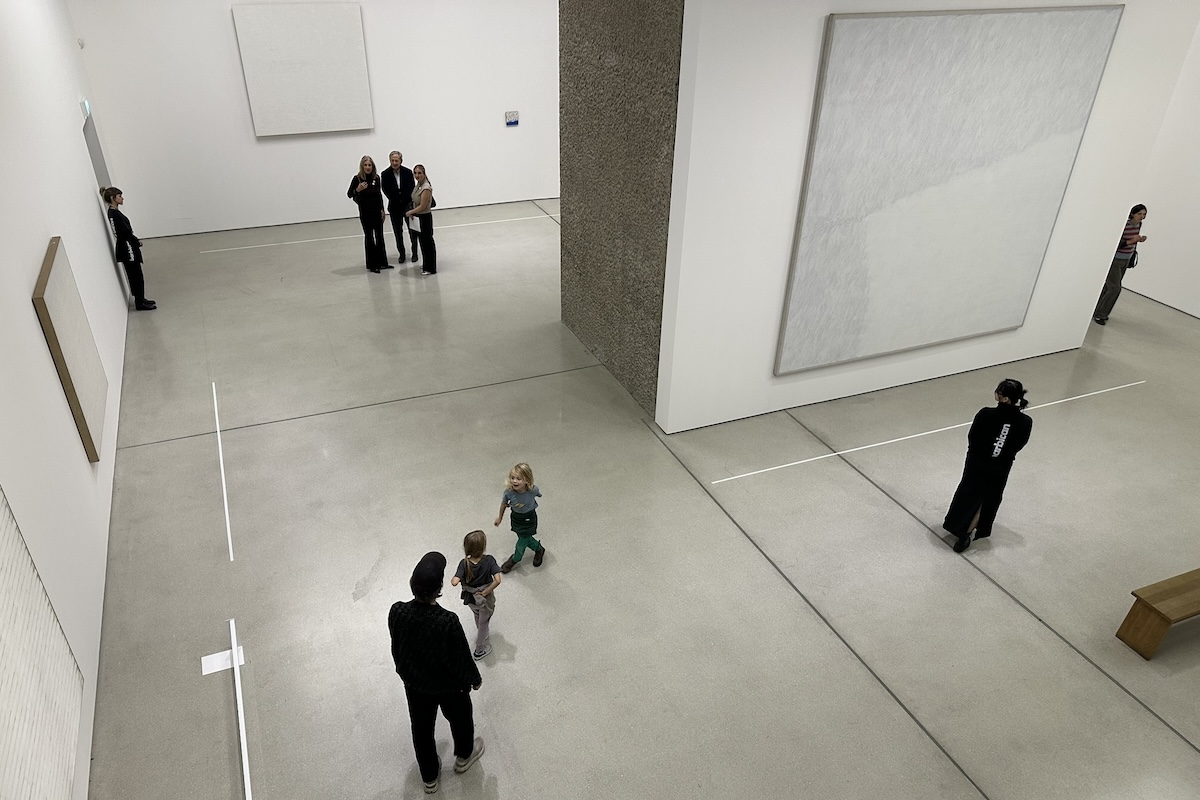
The Barbican is a fitting home for Robert Ryman’s The Real Thing. Its concrete is stern and unfussy, and so are his paintings. At a glance, many look like primed canvases, but his paintings are about careful looking, and they repay the effort handsomely.
Now, I have had a running argument with a friend for years concerning who created the ultimate white canvas. Names like Jasper Johns (White Flag) and Agnes Martin have appeared on the list, but after experiencing the Ryman show, he wins hands down.
Look harder and things begin to play up. Afterburn and snowblindness, the appearance of muted-coloured grounds peeking through the pale layers, lending a faint warmth or chill.
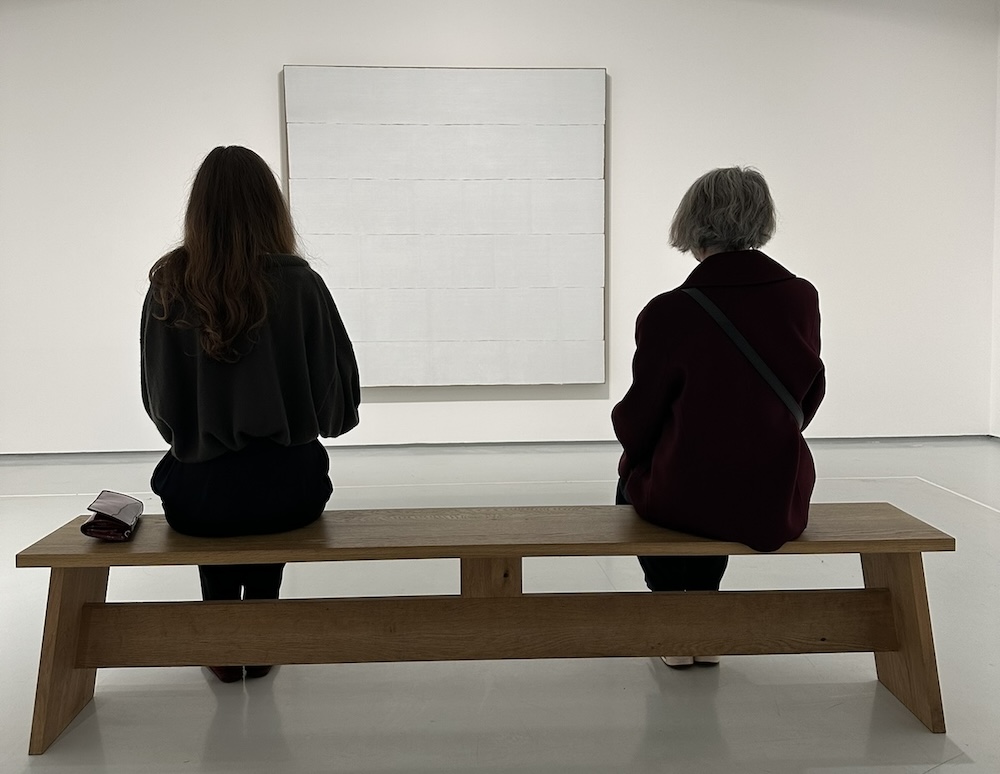
Robert Ryman At The Barbican Photo: P C Robinson © Artlyst 2026
Writing about this genre of painting is a tricky business. Ryman made a career out of variations of white, and describing them can sound pretentious to many. Yet the work can also be read as a denunciation of art’s long dependence on language. These are naked paintings. There is paint, a flat support and fixings to the wall. Nothing tells a story. They are not outwardly political. Or are they? Subversive theory needs to be absorbed first. You stand there with the materials and see how the paint sits and how it tosses the light. The real question is simple. How much do you enjoy looking at paint? In The Painted Word, Tom Wolfe stated that when “Art reaches the vanishing point”, it is finished—the elephant in the room of Minimalism —but this has never materialised.
In the diffused gallery light of the Barbican, against the warmer white of the walls, a painting turns a grey blue. The eye judges any colour by its neighbours, so a difference you could not see a minute ago becomes dramatic. That is Ryman’s trick. By narrowing his focus to almost nothing, he opens whole worlds inside it. Within that tight field he could do nearly anything. Different whites let you follow his hand as it turns from delicate to heavy, rough texture, then to exacting blurs of grey-white.
The curation is careful. Ryman died in 2019, aged 88, but his hanging methods have been rebuilt with care. The same waxed paper and tape hold the Surface Veil paintings to the wall. Staples, pencil lines, masking tape and paint spilling past the edges all remain. Other artists hide such things. Ryman left them in. He removed the meaning others were desperate to display. Intellect was beside the point, and the act of making came first. He insisted, despite appearances, that he was a realist.
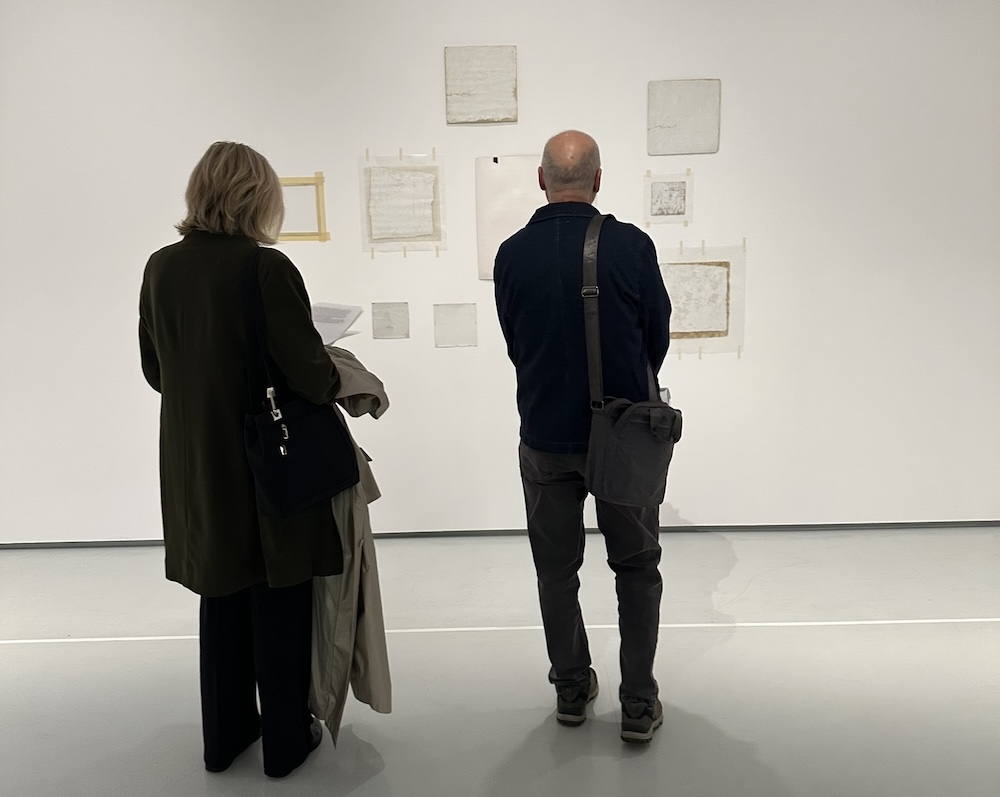
Robert Ryman At The Barbican Photo: P C Robinson © Artlyst 2026
The Barbican’s installation makes this possible. Everyone knows the show is demanding, even for believers, so benches steer you towards works that reward a long stare. The wall texts are admirably clear, yet they have been moved off the pristine walls and into a well-designed pamphlet. Even so, as my eye tuned itself to the tiniest shifts of white, returns began to diminish. A nagging thought crept forward. Does any of this matter? Is it merely connoisseurship for its own sake?
Ryman’s work has been accused of trickery. Past critics have said that the emperor’s new clothes are at work. Ryman never wanted grand theories to defend his paintings, and stated: “I will not supply one”. He pursued an elusive sense of wellbeing and rightness, which might be a harmonious arrangement of similar parts. His unframed canvases melt into the white walls, so that rightness belongs as much to the architecture as to the paint. The gallery feels like a cathedral, as a 1960s melodrama might picture it.
Perhaps I am not ready for a heavenly intervention. I began to feel as if I were immersed in a black-and-white television studio, sealed off from the world outside. The upheavals Ryman lived through, which the catalogue duly notes, cannot get in. Nor can ours. His concentration on a thin band of colour may offer brief shelter from the stories pressing on us. But no colour is neutral, and no room is either. At this moment the show feels less like a confrontation with reality than a retreat from it.
Born in Nashville, Ryman studied in Tennessee in the late 1940s and served two years in the Army Reserve. In 1952, he moved to New York to play jazz. A year later, he took a job as a MoMA guard. Seven years among the paintings helped turn him towards painting himself.
I enjoyed this show a great deal, which helps, since it is my job to explore the more difficult genres of painting. If you share the taste, parts of this exhibition will stop you cold. – PCR
Top Photo P C Robinson © Artlyst 2026