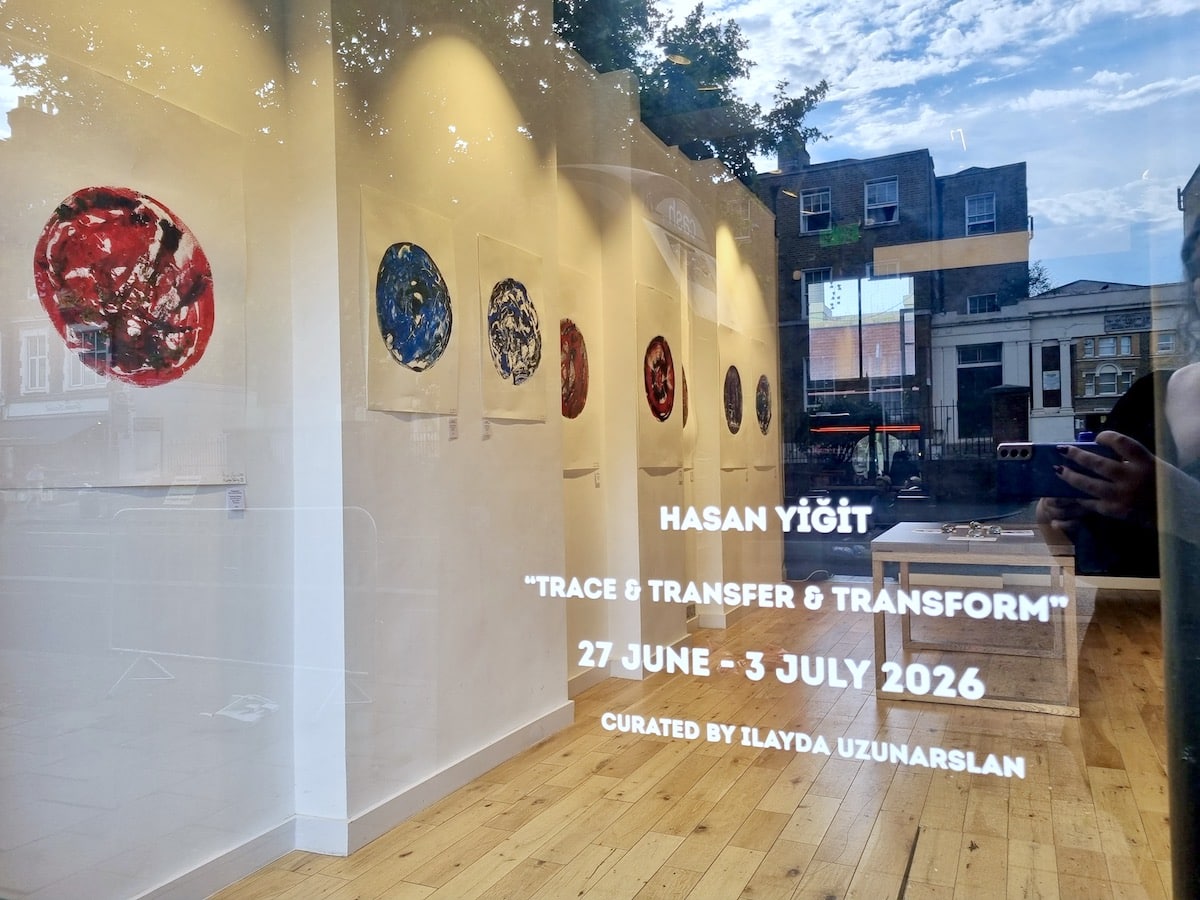
Turkish artist Hasan Yiğit’s recent solo exhibition at Versus Arts London (from 27 June to 3 July 2026) – titled Trace, Transfer, Transform – marked a significant development in the artist’s ongoing visual exploration of abstraction, memory, and printmaking processes.
Curated by Ilayda Uzunarslan, the solo exhibition featured a series of vibrant monotype prints in bold primary colours that push the boundaries of printmaking by merging abstract expressionist painterly techniques with conventional printmaking.
Hasan Yiğit was born and raised in Bursa, Turkey, and has lived in the UK and Thailand. Consequently, his visual language has been shaped by his formative years and an increasingly international perspective. His surroundings and travels inform his lexicon as an artist through geographical and cultural references, which he translates into an intuitive vocabulary of colour, gesture, texture and movement. The circular prints he exhibited at Versus Gallery could be seen as abstracted versions of elements informed by his memories, landscapes and experiences.
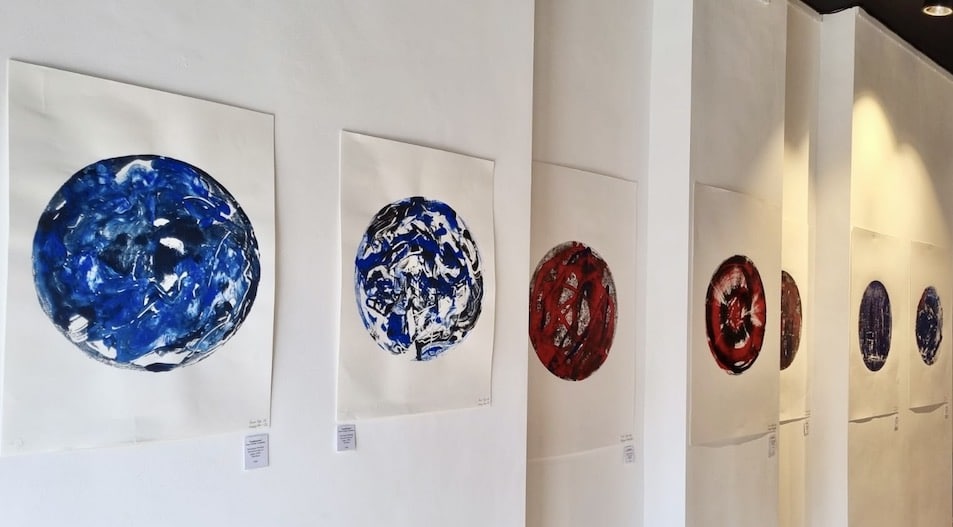
Installation view of TRACE, TRANSFER & TRANSFORM, Versus Arts London, 2026.
Yiğit’s gestural printmaking is bursting with movement and drama, demonstrating an affinity with Abstract Expressionism and echoes of Jackson Pollock’s dynamic application of paint and ink. As demonstrated in the monoprinting techniques Yiğit utilises in his Versus Gallery exhibition and in a previous exhibition of circular monoprints in Thailand, he departs from the Abstract Expressionist movement’s emphasis on painting by embracing monotype printmaking as a form of abstraction.
Visually, Yiğit’s monoprints remind me of expert printmaker Bryan Nash Gill, who was renowned for direct printmaking work influenced by nature. Yiğit’s monoprints are full of texture, with distant echoes of 18th-century artist William Blake, who was among the first to explore monotype printing as a means of creating textured works.
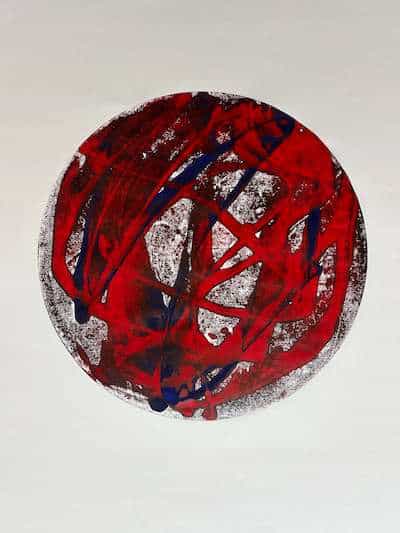
Hasan Yiğit, Transfer VIII, monotype on paper
Running through Yiğit’s work is an element of unpredictability, with images constructed directly onto a circular glass plate using water-based inks before being transferred onto paper. This technique creates subtle shifts in colour and texture, and distortions in the image that show a human touch. The result is images that are, on the one hand, calculated in that Yigit uses the technical process of monoprinting, but also exist somewhere between intention and chance. In his series of prints at Versus gallery, technical control of the printmaking process gives way to the agency of the ink and drama of the primary red and blue palette.
Yiğit chooses a recurring circular format, as seen in his London and Thailand exhibitions, using a 50-centimetre glass plate that provides compositional structure and a conceptual frame. The circular format suggests the human eye or a mirror, creating contained fields of vision that could be metaphors for the cycle of memory or the cyclical nature of life, death, and renewal. This is most prominently demonstrated in Transfer VIII, a monotype print with water-based ink featured in Yiğit’s Versus Art London exhibition.
His choice of dramatic blood-red and sea-blue generates drama and emotional tension in the Versus Art London exhibition, with red conveying a sense of urgency or danger and blue offering stillness and contemplation. Displaying the circular monoprints in a series on one wall accentuates the feeling of drama and shifts of emotion.
Standout works such as Transfer VIII featured in Trace, Transfer, Transform suggest that Yiğit’s technical ability and emotional depth as an artist have developed since his earlier exhibition in Thailand, where he first explored the circular monotype format. His London exhibition displays greater compositional confidence and a playful, free approach towards abstraction. He translates the physical action of painting and printmaking into a visual meditation on nature, culture and the circle of life.
Review by Lee Sharrock