
For the September Art Diary, we go travelling – to a variety of different locations and countries, across thresholds, and into the past. Locations visited include: Colchester, Durham, London, Melbourne, Milan, New York, Pollença, Salisbury, Salzburg, and Southampton. Featured artists include: Balraj Khanna, Anselm Kiefer, Luis Maraver, Andrea Modica, Isabel Nolan, and Sean Scully. Also highlighted are sculpture exhibitions including ‘Frieze Sculpture’ and installations by Rachel Kneebone and Zak Ové.
We begin in Pollença at the Dionís Bennàssar Gallery where ‘Luis Maraver: Traveling’ is to be found. María de la Pau Janer writes: “Luis Maraver believes in chance: that volatile magician who arrives suddenly, with unexpected surprises. The painter likes to surprise and be surprised. He surprises us, captivating viewers with the power of his work. He surprises himself, in a creative process that never falls into routine, maintaining just the right degree of exploration and restlessness. This constant search may be the best definition of his work: the pursuit of forms and nuances, of colours and materials. The painter begins an endless game with chance, a game without marked cards.
He who seeks is always a great traveller—a traveller along the paths of the earth, but also through the vicissitudes of life. Curious spirits do not adapt to mental stagnation, but rather journey through the world. Sometimes with hurried or lost steps. Sometimes through thought. A memory capable of recovering images, of reliving the hues of recollection, of feeling again those emotions that leave indelible marks. Maraver knows that his travels transport him to magnificent landscapes, to distant places from which he returns wiser. Perhaps he also senses that the best journeys lead him to lose himself in the corners of his innermost world. The one that allows him to transform lived experiences into art.
Our gaze places us at the threshold of the world. To look is always to discover. It stirs that curiosity that defines humankind—the desire to know, to find, to question—and that enables artistic creation. The best works of art are the fruit of an enormous curiosity, hungry for life. Curiosity is the antithesis of routine, of wandering along a path of concentric circles that lead us to the same place. Instead, it is related to research that involves experimentation and risk-taking. That is why the painter chooses risk when exploring pictorial worlds.”
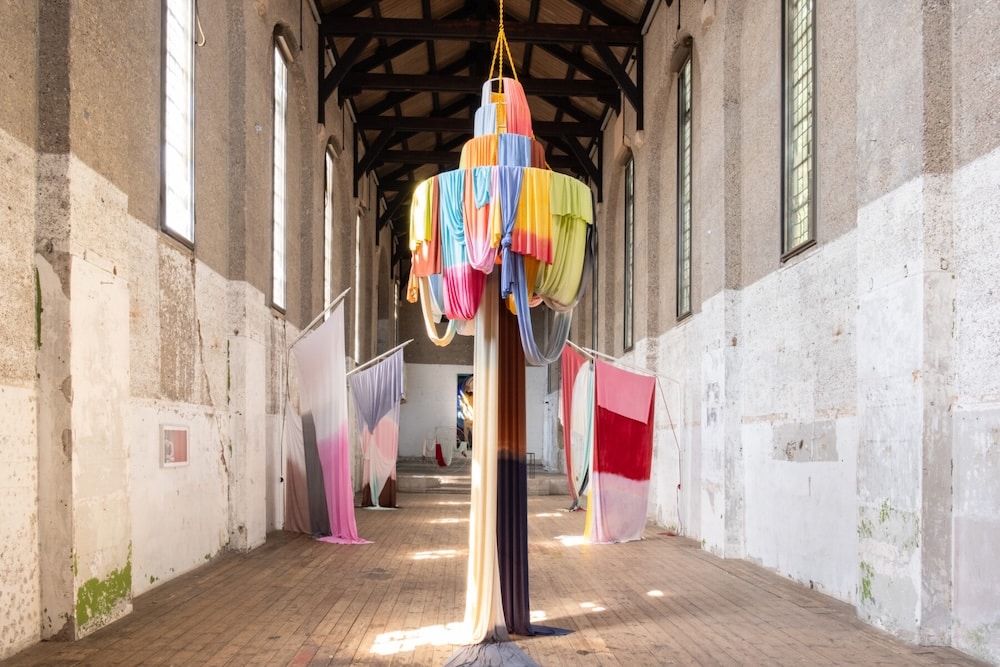
Isabel Nolan, Some Fundamental Forces 2026, Southwark Park Galleries, installation view © The Artist Photo © Rita Silva
Next, we come to London where Isabel Nolan (who is currently representing Ireland at the 61st Venice Biennale) explores ‘some fundamental forces’ in a touring exhibition that launches at Southwark Park Galleries before travelling to Bluecoat, Liverpool in 2027. This first comprehensive solo exhibition of Nolan’s work in the UK encompasses works from 2005 to 2025 and includes painting, drawing, sculpture, installation, photography, and tapestry.
Nolan’s powerful work makes the case that art can go beyond merely documenting the world, asking us to look to our place in the universe as well. Her interest in a variety of viewpoints- historical, scientific, and spiritual offers a sweeping perspective beyond our present situation. Using traditional materials such as painting, steel, pencil and textile, Nolan’s work confronts the viewer with a rich aesthetic and urges them to think beyond the here and now, and to look to the vastness of the cosmos.
‘The Alchemists’, a new and impressive exhibition by Anselm Kiefer, is part of the cultural programme of the Milan Cortina 2026 Winter Olympic Games. Curated by the art historian Gabriella Belli, the exhibition is set up in the Sala delle Cariatidi of the Royal Palace. ‘The Alchemists’ was born from a project started in 2023 and presents over forty large canvases, specifically conceived to dialogue with the dramatic beauty of this place scarred by the bombing of 1943.
Central to this is the connection to Milan, the city where Caterina Sforza, a scientist and military leader, spent her youth, author of a rare manuscript containing over 400 recipes, including medicines and alchemical formulas. Alongside her, Kiefer summons a constellation of female figures, both well-known and forgotten: from Isabella Cortese and Maria la Giudea to Marie Meudrac, Rebecca Vaughan, and Mary Anne Atwood. Through his material and symbolic painting, the artist restores faces and bodies erased from history, acknowledging the crucial role of female alchemists in the birth of modern scientific thought. Since debuting in the early 1970s, Kiefer has investigated the creative and redemptive powers of women, here translated into a female pantheon that intertwines myth, memory and regeneration.
‘The Lost World: The Art of Minnie Evans’ takes us to North Carolina (the home of Minnie Evans) and New York (where a major solo exhibition was held in 1975). Inspired by vivid dreams and visions, Minnie Evans made her first drawing in 1935 after the death of her beloved grandmother. During the subsequent decades, the artist created hundreds of radiant pencil and crayon drawings, oil paintings, and collages that combined imagery from her Afro-Caribbean heritage, mythology, religion, popular culture, decorative arts, and the natural environment of her native Wilmington, North Carolina. Her dense, kaleidoscopic compositions include images of angels, mythical creatures, watchful faces, and intricate patterns that suggest harmony and transcendence amid hints of an unsettling disquiet. At once evocative and mysterious, these works imagine a protective, spiritual province that existed before the great flood in the Bible—what the artist referred to as the “lost world.”
By the 1960s, Evans’s work had begun to garner national recognition. After small gallery exhibitions in Wilmington and New York, she was profiled in Newsweek in 1969. Group exhibitions at museums followed shortly thereafter, leading to a one-person exhibition at the Whitney in 1975. More than five decades later, this retrospective offers an opportunity to experience the visionary merging of the everyday and the divine that runs through Evans’s work.
Two concurrent solo exhibitions in New York of acclaimed American photographer Andrea Modica bring together complementary bodies of work exploring womanhood, identity, and Italian American heritage through the traditions and expectations that have shaped generations of girls and women. A professor of photography at Drexel University, whose career spans more than four decades, Modica is known for her intimate black-and-white portraiture and longstanding commitment to traditional photographic techniques. Working primarily with a large-format 8×10 camera and hand-printing her photographs using traditional processes, Modica creates tonal images characterised by a close and often deeply personal engagement with her subjects.
‘Andrea Modica: Catholic Girl’ at AMR Art DUMBO presents 19 photographs from Modica’s 1984 series portraying students at all-girls Catholic high schools in South Brooklyn and New Haven. Made early in her career, the photographs focus on young women navigating adolescence within the structures of Catholic education, capturing moments of intimacy, friendship, self-expression, and transition. ‘Andrea Modica: Italian Story’ at the Alice Austen House brings together 39 platinum prints created over more than four decades of Modica’s travels across Italy, beginning in the mid-1980s. Rooted in Modica’s Italian American heritage and her experience of returning to the culture that shaped her upbringing, ‘Italian Story’ traces her encounters with Italy through portraits of its people alongside photographs of landscapes, interiors, rituals, and everyday life. Together, the photographs form a deeply personal visual record of Modica’s evolving relationship with Italy.
This collaboration reflects the shared commitment of both institutions to championing the work of women artists and expanding opportunities for audiences to engage with significant voices in contemporary photography. Together, Alice Austen House and AMR Art Dumbo celebrate the enduring power of photography to explore identity, memory, family, and place while reinforcing the importance of collaboration in advancing the visibility and recognition of women artists.
‘Walls and Windows’ at The Minories in Colchester reveals forgotten mythological viewpoints lost to us through the demonising of women and animals, as the exhibition bids to reconnect the lost heritage of our Anglican tribal communities. The exhibition features a selection of artwork exploring the theme of empowerment. Through contextual reframing, this work opens up a diverse exploration about what our truth really is. How have abuse and selfish acts of non-consensual violation of our land and bodies ruptured our ability to stay tuned to nature? And in doing so, separated us from the birthrights all living beings have: to know and navigate the fabric of the world around them. The artworks in the show seek to reopen the vistas of our mind after trauma has caused us to shut off.
‘The (Un)Holy Trinity’ by Laura Jean Healey draws inspiration from three legendary ‘fallen’ women from Biblical times, Eve, Lilith, and Salome, who, through their supposedly ‘unnatural’ acts of defiance, aggression, or desire for autonomy, have been demonised throughout the ages, serving as a warning of the destructive nature of unchecked female sexuality. ‘He Who Came’ and ‘She Who Bore It’ by Antonia Layzell, is a transgender story of change and disillusion. These paintings were created when Antonia’s partner was coming out as transgender. They honour a powerful time of change, internal shadow hunting and self-empowerment. ‘True North’ by Nico Harbridge, a series of constructed paintings made from scavenged materials found in her natural environment, guide us home through a process of reorientation with nature. ‘Mythos’ by Peter Day explores the invisible stories that shape who we are. Formed by hundreds of intertwining lines, his sculpture evokes a web of memory, ancestry, belief and imagination. Each strand follows its uncertain course, yet contributes to a greater whole – a reminder that identity is not singular but woven from countless narratives passed through generations. ‘Mythical Imagination’ by Maija Liepins is a living archive of storytelling taken from explorations within her dream forest. Maija guides us through internal stories and dream work that contain archetypes from well-known, revisited fairy tales. Also included in this exhibition are works by Dennis Coote, Caroline Stannard, Wyn Haythornthwaite, Rebekah Wallace, and works taken from the Victor Batte-Lay Collection by Clare Iles and Ted Atkinson.
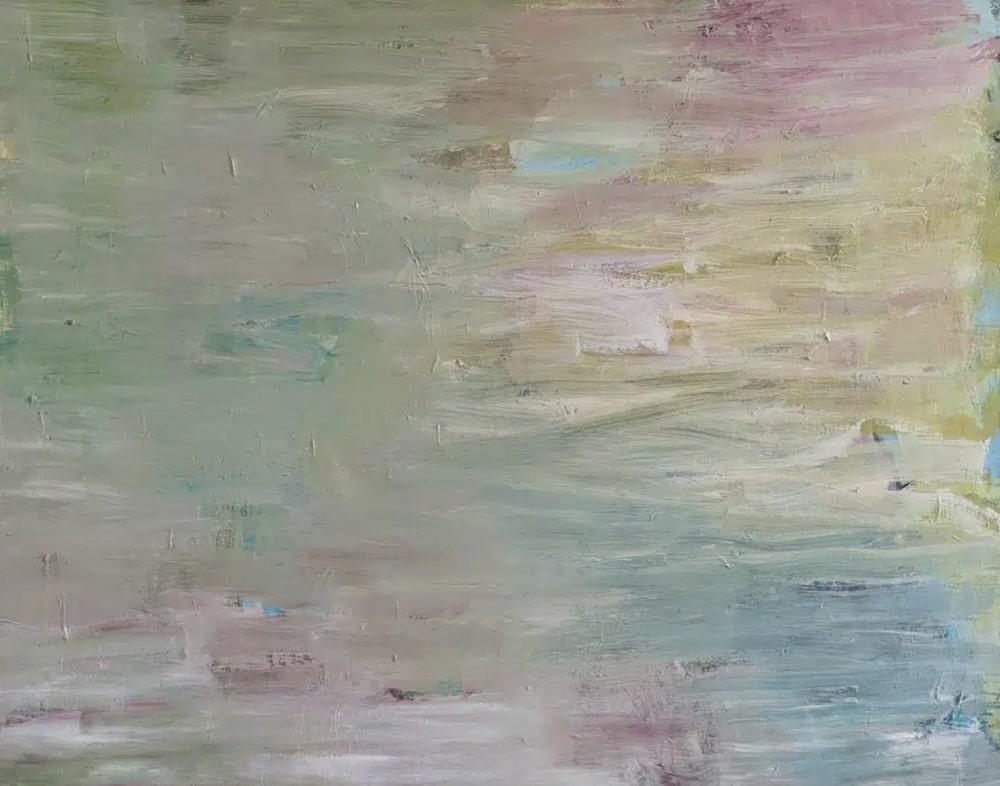
Simon Carter, The Unsayable Lights, Firstsite Colchester, courtesy the artist
Also in Colchester is ‘Simon Carter: From the Landscape’, which enables viewers to step inside a giant painting and get lost in a landscape inspired by the Essex coast. Visitors will discover over 30 acrylic paintings and drawings made since 2020, an early watercolour Carter painted when he was 23, and three new series created especially for Firstsite Gallery. Existing and brand-new works are placed over newly painted surfaces that respond to Firstsite’s architecture, light and atmosphere, layering paint, process and memory. With multiple entrances and exits, and carefully framed viewpoints inspired by the bird hides and pillboxes found across the Essex landscape, there’s no single way to experience the exhibition. Viewers can wander, pause and look again as the artworks come alive around them, with paintings spilling onto the gallery walls and a soundscape bringing the Essex coast indoors.
For more than 40 years, Frinton-based artist Carter has walked, drawn and painted the landscape around him. ‘From the Landscape’ brings together this long relationship with the Essex coast and countryside in an exhibition that asks us to look at painting in a different way. Through paint, Carter explores the act of looking, building up layers of colour and texture over months and sometimes years. Traces of places, plants, views and memories become held within each work, echoing the layers of the landscape itself.
At Salzburg Villa Kast, the exhibition ‘To Feel’ brings together oil paintings and watercolours from Sean Scully’s formative ‘Wall of Light’ series. Begun in 1998, this series features vertical and horizontal blocks of colour that form pictorial architectures reminiscent of brickwork. Dark tones, evoking compact wooden beams, alternate with brighter, contrasting colours, coalescing into rhythmic units within the compositions.
The impetus for this series stems from a small watercolour that Scully painted in Mexico in 1984, in which he transcribed the interplay of warm sunlight and shadow on the stacked stones of ancient Mayan ruins and architectural formations on the Yucatán Peninsula. The artist was fascinated by their surfaces and how the stones seemed to reflect the passage of time. Over the years, Scully moved beyond Mexico, responding to other lights and latitudes, and his paintings reflect the places and seasons in which they were created. Scully, “a distinctly cosmopolitan artist,” writes Antonia Hoerschelmann in the catalogue accompanying the exhibition, “has engaged intensely with European art and cultural history.”
The paintings in the exhibition possess a distinctly physical, architectural quality – a defining characteristic of Scully’s work, reflected in the title of the series, ‘Wall of Light’. He is, as Michael Auping has observed, “a builder of images”. Through variations in hue and brightness, his blocks of paint create a sense of weight, tension and motion. The thick layers of paint “push each other, but at the same time make room for each other”, as the artist has stated. Despite their apparent solidity, the pictorial walls emulate impressions of light, illuminating and permeating the colour bricks. “The wall is a barrier, but what I’m doing is dissolving it. It is metaphysical, transformative,” explains Scully.
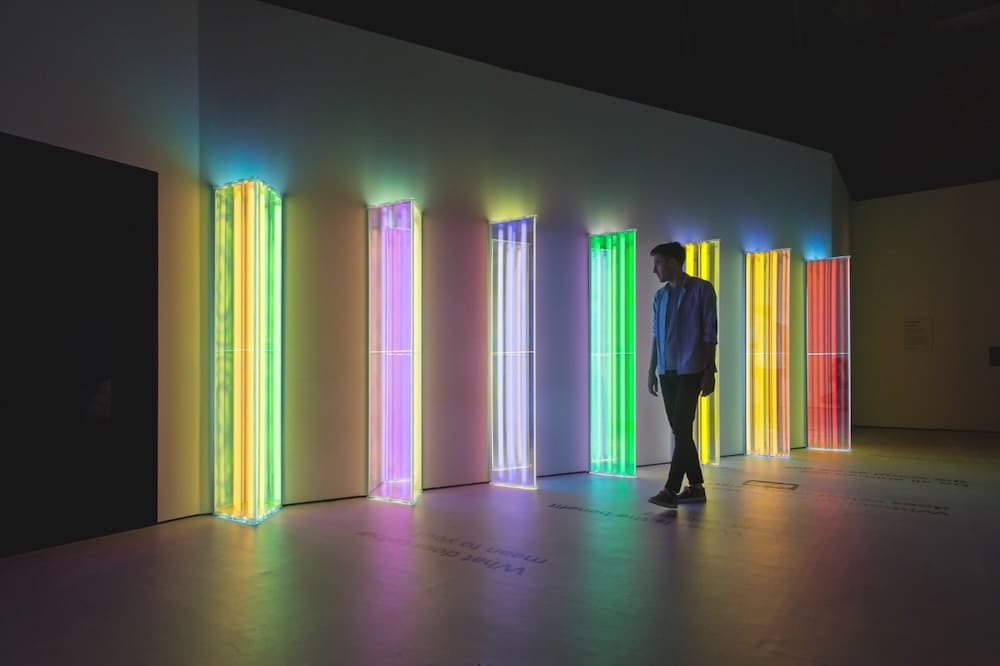
Our Spectral Vision 2016 by Liz West – Commissioned by the Natural History Museum, London, UK for the exhibition Colour and Vision: Through the eyes of nature. Image ©Hannah Devereux
Light is also explored in Durham in ‘Victory Over the Sun: Encounters with Light’, the inaugural exhibition at The Light, featuring works by Tracey Emin, Dan Flavin, Félix González-Torres, and Steve McQueen, among others. From the invention of the light bulb to contemporary light art, this exhibition explores how artificial light transformed the modern world and inspired generations of artists. This exhibition brings together spectacular works by leading international artists who have used light as material, medium, subject and metaphor.
Beginning with a remarkable local story, the exhibition takes as its starting point the invention of the electric light bulb by Joseph Swan, born in Sunderland in the historic county of Durham. Swan’s innovation helped transform everyday life, extending activity beyond daylight and reshaping homes, cities, work and leisure. The exhibition takes its title from the revolutionary 1913 Futurist opera ‘Victory Over the Sun’. Imagining the capture of the sun itself, the opera celebrated technology’s power to reshape the world. Its vision resonates with the invention of electric light, which transformed humanity’s relationship with darkness, daylight and the natural world.
Taking this moment of technological and social change as a point of departure, ‘Victory Over the Sun: Encounters with Light’ brings together 25 artists from across five decades who have explored the possibilities and meanings of light. Working with fluorescent tubes, neon, LEDs, projection and other illuminated media, they use light to create sculptural forms, transform space and investigate perception. The works on display reflect on the presence of artificial light in everyday life, from domestic interiors and urban environments to advertising, popular culture and digital technologies. Others connect light to wider questions of science, energy, time, memory, identity and the cosmos.
The artworks offer a variety of experiences: to engage with the magnified remnants of an exploded star, to see moonlight captured, to be bedazzled by a grid of pastel-hued laptop screens, to look down an endless manhole or to bathe in saturated colour in immersive installations. There are also interactive pieces where visitors can play together with light or scan their fingerprints and heartbeats to be displayed in the gallery. Together, the artworks reveal light not simply as a means of illumination, but as one of the defining materials and ideas of modern life.
Sound is the focus of ‘Joyful Noise’ at Salisbury Cathedral, which brings together painting, sculpture, text, video, and sound artworks to explore how joyful noise can affirm presence, belief, community, and care. The exhibition includes works by Denzil Forrester, Christine Sun Kim and Thomas Mader, Yuri Suzuki, Sokari Douglas Camp, and Phyllida Barlow, along with new commissions from Caroline Walker, Tim Etchells, and Emeka Ogboh.
’Joyful Noise’ reimagines the biblical call to “make a joyful noise unto the Lord” as a modern take on how sound can unite, inspire, and celebrate. The phrase is rooted in religious tradition, but it speaks to shared human experiences. It encourages us to see sound as a universal force that crosses beliefs, cultures, and personal stories, and has long been used to express worship, gratitude, and unity. Throughout the exhibition, joyful noise takes many forms. It appears in language, musical instruments, and the human voice, as well as in clapping, chanting, singing, dancing, spoken prayer, ritual recitation, and even the sounds of nature.
“Balraj Khanna: Lines of Flight offers a long-overdue recognition of an artist whose work bridges cultures, geographies and generations, highlighting his significant contribution to post-war British abstraction”, says Antonia Blocker, Artistic Director, Exhibitions (Maternity Cover) at Ikon Gallery in Birmingham. Bringing together more than 40 paintings made over six decades, ‘Lines of Flight’ offers the most comprehensive overview to date of Khanna’s remarkable career as a painter, writer and curator. The exhibition traces the evolution of his distinctive vision of abstraction shaped by travel, including his youth in the Punjab region of India, his life in post-war Britain, and an enduring fascination with the natural world. Through these works, he explores themes of migration, Partition, identity and belonging.
Born in Jhang, Punjab (now Pakistan), and based in Britain from 1962, Khanna developed a distinctive artistic language informed by migration, memory, landscape, and cultural exchange. Across a career spanning six decades, he produced a substantial body of paintings, reliefs, writings, and publications. A self-taught artist, Khanna witnessed the Partition of India in 1947 before relocating to London in 1962. Following a road accident in 1965, a period of recuperation in Metz, France, proved pivotal to his practice. Immersed in the surrounding Forêt de Saint-Bernard near Metz, he began to develop a highly individual form of abstraction, characterised by layered surfaces, the use of line and string, organic and geometric forms, and an acute sense of spatial rhythm.
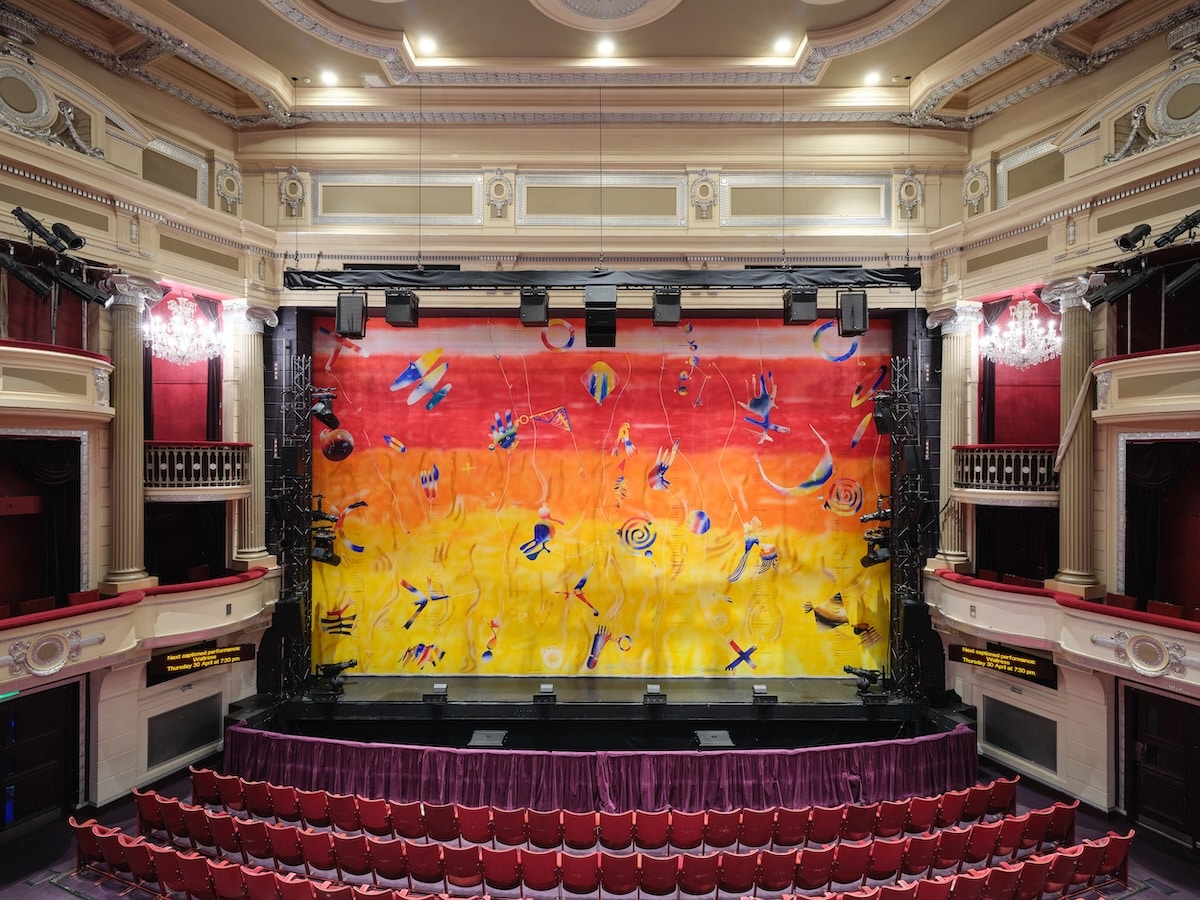
Rarely seen works from the 1960s and 70s are presented alongside large-scale compositions from the 1970s to the early 2000s. Early paintings inspired by the forests of Metz, France, are shown alongside later works that explore childhood memories, diasporic identity, postcolonial politics, and the enduring legacy of the Partition. ‘Remote Region’ exemplifies Khanna’s use of line, with its repetitive, grid-like structure suggesting boundaries. Mixed media works from the 1980s to the 2010s highlight his innovative use of sand, spray, stencil and mark-making, revealing a visual language that is both sensorial and meticulously constructed. In contrast to the vibrant colour palette found across much of his work, the grey tones of ‘Hampstead Heath in Winter’ reflect Khanna’s adjustment to life in England, while ‘Caught at Play’ exemplifies his interplay of precision and texture, foreground and background. The exhibition also celebrates Khanna’s deep connection to Birmingham through ‘Astral Dance’, his monumental painted safety curtain for Birmingham Hippodrome, which marks its 25th anniversary this year.
Artist and curator Michael Cook has a unique eye for the painterly lyricism of the in between and always curates and creates beautiful shows at the magical Manger Gallery, including his own stunning paintings as well as work by Cook, ‘Thresholds’ features work from Tamsin Abbott, Rob Floyd, Derek Harbinson, Michelle Holmes, Lynne Lamb, Andrea McLean, Rima Staines, and Sue Walsh, which includes paintings, drawings, stained glass, cyanotypes, ceramics, and textiles.
The travel theme of the show is described as follows: ‘In the moment between waking and dreaming, where night gives way to gold. At the place where path becomes forest, where a tree is a gate, the sky a mirror. Doorways to holy places, windows to other realms. The borderlands of inside and out, of now and forever, where a hedge is on the verge of eternity, a season turns. An empty space where absence is fullness, and a hollow is the home of presence.’
‘Art Then! British Painting, Sculpture and Drawing, 1910–1960’ at Southampton City Art Gallery travels to the past to showcase how British artists responded to the Modern Art revolution that swept across Europe and beyond.
It has been over a century since Roger Fry caused an art sensation in Britain with his 1910 exhibition ‘Manet and the Post-Impressionists’. 23 years later, Herbert Read’s seminal book ‘Art Now’ reviewed how the mostly France-based avant-garde artists had impacted the British art scene. This exhibition continues this modern art story with a selection of paintings, sculpture and drawings, from over 100 artists, such as Paul Nash, Barbara Hepworth, David Bomberg, Henry Moore and Lucian Freud, demonstrating how that pivotal moment in art history led to some of the most exciting, daring and influential work ever to be produced on these shores.
This celebration of half a century of Modern British Art draws on one of the UK’s leading collections of the period – the Ingram Collection – as well as Southampton City Art Gallery’s own internationally-renowned collection, including rarely displayed works. From modern art’s most well-known practitioners and the leading British artists of the day to fascinating lesser-known names now being recognised for their impactful contributions, the exhibition serves both as an introduction to this exciting period and as an opportunity to uncover forgotten and unknown gems. The sheer creativity and variety that exploded with modernism are fully represented in the exhibition, from Impressionism, Expressionism, and Fauvism to Social Realism, Surrealism, and postwar figurative painting, and much more.
‘Seven Decades of Contemporary Art: Norfolk Contemporary Art Society’ at Norwich Castle celebrates the 70th anniversary of Norfolk Contemporary Art Society (NCAS). Since its founding in 1956, NCAS has supported the Castle in presenting work by innovative contemporary artists, including Eduardo Paolozzi, Colin Self, Bridget Riley and Roger Ackling. Their work features in this display of more than thirty artworks that NCAS members have helped collect over the past seven decades.
Recently supported acquisitions include Florence Peake’s performance-based figurative paintings and photographic work by Daniel & Clara, which explores imagined narratives in a country estate. Work from ‘Wall Existing’, a multi-layered photographic survey of Norwich’s medieval city walls by Robert Filby and Glen Jamieson, is also exhibited. These new additions to the collection are shown with highlights from the early decades of ncas’ activity, including ‘Landscape with Farm Buildings’ by L.S. Lowry, a purchase which inspired the formation of ncas; and ‘Man entering a Boiler House’ by Prunella Clough, which was the very first work collectively acquired by ncas members. Other artists featured in the exhibition include Ruth Ewan, Maggi Hambling, Nigel Henderson, Allen Jones, Frances Kearney, Penny Slinger, Mary Webb and many others.
Korea comes to London with an exhibition exploring how museums shape the ways in which culture is preserved, recorded, and made visible, presented to coincide with the British Museum’s major exhibition ‘Korea’ this autumn. The Korean Cultural Centre UK is presenting ‘The Unclassified’, which interrogates the limits of the systems and assumptions through which museums produce cultural knowledge, with works that challenge what can be collected, classified, and contained. Unfolding across four key themes, the exhibition offers alternative ways of thinking about culture and heritage, examining what museums can and choose to preserve, and what remains beyond their reach. This exhibition brings together four leading contemporary Korean and Korean heritage artists: Meekyoung Shin, Ayoung Kim, siren eun young jung, and Gala Porras-Kim.
Meekyoung Shin explores preservation through an interactive commission ‘Korean Classic: In Use’, inspired by the plaster casts of classical Greco-Roman heads familiar to generations of Korean art students. Produced in collaboration with Lush, these soap sculptures begin their journey beyond the gallery, travelling across the UK to schools, restaurants, a Scottish whisky distillery and other public spaces, where visitors will be encouraged to handle and use them. Gradually worn away through everyday contact, the sculptures will return to the exhibition transformed by touch and time, challenging conventional ideas of conservation, permanence, and the museum’s role in preserving objects.
Museums preserve cultural knowledge through objects and collections, but some traditions are passed on through people and performance. siren eun young jung’s ‘Yeoseong Gukgeuk Project’ centres on yeoseong gukgeuk, an all-female theatre genre that flourished in South Korea in the 1950s. With women performing all roles, including male characters, the art form actively subverted heteronormative gender roles. It offered a historically significant space for gender fluidity, same-sex desire, and queer expression. Through video, performance, interviews, and archival materials, Jung’s project creates a living archive shaped by oral testimony, embodied memory, and queer genealogy, tracing how knowledge and cultural traditions are passed across generations.
Exploring competing records, Ayoung Kim presents the two-channel video installation ‘PH Express’, which revisits the Port Hamilton Incident of the 1880s, when the Korean peninsula became a site of negotiation between imperial powers, its own sovereignty barely legible in the official record. Blending documentary, fiction, and dark humour, the work moves between historical research and imagined narratives to question how history is recorded, whose voices become part of the official record, and who has the authority to shape our understanding of the past.
Gala Porras-Kim presents two works, ‘Burial chamber scene’ and ‘All Earth energy sources are known to come from the Sun’, which explore the limits of museum conservation and control. ‘Burial chamber scene’ imagines the view from inside a grave, inviting viewers to reflect on the aspects of cultural heritage that remain beyond complete understanding. In ‘All Earth energy sources are known to come from the Sun’, a brass sheet reflects natural sunlight onto a gallery wall, gradually leaving a mark shaped by changing environmental conditions rather than the artist’s direct control.
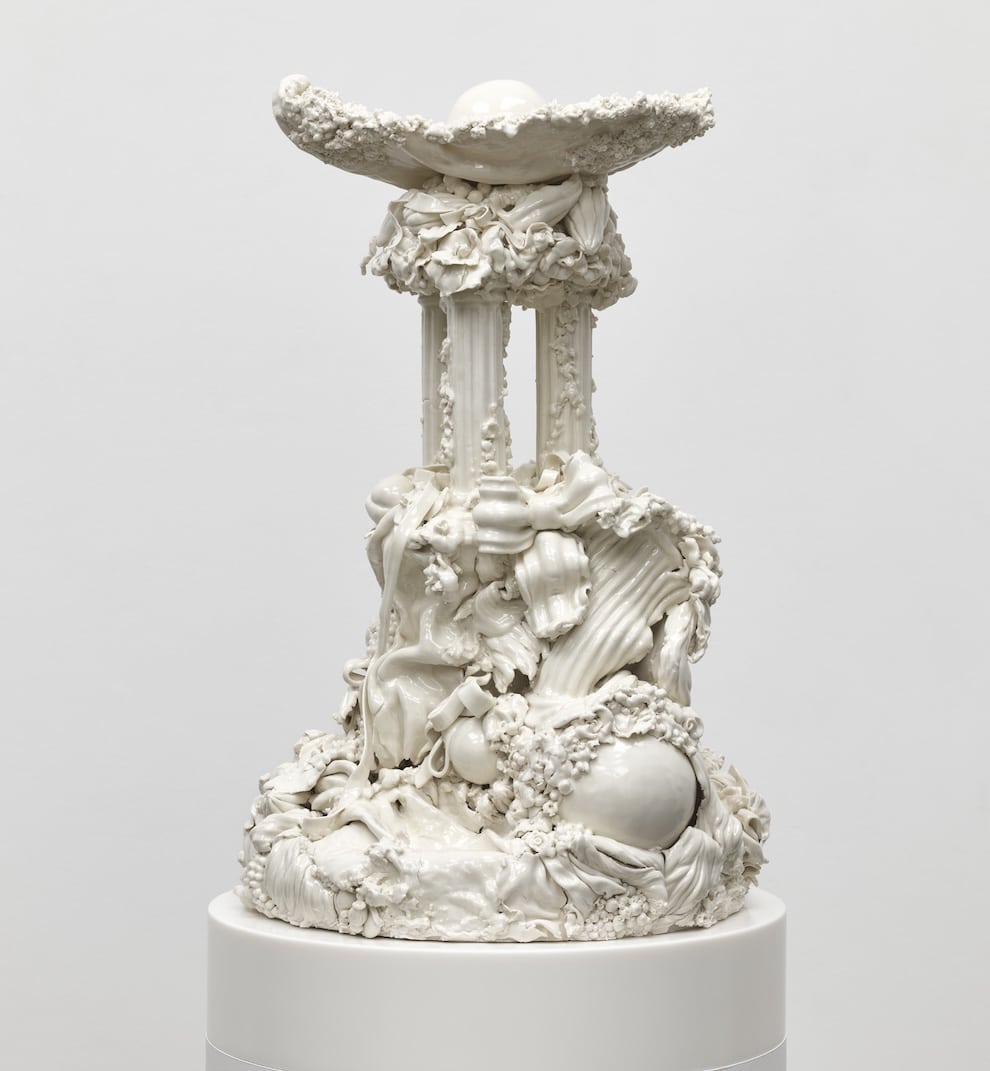
Rachel Kneebone, Temple, 2026, Porcelain, 2. © Rachel Kneebone. Photo © White Cube (Theo Christelis)
With the Wallace Collection’s decorative interiors as her backdrop, acclaimed artist Rachel Kneebone places nine white porcelain sculptures throughout the galleries for ‘Metamorphoses: Porcelain Sculpture by Rachel Kneebone’. Two of these sculptures, ‘Bower’ and ‘Temple’, were created especially for the display and are shown for the first time. Kneebone says: “The Wallace Collection has long been a rich resource for me; a place of pleasure, delight and instruction. The works I am placing are responses to the Collection, to forge connections and contrasts within the space.”
The Wallace Collection is renowned for its sumptuous collection of Old Master paintings and decorative arts, epitomised by the creations of Rococo painters such as François Boucher and Jean-Honoré Fragonard, and its beautiful Sèvres porcelain. This display, in this luxurious setting, reveals how Kneebone’s contemporary sculptures find unexpected kinship with the Collection’s historic treasures.
White porcelain is a material traditionally associated with stillness and perfection. By contrast, Kneebone’s white sculptures, finished with a clear gloss glaze, move light across the surface, breaking and connecting form, inviting the viewer to look closely and delve for meaning. Surreal and profuse, her works also suggest narrative and movement, resonating with the Roman poet Ovid’s stories of metamorphoses and transformation.
Having long been fascinated by dance and movement, Kneebone is keen to engage with works relating to this theme in the Wallace Collection. Examples include ‘Dance’, which is placed on a table in the Billiard Room to echo the bronze ‘Borghese Dancers’ on a nearby wall. Unlike the stately movement of these figures, however, the disembodied limbs that comprise her piece convey riot and fragmentation. Similarly, the ‘After the Dance’ sculptures, with protruding legs, can be seen as a playful response to the rich Baroque decoration of the Back State Room and the dynamic bronze sculptures that line the Great Gallery.
One of the works, ‘Pull’, an unfurling hive-like configuration, will be suspended from the conservatory ceiling on the first-floor landing. Others, including ‘Bower’ (made in response to Fragonard’s famous ‘The Swing’), are placed at eye level, encouraging the viewer to peer into tangled masses of interconnected forms offered up for close viewing.
Kneebone’s sculptures will appear strikingly different from the works that comprise the permanent collection. Aware that they will look startling in this environment, Kneebone believes they will not jar because of the many ways they blend with the surroundings, inviting the viewer to tease out connections with them, making the past appear contemporary and the present historic.
‘Zak Ové: The Invisible Man and the Masque of Blackness’, an extraordinary assembly of imposing, monumental and identical figures by British Trinidadian artist Ové, transforms the historic gardens of The Sherborne this autumn. Thirteen monumental figures create a powerful encounter for visitors to the historic Georgian house.
Ové’s immediately impactful installation explores the strength and resilience of the African diaspora, with its title referring to Ralph Ellison’s landmark novel ‘Invisible Man’ and Ben Jonson’s Jacobean court entertainment ‘The Masque of Blackness’, first performed in 1605. The Sherborne presentation brings the figures together in a new formation, created specifically for the historic garden. Ove’s silent gathering becomes not an army preparing for conflict, but a peaceful force assembled in the service of visibility, dignity and shared humanity.
The arrival of the Invisible Army comes at a defining moment for the town. Sherborne has just been named Dorset Town of Culture 2027, recognising the strength of its creative community and its ambition to place culture at the heart of the town’s future. Liz Gilmore, CEO of The Sherborne, says: “The arrival of Zak Ové’s extraordinary figures will be a defining moment for The Sherborne. They are visually breathtaking, but their power extends far beyond their scale. Together, they speak of visibility, resilience and belonging, asking us to consider who is represented in our cultural landscapes and whose stories we choose to carry forward.
“To place these figures within the garden of an 18th-century house, in which the extraordinary mythological world painted by Sir James Thornhill spectacularly illuminates the stairwell, creates a compelling conversation between histories. The Sherborne exists to inspire curiosity, welcome new perspectives and connect our heritage with the most important ideas of the present.”
For The Sherborne, the installation is more than an exhibition. It is a declaration of intent: that art of international significance belongs within the landscapes, communities and historic places of the regions.
Curated by Fatoş Üstek, Frieze Sculpture returns to The Regent’s Park with 11 international artists including Angel Otero, Conrad Shawcross, Tarini Sethi and Ivana Bašić. Frieze Sculpture coincides with London Sculpture Week 19–27 September 2026, a city-wide celebration of public art that unites five major initiatives: ‘Frieze Sculpture’, the ‘Fourth Plinth’, ‘East Bank’, ‘Sculpture in the City’ and ‘The Line’. ‘Frieze Sculpture’ also coincides with ‘Frieze London’ and ‘Frieze Masters’, which take place in The Regent’s Park, 14–18 October 2026. Sited throughout the Park’s historic English Gardens, ‘Frieze Sculpture’ extends the reach of the fairs into the public realm and brings contemporary art to park visitors throughout the autumn season.
‘Frieze Sculpture’ 2026 presents sculptural works that combine media, materials, techniques and cultural references to create a vibrant hybrid ecology shaped by different spatial, social and environmental contexts. Rather than presenting the sculptures as objects in isolation, this year’s edition invites audiences to encounter them as a web of interactions linking materials, stories and communities with the natural environment.
Each of this year’s artists explores the notion of hybridity in a different way, from Angel Otero’s threshold-like doorway descending beneath the grass to Ramesh Mario Nithiyendran’s vibrant dual-faced idol, and from Ivana Bašić’s powerful brutalist monument to Tarini Sethi’s intricate stainless-steel screens depicting utopian scenes. Together, these works affirm the edition’s central vision: sculpture as a living, adaptive and expansive language. For 2026, the Mtec Bursary has been awarded to Dom Art Gallery with Elena Nemkova for the artist’s new commission, ‘Agony in the Garden’, enabling the realisation of an ambitious new work and bringing it to a broad public audience in The Regent’s Park.
With ‘In Dreams and Salt’, Otero revisits the concept of passage between locations and identities. This idea takes shape as a plywood door set at an angle in the earth, slightly ajar to reveal a descending staircase. The door’s displacement disrupts the space and functions simultaneously as an entrance and an exit, a departure and a return. Rooted in Bašić’s childhood during the collapse of Yugoslavia, ‘Metanoia’ breathes life into a utopian monument from her homeland, contemplating humanity’s yearning for wholeness, and the power – and fragility – of collective ideals. Nemkova’s ‘Agony in the Garden’ is the gesture of an unknown animal turning towards the cosmos in search of salvation. Emerging from the ground, its rough, untamed form inhabits the park like a presence out of place: a totem, a disturbance, a stone in the shoe of the present. The religious reference in the title is reflected through posture. Two paws rise in a near-architectural arch, while crossed claws introduce an undertone of hesitation and defence.
Fatoş Üstek, Curator, ‘Frieze Sculpture’ says: “Frieze Sculpture returns to The Regent’s Park with a heightened awareness of the hybrid world we inhabit: one in which cultures continually inform one another, artistic mediums merge to generate new forms, and social life is shaped both online and in person. We invite visitors to step outside the rhythms of everyday life and into the park, where artistic propositions open up new ways of thinking and feeling. Through materials, references and critical engagements with history, myth, ritual and forms of belonging, the works illuminate hybridity not as a condition to be explained, but as a reality to be experienced.”
Lead image: Balraj Khanna, Astral Dance (2001), Birmingham Hippodrome Safety Curtain. Photo by Andrew Judd
‘Luis Maraver: Traveling’, 15 August – 10 September 2026, Dionís Bennàssar Gallery, Pollença, Mallorca – Visit Here
‘some fundamental forces: Isabel Nolan’, 15 August – 1 November 2026, Southwark Park Galleries – Visit Here
‘The Alchemists’, 7 February – 27 September 2026, Sala delle Cariatidi, Milan – Visit Here
‘The Lost World: The Art of Minnie Evans’, 22 August 2026 – 10 January 2027, Whitney Museum of Modern Art – Visit Here
‘Andrea Modica: Catholic Girl’, 10 September – 22 October 2026, AMR Art DUMBO and ‘Andrea Modica: Italian Story’, 12 September 2026 – 15 February 2027, Alice Austen House Museum – Visit Here
‘Walls and Windows’, 20 August – 6 September 2026, The Minories, Colchester – Visit Here
‘Simon Carter: From the Landscape’, 19 September 2026 – 17 January 2027, Firstsite Colchester – Visit Here
‘Sean Scully: To Feel’, Until 26 September 2026, Salzburg Villa Kast – Visit Here
‘Victory Over the Sun: Encounters with Light’, 22 August 2026 – 17 January 2027, The Light, Durham – Visit Here
‘Joyful Noise’, 16 May – 25 October 2026, Salisbury Cathedral – Visit Here
‘Balraj Khanna: Lines of Flight’, 30 September 2026 – 21 February 2027, Ikon Gallery, Birmingham – Visit Here
‘Thresholds’, 31 July – 17 October, The Manger Gallery, Melbourne, Derbyshire – Visit Here
‘Art Then! British Painting, Sculpture and Drawing, 1910–1960’, September 2026 – February 2027, Southampton City Art Gallery – Visit Here
‘Seven Decades of Contemporary Art: Norfolk Contemporary Art Society’, 28 March 2026 – 6 June 2027, Norwich Castle – Visit Here
‘The Unclassified’, 25 September – 31 December 2026, Korean Cultural Centre UK, London – Visit Here
‘Metamorphoses: Porcelain Sculpture by Rachel Kneebone’, 23 September 2026 – 25 April 2027, Wallace Collection, London – Visit Here
‘Zak Ové: The Invisible Man and the Masque of Blackness’, 7 September 2026 – 6 September 2027, The Sherbourne – Visit Here
‘Frieze Sculpture’, 16 September – 1 November 2026, Regent’s Park, London – Visit Here