
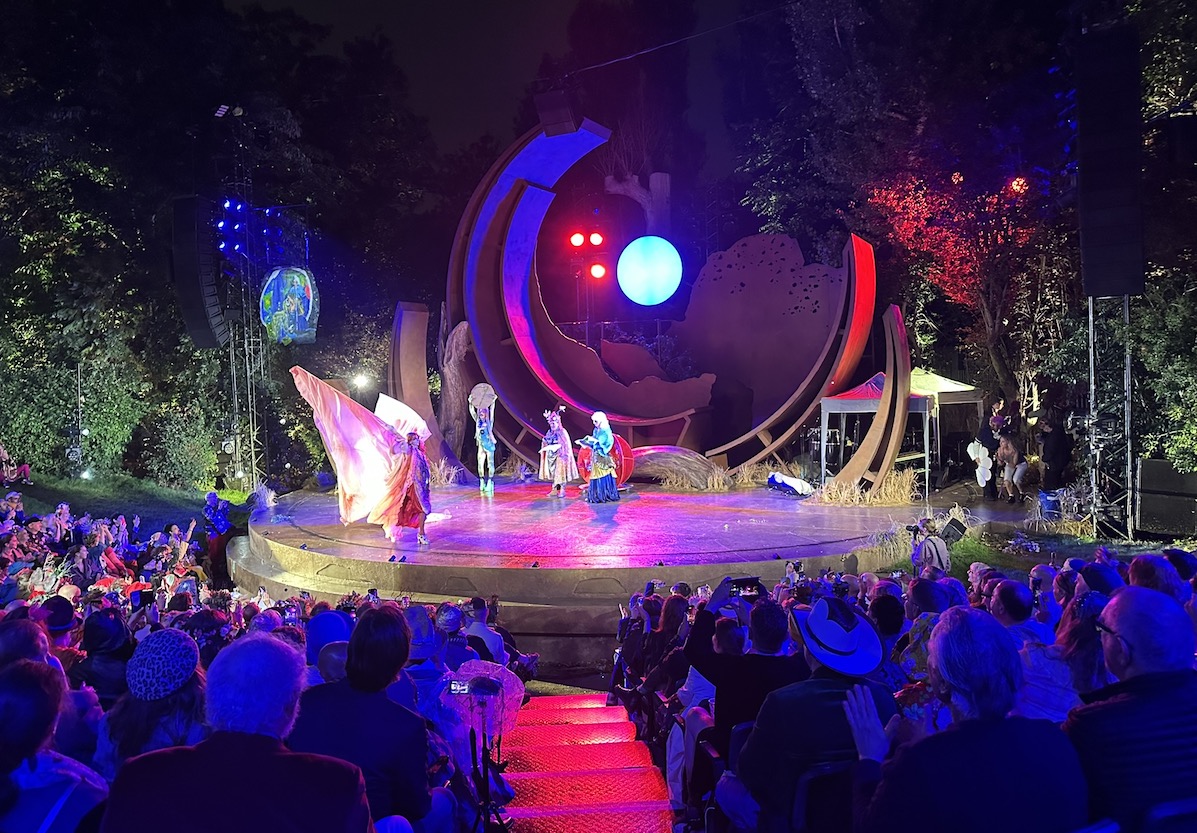
There is really nothing in British culture quite like the Alternative Miss World Competition. Now in its sixteenth outing since 1972. This year, it was staged beneath the open sky and beautiful gardens of Regent’s Park Open Air Theatre. Not even the heavy rain could hinder its good-natured Glam-Hippie vibe. It has once again proved why it has survived and thrived for more than five decades without ever losing its capacity to surprise.
This year’s theme was Gaia, a title chosen with obvious intent. The name draws on James Lovelock’s famous hypothesis, the idea that the planet functions as a single living organism, its inhabitants bound together in a web of interdependence too easily forgotten in daily life. Given how relentlessly grim the ecological news cycle has become, staging a pageant built around planetary reverence felt less like whimsy and more like a necessity. And if there is an organising principle better suited to capturing the beautiful chaos of Earth as a living system than the organised chaos of Alternative Miss World itself, nobody has yet found it.
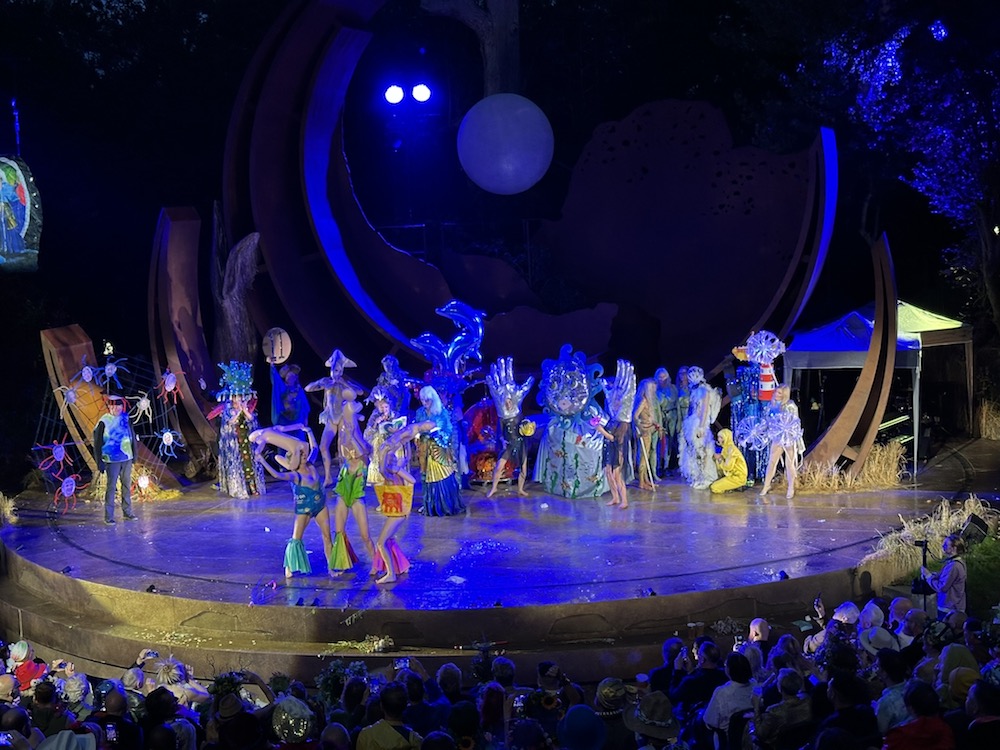
Andrew Logan and Eve Ferret host the 16th Alternative Miss World Pageant. Photo Courtesy Artlyst 2026. © Artlyst 2026
Hosted by the colourfully androgynous Andrew Logan and the actress, comedian Eve Ferret, who held the show together like a multi-faceted mirrored brooch. The winner, in the end, was Miss Fiontasia, competing as @fiontasia, whose homage to the dancer Loie Fuller arrived rendered with genuine visual elegance and, notably, a playful anatomical twist that gave the whole tribute a distinctly contemporary edge. It was a stunning piece of work. Whether it was the correct winner is another matter entirely. A fair amount of chatter afterwards suggested that, given the Gaia theme, if any entrant truly deserved the crown this year, it should have gone to the Neonaturists competing as Miss Woman O’sphere, whose devotion to the goddess concept apparently ran deeper and stranger than anyone else’s on the bill. Pageant politics, as ever, remain gloriously contestable. Regardless, the room seemed united in one thing: gratitude toward Andrew Logan, the sculptor behind the entire enterprise, for pulling off yet another spectacularly produced evening.
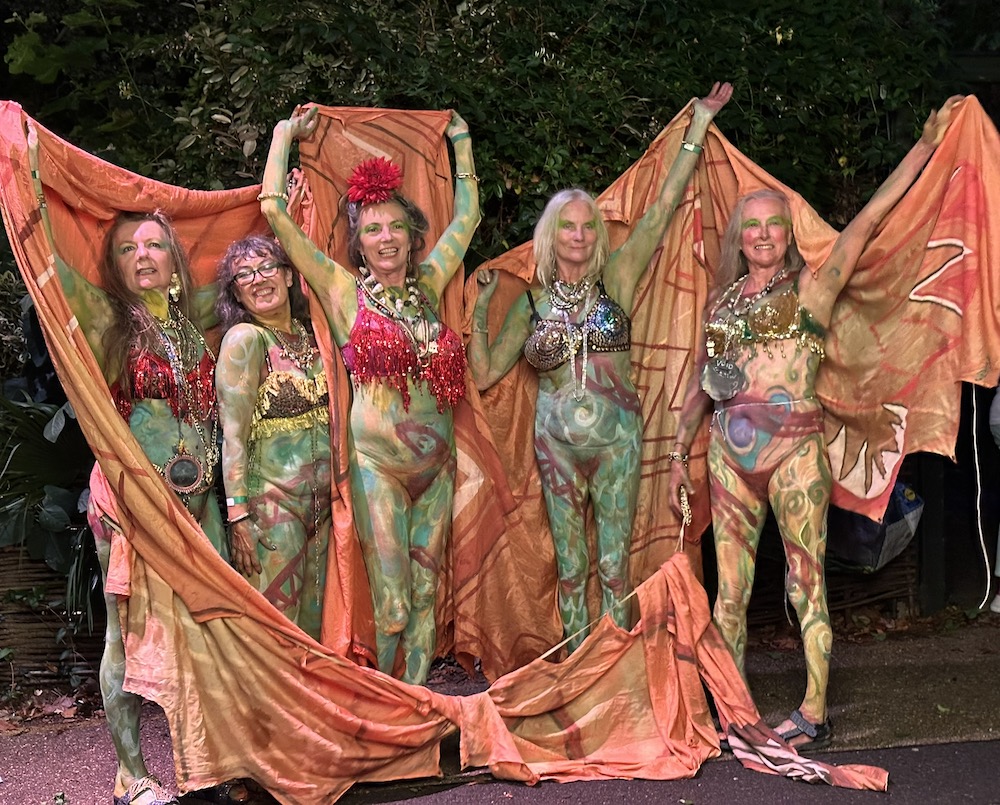
Neonaturists competing as Miss Woman O’sphere photo Artlyst © 2026
Outstanding contestants included Miss Diagnosis for her name alone and Miss Crocodile in her snappy outfits. Other noteworthy contestants were Miss Nomadique Vagabond, Miss Mama Jama, Miss Pretzel Cosmic Cage, Miss Gaia-Daia-Oceana-Phoenix, Miss Guy Ai, Miss Magma Mcgoo, Miss Iona Plankton, Miss Anthropocene, Miss Iolocene, Miss Mortal Coil, Miss Mother Girth and Miss Lady Gagaia.
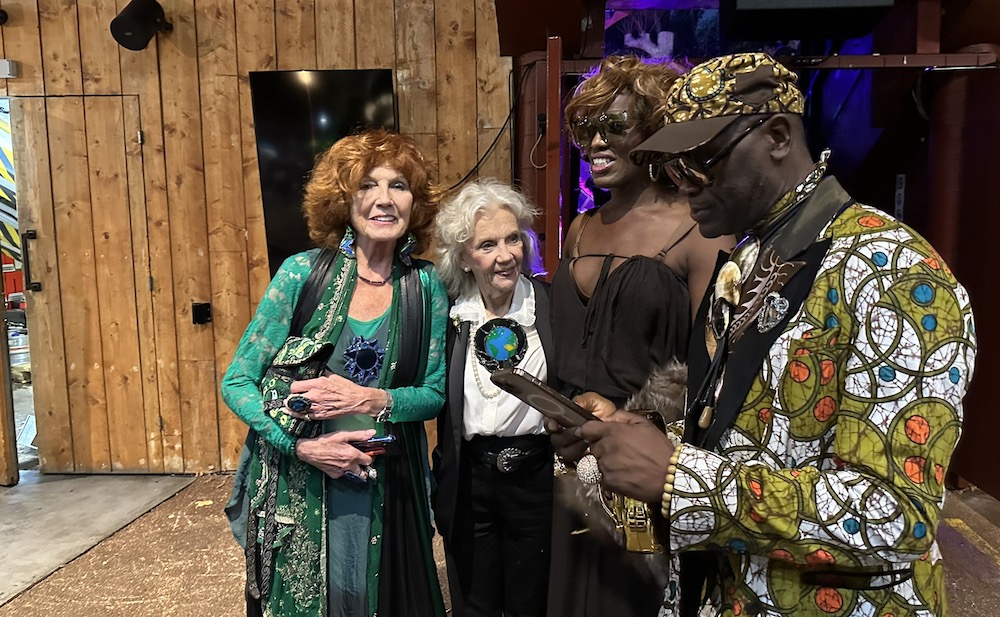
The legendary actors Hayley Mills (centre) and Rula Lenska (left) were judges for the pageant photo Artlyst © 2026
The judging panel this year was a remarkable cross-section of British eccentricity and achievement, including Dame Zandra Rhodes, Jarvis Cocker, Hayley Mills, Rula Lenska, previous winner Janet Slee, milliner Piers Atkinson, Doctor Jane Wilson among others, a group whose collective presence alone tells you something about how seriously the wider cultural establishment now takes what began as an intimate party in a converted Hackney jigsaw factory.
That origin story is worth revisiting, because it explains almost everything about why the event still works. Logan founded the competition on 25 March 1972, inspired, improbably enough, by a visit to Crufts. Rather than adopting the narrow, punishing metrics of conventional beauty pageants, he borrowed Crufts’ own judging categories instead: poise, personality and originality, criteria designed originally for dogs. He repurposed it here as a pointed joke at the expense of the entire Miss World industry. Contestants were still asked to present daywear, swimwear and evening wear, mimicking the structure of a televised pageant almost exactly, except the results bore no resemblance whatsoever to anything you might see on television. Winners did not receive a standard tiara. They received custom, wearable crown jewels, each one designed personally by Logan.
Because staging the event demands such enormous energy and planning, Logan has always spaced the pageants out irregularly rather than running them annually, which has, if anything, only heightened their mythology.
The first edition’s judging panel included David Hockney. By the second, demand had grown so intense that David Bowie was reportedly turned away at the door. Derek Jarman filmed those early years on Super 8, footage that now serves as an invaluable, slightly grainy record of a scene that, at the time, barely knew how significant it was becoming. The third edition, held at Butler’s Wharf under the theme Wild, produced what may be the pageant’s single most consequential moment.
Contestant Gaby Longhi walked the runway in torn clothing held together with safety pins, an image that Malcolm McLaren and Vivienne Westwood were both in attendance to witness, and one that many credit as a direct spark for the visual language that would soon define punk. It is a striking claim, and not one that gets made lightly, yet the details line up well enough that it has become part of the pageant’s accepted lore.
In 1978, Divine co-hosted the event under a circus tent on Clapham Common, an evening that was later turned into a documentary that premiered at Cannes, prompting the genuine, official Miss World organisation to attempt to block its UK release, presumably unable to see the humour in being so thoroughly mocked. The pageant has since moved through a long list of London venues, the Clapham Grand, the Hippodrome, the Roundhouse, before finding a more settled home at Shakespeare’s Globe from 2014 onward, and now, with this year’s edition, expanding into the open-air setting of Regent’s Park.
Throughout its history, the event has drawn an almost absurdly starry roster of hosts, judges and guests, including Leigh Bowery, Julian Clary, Ruby Wax, and Grayson Perry, alongside entrants who have included bankers, builders, drag performers, and, on at least one occasion, a robot. Anyone can enter, regardless of gender, nationality, age or background, which remains the pageant’s most calmly radical feature even now.
Grayson Perry once described it as British folk heritage colliding head-on with a post-Stonewall explosion of freedom, and having watched Gaia unfold beneath a damp Regent’s Park sky last Sunday, it is hard to think of a better description. Fifty-three years in, the Alternative Miss World has lost none of its capacity to feel both deeply moved and genuinely part of a creative subculture that is the best of British eccentricity.
Photos/Text P C Robinson © Artlyst 2026