

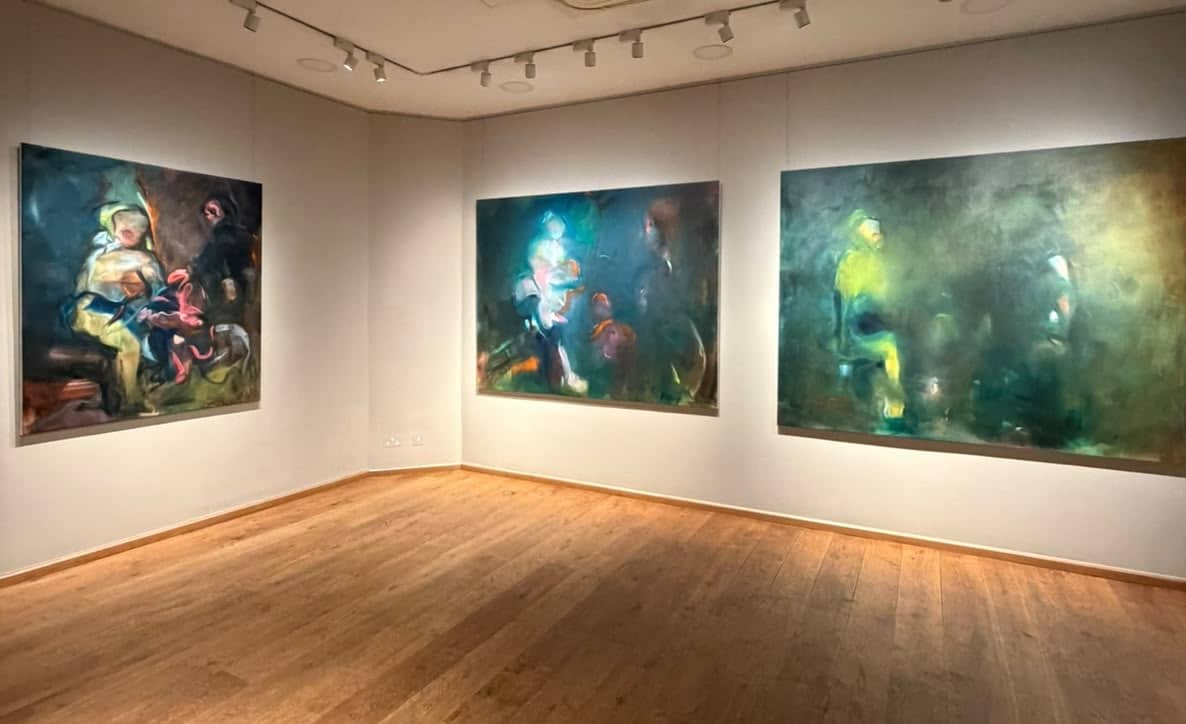
The first thing you notice as you walk into Anthony Daley’s new exhibition at Varvara Roza Galleries is the pink. It spreads across three enormous canvases, gathering in some places and thinning to a haze in others, and then a shard of blue catches your eye, or a quick brown stroke sends it off in another direction. It may take a moment to realise that all three paintings began with the same eighteenth-century portrait. By then, Daley has already drawn you into the part of painting that interests him most. Colour can move you before you’ve had time to work out what you’re looking at.
Born in Jamaica and based in London, Daley has long looked to European painters such as Rubens, Delacroix and Gainsborough. His solo exhibition Son of Rubens at Dulwich Picture Gallery drew on Rubens’s works in the collection, bringing his own abstract paintings into conversation with them. At Varvara Roza Galleries, Rubens returns alongside a perhaps less obvious companion, Joseph Wright of Derby. Bringing the two painters together allows Daley to explore very different kinds of light, from the airy pinks and golds of the opening room to the glints of flesh and metal that emerge from the darkness of the next.
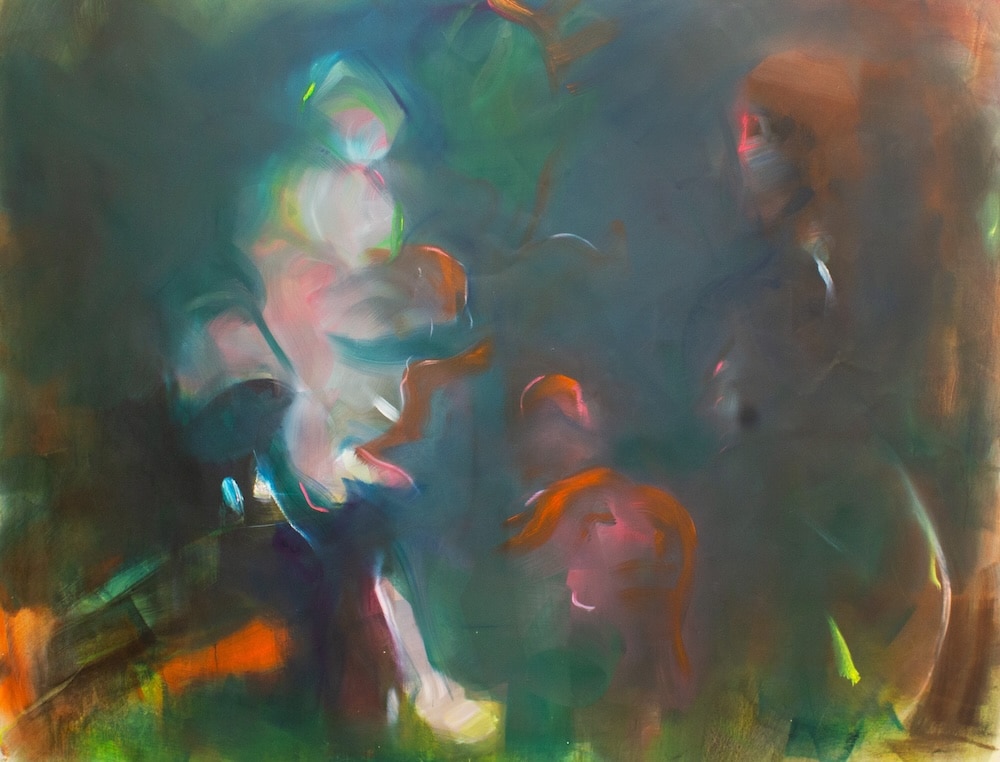
Anthony Daley, Spoils of War, 2026
The starting point for the first three canvases is Wright’s Mr and Mrs Coltman. A portrait ordinarily gives you somewhere to look first, usually a face, but in Daley’s paintings, your eye might go straight to a patch of luminous pink, only to find that it has no obvious edge. A flash of blue brings you back to the surface. Then there are those thin, calligraphic strokes of brown, which can feel surprisingly decisive amongst all that floating colour. The scale makes a difference here, because seen from across the room, a painting of his can seem almost to dissolve into light, but up close, the movement of the brush becomes much harder to ignore.
The three works share a palette, but each makes you move through it differently, with a colour that seems to hold one canvas together becoming a passing accent in the next. After a while you may find yourself going back to the first painting to see whether the pink you remember is quite as intense as you thought. He is a master colourist, and you feel that he enjoys the process. This is one of the pleasures of seeing his works together as your perception changes and one colour changes how you see another.
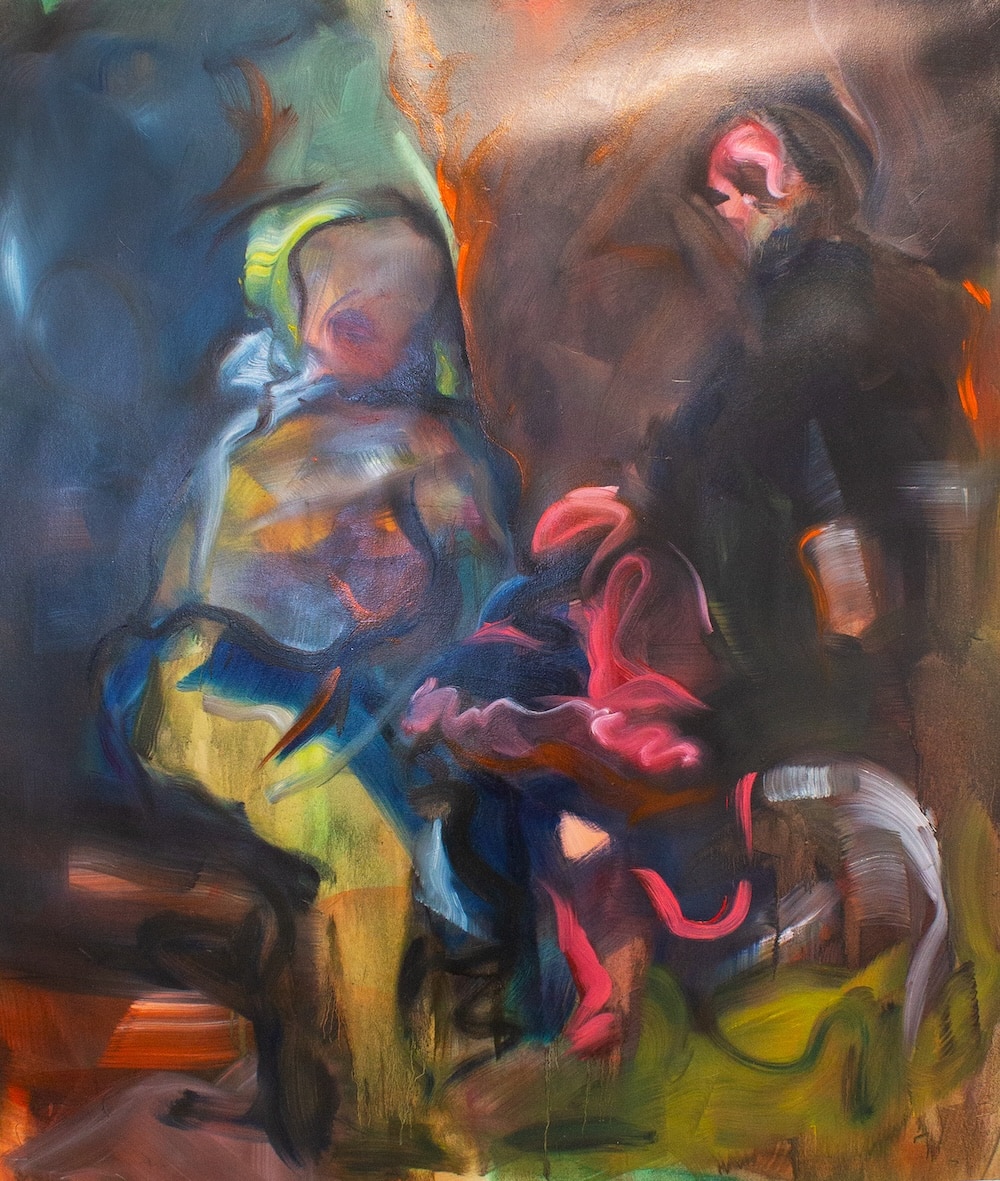
Anthony Daley, Peacemaker, 2025
Walking into the second room feels a little like coming indoors from bright sunlight, and it takes a moment for your eyes to adjust. Here Daley turns to Rubens’s Venus, Mars and Cupid, and the palette shifts to moss green, ebony, burnt umber and a sharp acid yellow. With all abstract work, we try to make sense of it; we can’t help ourselves, and the suggestion of a figure, of a body, is stronger in this room, although it can vanish almost as quickly as it appears. A curve catches the light, and you think of Venus’s skin in Rubens’s original and a cooler glint suggests Mars’ armour. Look again, and there is the paint itself and Daley’s colour palette, which can suggest, in the merest flickers, warm flesh and cold metal within inches of each other.
That uncertainty brings you surprisingly close to Rubens. Part of the pleasure of looking at a Rubens is knowing that the flesh which seems so palpable is made of paint. Daley keeps that pleasure alive while giving us fewer cues. How much of a body do you actually need to see before you supply the rest? The darker paintings keep returning to that question. You can spend a long time looking at one passage, following a line that seems about to turn into a shoulder, and find yourself just as absorbed when it slips back into shadow.
Downstairs, Daley returns to Wright of Derby in a series of smaller, brighter paintings. They ask for a different kind of attention. Upstairs you can step back and let the big canvases fill your field of vision, but here you come closer, and the eye can cross an entire painting in an instant. It often doubles back. This is where Daley’s idea of “resonance” becomes especially easy to feel. A colour on one side of a canvas can alter a colour you’ve already seen on the other, with the effect continuing as you look from one painting to the next.
Isabel de Vasconcellos’s sensitive curating gives each of these shifts room to register. The warmth of the first room stays with you as you enter the second, where even a small flicker of light can command your attention. By the time you reach the smaller paintings, you may find you’re looking more slowly, even though there is far less canvas to take in.
When I got home, I looked up the Wright and the Rubens, curious to see which details might have caught Daley’s eye long enough to set a whole painting in motion. And the longer I looked, the more I wanted to go back to the gallery and see exactly what that pink was doing.
Anthony Daley, ‘Resonance’, 10-28 November, Varvara Roza Galleries, 8 Duke Street, St James, London SW1Y 6BN
Visit Here