EDGE: Where the Land Meets the Sea at Hastings Contemporary is a fascinating collection of work focusing on the connection between land and sea and the management of this landscape by different organisms. Co-curated with The Land Gardeners, who presented the acclaimed exhibition SOIL at Somerset House in 2025, this show draws on their expertise, relocating the examination of the environment in the coastal area of Sussex. As residents, we all spend part of our time walking along the shoreline, encountering creatures and different perspectives from those on the street. This show brings that experience into focus and inspires discussion of the tiny creatures with which we live.
The video and photography work are the most compelling and remarkable images in the show for me. The large photos of France Bourély take me into alternative spaces. It is a thrill to see physical copies, as I have long admired his work online. Bourély uses a scanning electron microscope. This produces images by scanning the surface with a beam of electrons, which interact with atoms to reveal information about topography and composition. Like television and other visual systems, this is basically a rake, line-by-line scanning, similar to how a person’s eye travels when reading lines of text. The subject sends a fax of itself from beyond. There are echoes of ingenuity in Hastings’ local inventor, John Logie Baird, in more than one coincidental way. Baird’s electronic camera, which included rotating colour discs, was part of the live broadcast of the Apollo 11 mission to the moon. And Bourély has been dubbed a ‘micronaut’ by NASA astronauts in 1994; her image of the pores of a gnat’s abdomen was brought into space by astronaut Mike Lopez-Algeria in 1996. Bourély’s microscopic structures are used to show how life technology can benefit future engineers, and seeing the microworlds she reveals in these physical prints stimulates not only wonder but possibilities.
Wim van Egmond (Biofilm, 2026) is also a study in microlife. He is an advocate for the importance of microbes, and this belief lends seriousness to his moving pictures. He has said that if he had to choose the key organisms on Earth, he would choose cyanobacteria, who invented photosynthesis, released oxygen into the atmosphere, and put the green into our plants. His joy in observing the movement of microorganisms that thrill and flit across the screen is easily shared. I wonder about time. Some seem to move so slowly. Then sometimes some travel in short, fast bursts that remind me of Schrödinger’s cat, in and out of the box. Now you see it over here, now you see it over there; there is no in between. And the prison of the human time scale and our limitations is brought to the fore when watching these unfamiliar, alien environments. Extreme close-ups transform these microscopic landscapes into fantastic dreamscapes that you don’t need to analyse to enjoy.
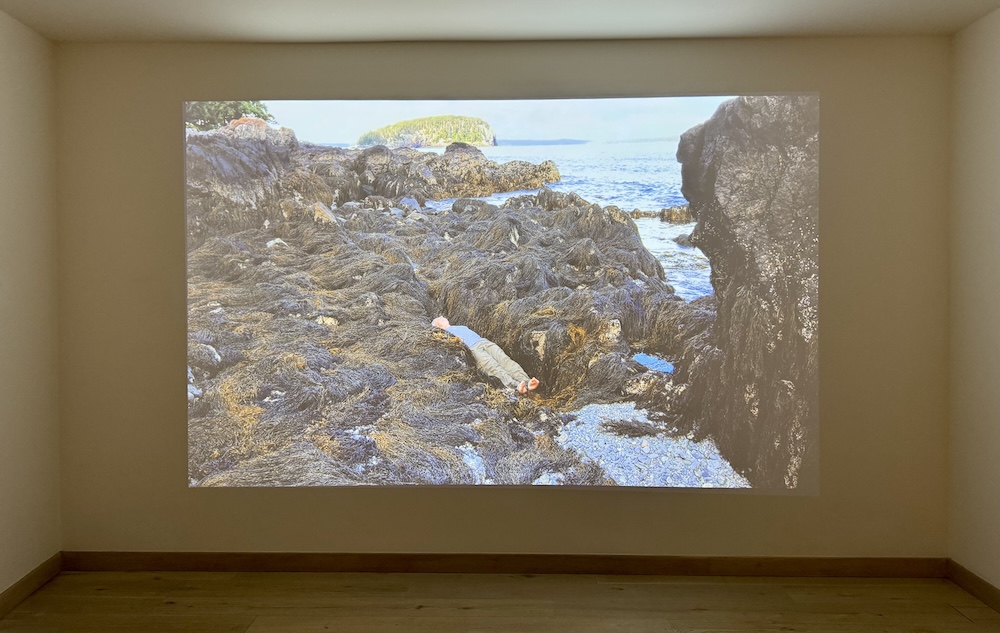
Andy Goldsworthy, still from Rockweed 2023
One of the features of the time-based media in the show is this immersion in different time scales. This effect can be achieved in multiple ways. Andy Goldsworthy’s film is in real time, but feels long as little happens. But what does happen is powerful in its simplicity. How extraordinary! When he has been lying in the seaweed, to see him step out of it in his ordinary clothes and make his way uncomfortably off-screen. What a way to spend an afternoon, watching a sea-shore rocky beach with the waves coming in, knowing that the artist is present in uncomfortable conditions and waiting in anticipation for him to rise, like a king or a god, out of the waters. While I was there, a young couple were watching the full 30 minutes, and I was lucky enough to enjoy their reactions. I got there 5 minutes before the moment he rose up and out. Hypnotic. Timing is all.
There is so much gentle education in this exhibition of the kind I appreciate. Joya Berrow’s five-minute film (Where Two Kingdoms Meet, 2025) explores the hidden connection between Britain’s temperate rainforests and the fungal networks beneath. The information alongside states that although ancient rainforests once covered around 20% of the British Isles, only a small fraction remains. The ecological value enhances the pleasure of seeing plant roots beneath the forest floor, helping plants access water and nutrients and illustrating the hidden networks beneath our feet. And many of the labels include information about threats to the survival of aspects of our environment, juxtaposed with the visual impact of the items. In a more domestic context, it was delightful to see Emma Tennant’s botanical watercolour of the edible sea kale, which grows well here on the Hastings beaches, and, as a resident, I notice it every year, as it seems to be thriving on the South Coast after having been over-cultivated in the past.
There are many other works worthy of comment, but I think the inclusion of organised land elements was my other favourite aspect. I enjoyed seeing the alternative chalks and muds laid out for inspection—the clumps of earth, the labelled specimens in cabinets. The selected real-world elements competed with artifice for attention, and won my appreciation. At the end, I felt I did not want to see paintings, prints, embroideries, or human-made sculptures, but only because the other shone so brightly out of the dark. Friends I always know are there but rarely take the time to see.
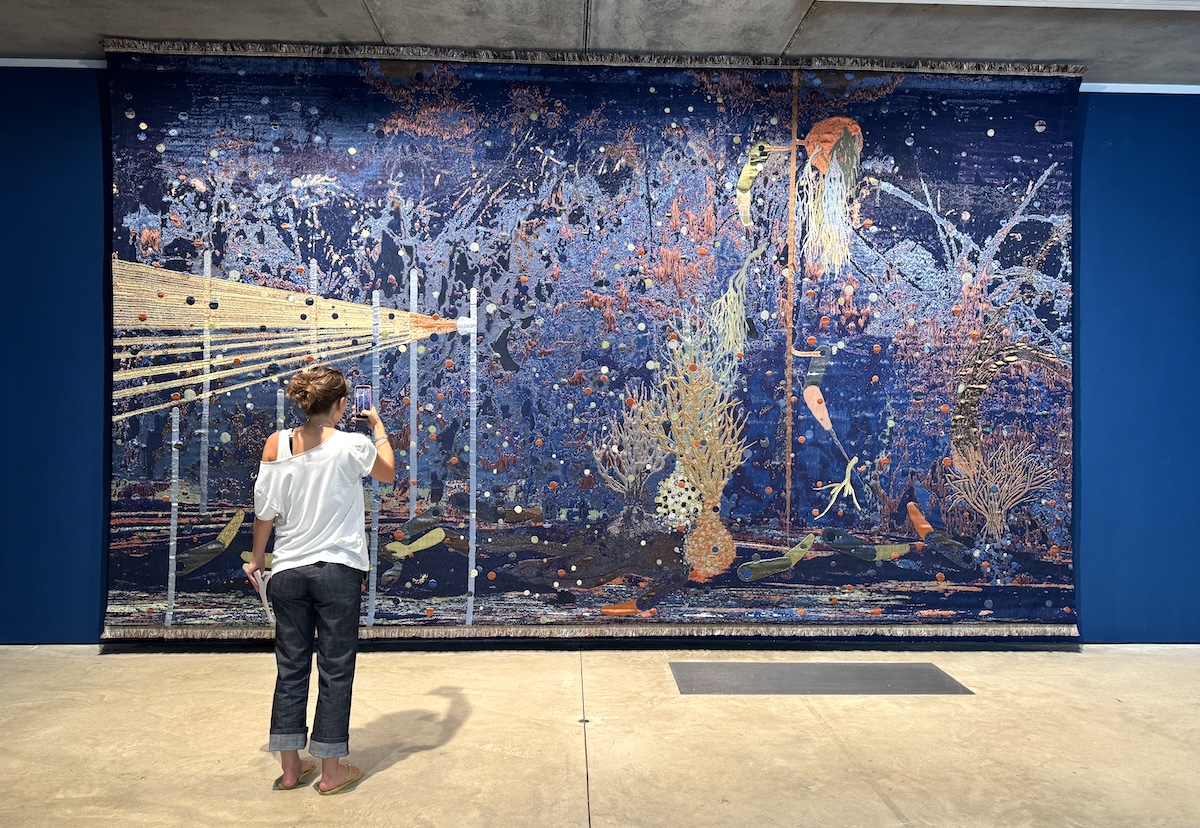
Lead image: Otobong Nkanga, Tied to the Other Side, 2021, woven tapestry
Edge: Where the Land Meets the Sea, Hastings Contemporary, 26 September 2026 – 3 January 2027
Visit Here