Kehinde Wiley has written directly to President Trump, asking to buy back one of his own paintings after administration officials pulled it from the American Embassy in the Dominican Republic, publicly dismissed it as aesthetically terrifying, and, somewhat bafflingly, described it as depicting a lesbian picnic.
Speaking to The New York Times on Monday in his first public comments on the episode, Wiley described the experience as leaving him with a deep sadness. “If the administration is not particularly interested in the work, bring it home. Let me have it,” he said. “It was a really successful painting, and it is a shame it was so little understood.”
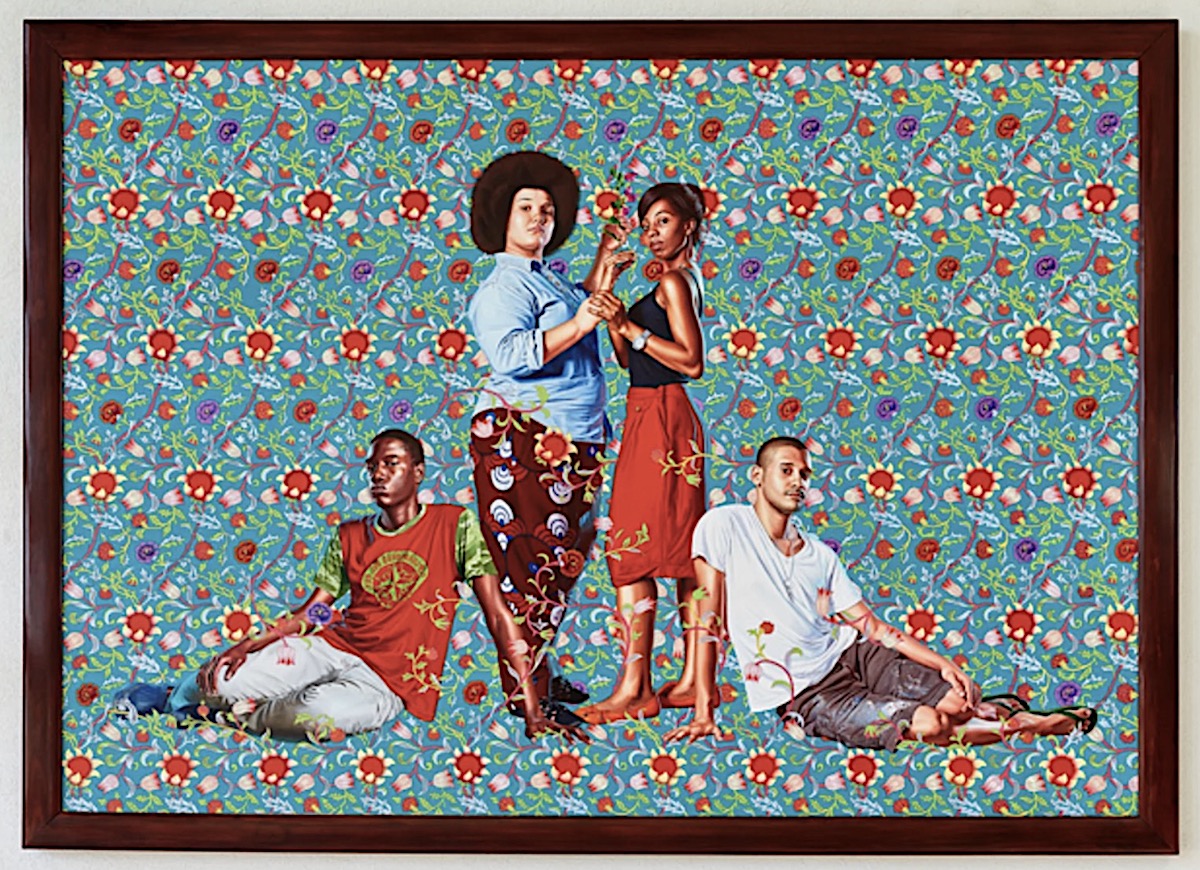
The painting in question, Young Artists After Siamesas 1960, was commissioned in 2013 through the State Department’s Art in Embassies program. Wiley has said he spent two years studying the work of Dominican painters before settling on the composition, eventually asking four local art students to pose against a backdrop of flowers for the final piece.
Its removal became public earlier this year after Leah Campos, the current ambassador to the Dominican Republic, took a dislike to the painting, which greeted visitors as one of the first things they saw entering the embassy. She raised her concerns with Erin Scavino, who heads the State Department’s Art in Embassies program. Scavino, a former contestant on The Apprentice who is married to one of Trump’s closest aides, has, according to former State Department officials, used her position to reshape federally funded art programs along more politically favourable lines, in some cases handing leadership roles to personal friends without professional backgrounds in the arts. Between them, Campos and Scavino settled on a plan to remove Wiley’s painting and potentially sell it off entirely.
When questioned initially about what specifically made the painting objectionable, a State Department spokeswoman sidestepped the substance. Instead, she pointed to allegations of sexual assault against Wiley, which the artist has denied. It was only later that an old radio interview with Campos surfaced, in which she described the artwork, in Spanish, as depicting a large painting of a picnic in a park with flowers and, in her words, some lesbians. Scavino, for her part, told a podcast that she had personally been responsible for the painting’s removal, calling it aesthetically terrifying.
Wiley said in his interview that he genuinely struggled to understand where the lesbian picnic reading came from at all. “I wasn’t quite sure how they got there,” he said. “What I have in the painting depicted are four young people coming together within a field of flowers.” Asked whether he suspected homophobia behind the characterisation, he was careful but direct. “Was it homophobic? It’s possible,” he said. “To look at the painting and draw those conclusions presupposes a lot. It says a lot about panic and fear, and about creating a specific type of narrative surrounding queer people and people of colour.”
Wiley’s letter, sent by certified mail late last week and addressed to Trump, Scavino, Ambassador Campos, and Secretary of State Marco Rubio, explained that he had originally accepted the embassy commission because he believed such spaces existed specifically to allow art to build connections between nations. “If your administration has determined that it no longer wishes to display the work, I would like to ask for the opportunity to purchase it back,” he wrote. The White House declined to comment on the letter, and neither the State Department nor Scavino responded to requests for comment.
The episode fits into a broader pattern under the current administration, which has intensified efforts to strip what officials view as liberal bias from major cultural institutions, targeting both the Smithsonian and the Kennedy Centre in recent months. Singling out an individual artist by name is, however, a somewhat unusual escalation, and Wiley himself seems well aware of the likely reason behind it. He remains best known for painting Barack Obama’s official presidential portrait, a fact he raised unprompted. “I just happen to be the guy who painted Obama,” he said. “That is the elephant in the living room.”
The controversy lands at an otherwise significant moment for Wiley professionally; he is now preparing his first major US show in roughly two years, opening 6 November at dealer Sean Kelly’s Manhattan gallery, featuring close to a dozen new paintings and other pieces drawn from chance encounters between the artist and ordinary New Yorkers he met around the city.
For Wiley, the timing of the embassy dispute feels almost inseparable from that return. “Out of all the artists in the world and the millions of paintings that could have been chosen at this point, why me?” he asked. “Why this moment? Why this painting?” He told the NY Times.