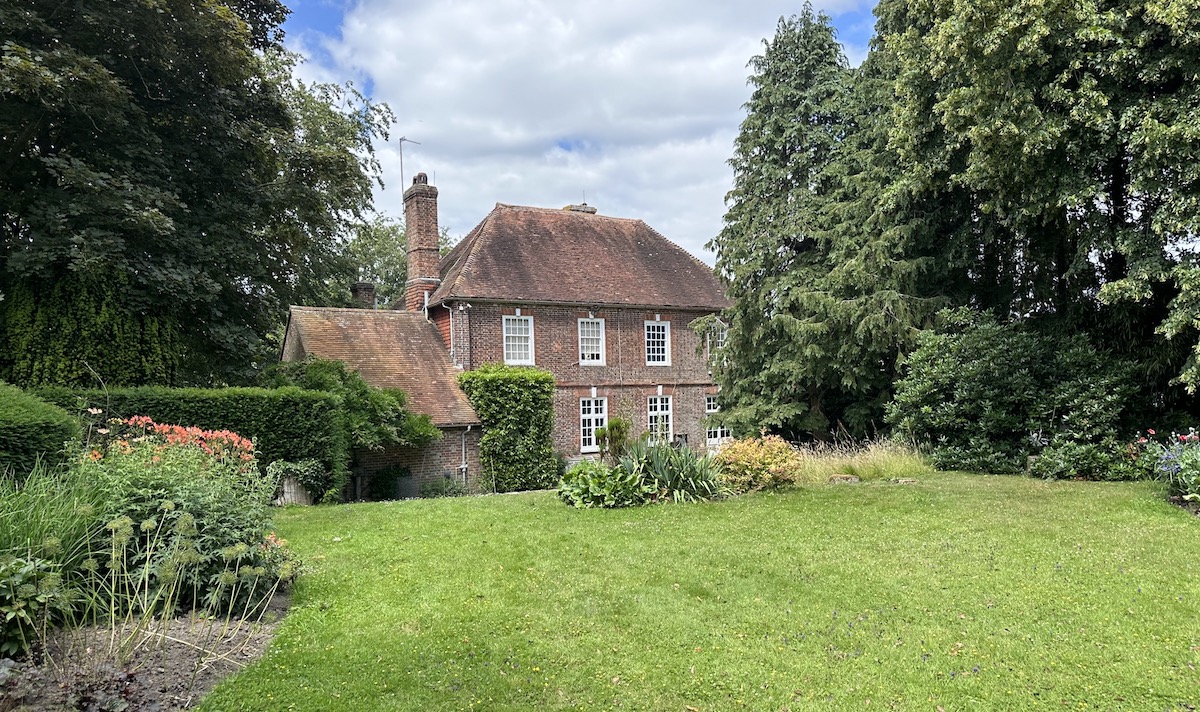
Farleys House and Gallery in Chiddingly, near Lewes in East Sussex, the home of photographer and war correspondent Lee Miller and the surrealist artist Roland Penrose, is to transition to charitable status under the newly formed Farleys House and Gallery Trust. The move is intended to secure the property’s long-term future and preserve both the house and its remarkable contents for coming generations.
Miller and Penrose moved to Farleys in 1949, following the end of World War II, and the farmhouse subsequently became one of the more extraordinary private gathering places in twentieth-century British art. Pablo Picasso stayed in 1950. Max Ernst, Joan Miró, Man Ray, Leonora Carrington and Dorothea Tanning all visited from abroad. At the same time, Eileen Agar, Kenneth Armitage, William Turnbull, John Craxton and Richard Hamilton formed a British contingent of regular guests. The house absorbed all of this and kept it. Today, it remains largely as it was when Miller and Penrose lived there, the walls brightly coloured, the rooms generously proportioned and slightly asymmetric, filled throughout with works by many of the artists who passed through.
Antony Penrose, the son of Miller and Penrose and the founder of the Lee Miller Archives, established the archive at Farleys in 1984 and has spent decades making the house accessible to visitors. He described the experience of growing up surrounded by that level of creative activity as one he only fully appreciated over time. He also spoke about what Farleys represented to his mother in a more personal sense. Miller had been among the first photographers to enter Dachau at the liberation, bearing witness to scenes of mass starvation that marked her for the rest of her life. The land at Farleys, where she grew food in abundance to share with others, offered her something she badly needed. “To come here and grow masses of food that she could share with people was so important for her,” Penrose said.
Miller’s life before Farleys had already taken her through several distinct and remarkable phases. She began as a fashion model for Vogue and Vanity Fair before becoming a surrealist photographer in Paris, where she worked closely with Man Ray and moved in the circles around Picasso and the broader surrealist movement. During World War II, she became an accredited war correspondent and photographer for Vogue, producing some of the most unflinching photographic documentation of the conflict, including images from the liberated concentration camps and the famous photograph of herself bathing in Hitler’s Munich apartment, taken on the day of his death. After the war, she largely withdrew from public life, and it was only after she died in 1977 that Antony Penrose discovered the full extent of her photographic archive, finding tens of thousands of negatives stored in the attic at Farleys.
Ami Bouhassane, Antony Penrose’s daughter and co-director of the archive, said that when her parents first established it, they had not imagined people would come to the house in any significant numbers—the response since has demonstrated otherwise. “When you visit an artist’s house, seeing the way they live shows another side of them,” she said, a point that Farleys makes with particular force, given how densely layered its interiors remain.
The building’s exterior gives little away. Inside, the house opens into something considerably more surprising: a sequence of rooms whose walls, furniture and surfaces carry the accumulated evidence of decades spent at the centre of surrealist and modernist life in Britain. Works by Picasso, Miró, Penrose and others are displayed throughout, with pieces regularly rotated as loans go out to exhibitions internationally. The effect is less of a museum than of a home that has never been emptied, and that particular quality of lived-in authenticity is precisely what the trust hopes to protect.
With charitable status secured, the trust intends to raise funds for conservation work across the collection, beginning with specific items, including the sitting room sofa, whose condition reflects the degree to which the house has functioned as a working, inhabited space rather than a hermetically preserved monument.
Farleys also operates two gallery spaces adjacent to the house. The Farleys Gallery occupies a converted Sussex barn and hosts a changing programme of exhibitions, workshops and events. The Lee Miller Gallery, a newer addition, is designed to accommodate larger-scale presentations. Both are open Thursdays, Fridays, Sundays and selected Saturdays from April to October, between 10 am and 4.30 pm. All visits to the house itself are by guided tour, with booking recommended. The tour is not suitable for children under twelve.
Miller’s life and work reached a new, considerably wider audience with the release of the 2023 film Lee, in which Kate Winslet portrayed her across multiple decades of an extraordinary life. The film prompted renewed interest in both the archive and the house, and the timing of the transition to charitable status reflects an opportunity to build on that attention with a more sustainable institutional foundation.
Top Photo: P C Robinson © Artlyst 2026