
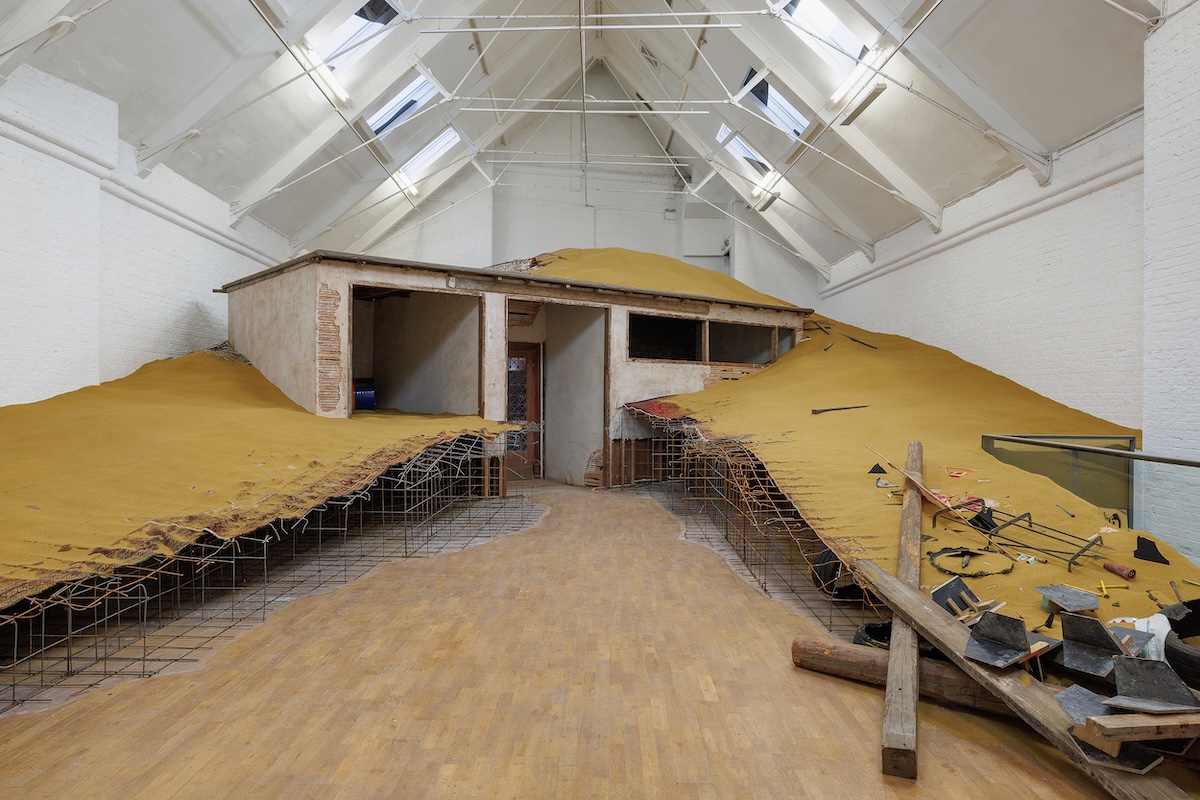
Mike Nelson’s Double Negative (The Clown) is a re-enactment of his 2004 Triple Bluff Canyon large-scale installation at Museum of Art Oxford. For that show, Nelson drew on magic, geometry and Land Art, more specifically Robert Smithson’s Partially Buried Woodshed (1970) at Kent State in Ohio. Entropy eventually overcame the woodshed, accelerated by the 20 truckloads of earth, and a human-built structure became a mound.
Double Negative (The Clown) involved six weeks of assemblage and staging, and not pristine – more a series of spaces than rooms, and a mineshaft passageway. The rooms are like re-collections of objects, all this loaded like a shipwreck with cues and clues… One room you enter has a door with “2,250 Gallons Total in Shed. NO SMOKING”. Inside a room called The Book of Spells, there is a raft of travel guides, shelf after shelf. Arranged in such a way, each “unique” destination seems so banal and generic. You can only look into another such room through a star-shaped hole in the door at eye level. The piece recalls Marcel Duchamp’s last work Étant donnés at the Philadelphia Museum of Art, for, like Duchamp’s, you can only catch a glimpse through a small opening. Inside, you see one of Nelson’s quasi-modernist rough ‘n ready plaster sculptures that look like they were designed by a madman on an island.
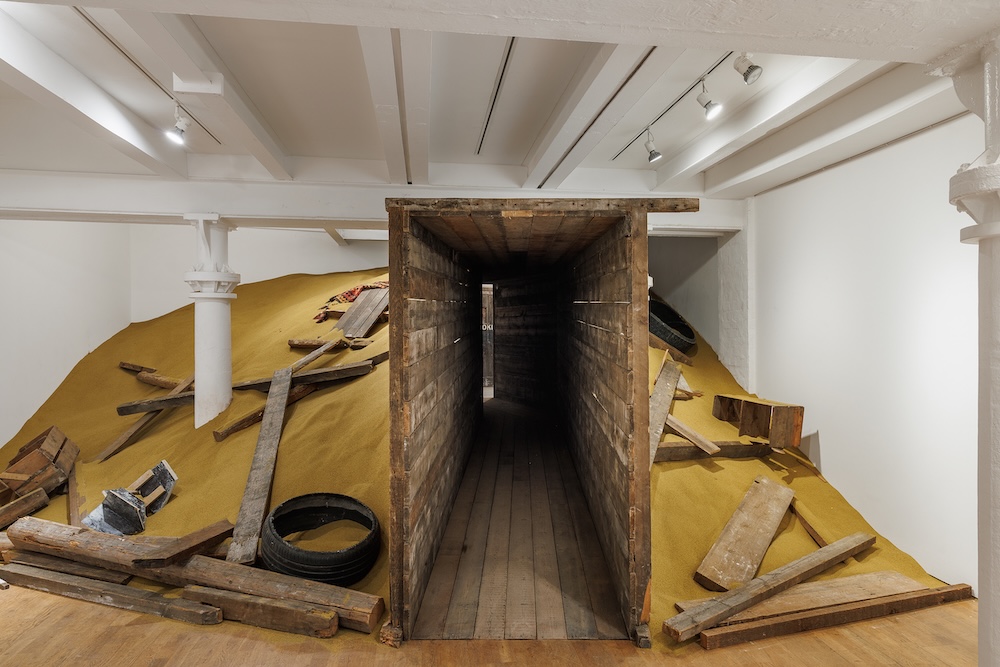
Mike Nelson-Double Negative TheClown, Modern Art Oxford, Dan Weill Photography
There are more of those vaguely modernist plasters made with recycled chicken wire, wood from Wales and plaster near the entrance to the show. The wild fingermarks that cover the plaster surfaces on these “sculptures” are like a madman’s revenge on modernism…with allusions to Rodin? Structures and artefacts from the oblivion pavilion are a soup that mocks the exhibition’s very visual nature. In a quiet corner, we see a broken mirror and a replica human skull. Projected on the wall in miniature are double-exposure photos of Nelson and world sites he has been to – an artist’s mini Memento Mori.
From inside another open room, sand has blown in, recalling Japanese author Kobo Abe’s Woman of the Dunes, where there is this persistent filmic action of wind and sand blowing in on everything.
Science fiction novels were a source for Smithson, notably Brian Aldiss’ Earthworks, as they were for Nelson early in his career. We see an image of him as a young artist carrying such a quote …“(…) we spiral… building blok upon blok a past, ascending to a future One, two, three, four, horsemen are dead, five, sic, seven, and its biz; the amnesiacs that go to…” Ah! Les artistes!
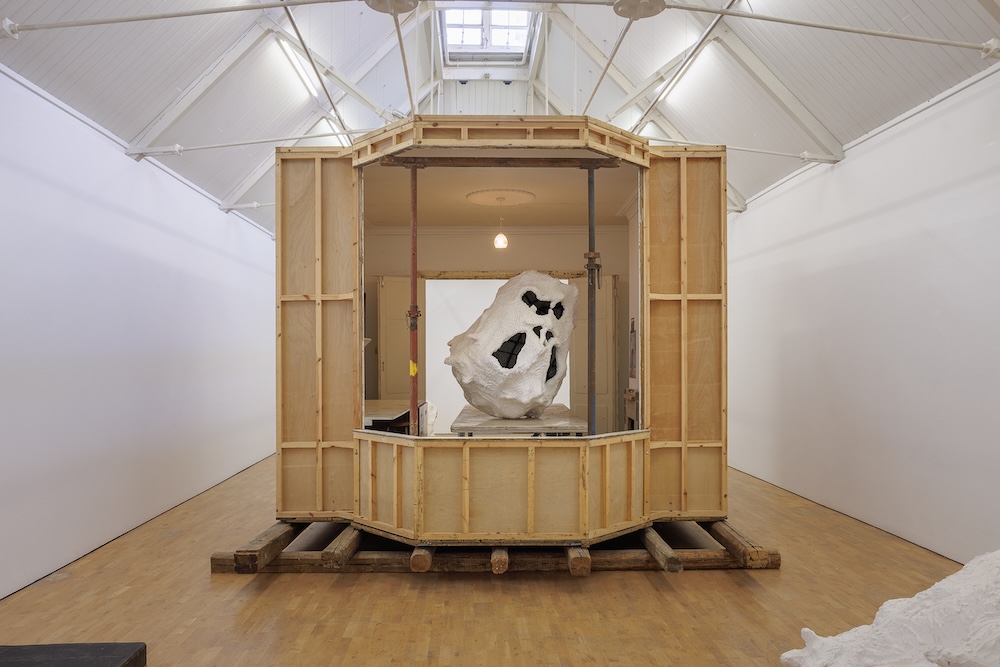
Mike Nelson, Double Negative TheClown, Modern Art Oxford, Dan Weill Photography
A bundle of wood tied together stands nonchalantly against a wall, recalling the way Robert Smithson left bundles of wood haphazardly at the original shed site on Kent State. Stanislas Lem, Bill Burroughs and Andrei Tarkovsky remain influences in the way Mike Nelson works with distance and memory.
Nelson’s frenetic approach is like writing with objects, building pathways to and fro, backwards or forwards, to these temporary camp-like sites or memory modules. We go through a mine shaft tunnel to arrive on the other side. The fool’s gold is there – stretches of sand that overcome Nelson’s shed. Cues and clues are in the sands – those haphazard wooden pointed objects that in a primitive way recall drones of our era, the old cast-away red door with a “Jesus Saves” cross on it, the shards of truck and auto tyres like dinosaur tracks from the age of oil, right next to a Socialist Party sandwich board, a red motor helmet filled with sand, Tarot cards, a slipper and a paperback copy of The Socialist Party and War, again partially buried. Everything, it seems, is expendable, like the Gulf Oil can inset in the structure that is disappearing. The lives of objects are brief, cyclical, flickering, like our lives. Even our memories of that cycle of wars, like the escalation of the war in Iraq, when Nelson’s Triple Bluff Canyon show was on, draw a blank in front of your cellphone as a reference point. The fragments of broken mirror-like plexiglass used in the first show have now, for this show, been set in the sand, in part a tribute to Robert Smithson’s 1969 Mirror Displacement works set in nature in Mexico and the UK… Artists recognise artists…
Mike Nelson’s way of working is arranged artifice from the brink. Nothing is permanent. There are echoes of the fast lane. First, in the Victorian age of coal and draft horses, like those beautiful industrial carcases of machines seen at Tate Britain. Here at Oxford in 2004 and 2026, of the age of oil and motor cars, a rustic mine tunnel passage references all that. And what a fast eraser technology can now be. Fictional staging, reframing, time changes our memories of place and time, and the way we see even our own experience. Entropy, even the entropy of museology, of star systems, of what history is or could be, is truly a cause these days. Mike Nelson provides a creative interface with realities and displacements of experience. He does it with this cornucopia of detritus, driven through the tunnel of time. What a wry sense of humour!
publications for John K. Grande… See Here
Art Space Ecology; Two Views Twenty Interviews / Black Rose Books / U. of Chicago, 2018)
See Here